How to Write a Consulting Engagement Letter: Scope, Responsibilities and Approval
How to write a consulting engagement letter for a strategy review, with draft language for purpose, parties, responsibilities, limits, signatures and approval checks.
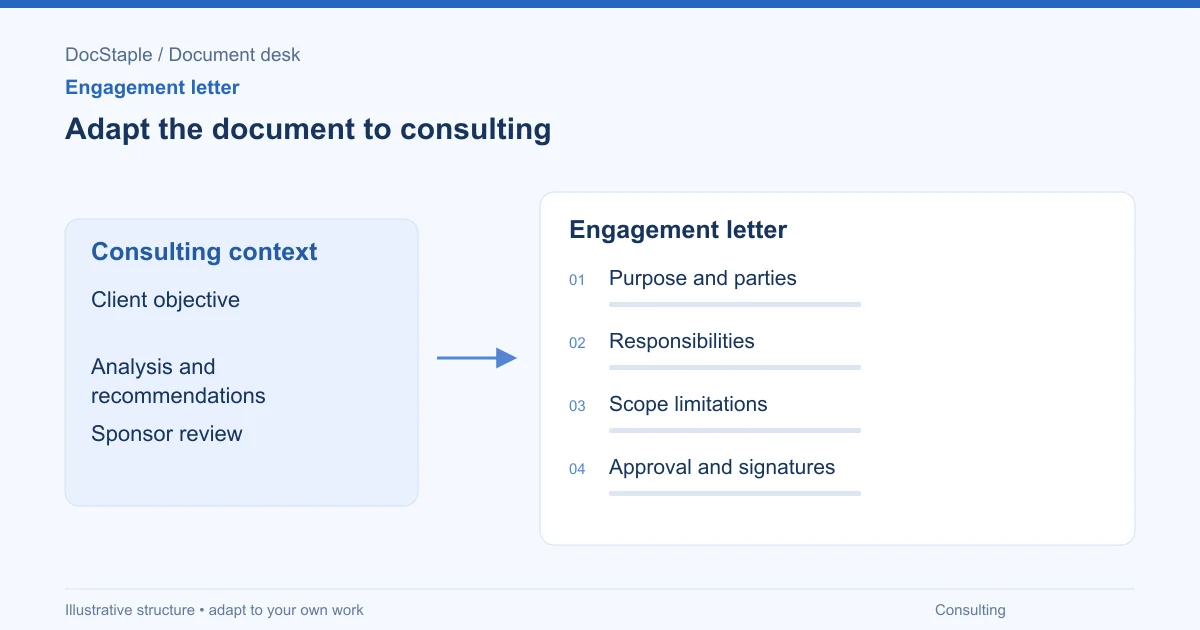
A consulting engagement letter is the moment a sales conversation becomes an operating record. The proposal may explain why the work matters. The engagement letter should say exactly who is doing what, for whom, under which limits, and who is allowed to approve the work.
This guide uses a fictional scenario: a boutique consulting firm is engaged by a regional logistics company to run a six-week strategy review on warehouse capacity. The output is a recommendations report for the client sponsor. All names, dates and facts below are examples. Replace bracketed text with verified information, and have legal terms reviewed in the jurisdiction that governs the engagement.
Start With The Purpose And Parties
Open by naming the client legal entity, the consultant legal entity, the contact people and the business reason for the engagement. Do not begin with brand language. The opening should help a future reader identify the file without guessing.
Weak draft
We are pleased to support your business with strategic advisory services.
That sounds polite, but it does not say who the client is, what the work is, or which decision the work supports.
Stronger draft
This engagement letter records the understanding between [Consultant legal name] and [Client legal name] for a strategy review of warehouse capacity. The review supports [Client]'s decision on whether to lease an additional warehouse before [decision date]. [Client sponsor name and title] is authorized to instruct us on scope and approve deliverables for this engagement.
The Oregon Department of Transportation's Statement of Work Writing Guide says a scope document should identify work, deliverables, responsibilities and decisions with enough clarity that performance can be evaluated against the written record (ODOT Statement of Work Writing Guide). A private consulting letter is not an Oregon public procurement document, but the drafting discipline transfers well: make the decision, the authority and the output visible.
Add the effective date and engagement period early:
The engagement begins on [start date] and is expected to end on [end date], unless extended by written agreement. The dates assume the client provides the access and information listed in Section [x] by the dates stated there.
This protects both sides from a hidden assumption that the timetable remains fixed even if interviews or documents arrive late.
Define Consultant And Client Responsibilities
Responsibilities are stronger when they are paired. For every consultant task, ask what the client must provide. For every client responsibility, say why it matters.
Consultant responsibilities. We will plan and conduct up to [number] stakeholder interviews, review the documents listed in Appendix A, compare the capacity options against the agreed criteria, and prepare a written recommendations report.
Client responsibilities. [Client] will nominate interview participants, provide the documents listed in Appendix A by [date], identify one sponsor for consolidated feedback, and confirm factual corrections within [number] business days of receiving a draft.
Annotate the language as you review it:
- "Up to [number]" prevents the interview plan from expanding without approval.
- "Appendix A" keeps document requests versioned and easy to check.
- "One sponsor for consolidated feedback" prevents several executives from issuing conflicting instructions.
- "Factual corrections" avoids opening a new round of strategy debate after the draft is prepared.
Federal Acquisition Regulation guidance for service orders says statements of work should include a work description, location, period of performance, deliverable schedule, performance standards and special requirements where applicable (FAR 8.405-2). That rule governs specific federal purchasing procedures, not your private consulting letter. Still, it is a useful checklist for what a buyer needs to understand before work starts.
Set Scope Limits Without Sounding Defensive
Scope limits are not an apology. They are how you keep the engagement letter accurate. Write exclusions in neutral language and place them near the scope, not in a footnote.
Scope limits. This engagement does not include implementation of recommendations, supplier negotiations, property lease negotiation, financial audit, tax advice, legal advice, system selection or operational management after the recommendations report is delivered. Additional interviews, workshops or analysis are handled through the change process in Section [x].
Use this test: if a client could reasonably assume the task is included, say whether it is included or excluded. "Operational management" may sound obvious to the consultant, but the client might interpret a strategy review as including help running the transition. Naming it now avoids a difficult conversation later.
Avoid vague phrases like "as needed", "reasonable assistance", "support", and "best efforts" unless the document defines what they mean. Replace each with an action and a decision owner.
Weak draft
We will provide reasonable support during the review.
Stronger draft
We will answer written clarification questions about the recommendations report for [number] business days after delivery. Questions that require new analysis, new interviews or revised modelling are outside this engagement unless approved as a change.
That sentence gives the client a real support window while protecting the team from an open-ended obligation.
Handle Fees, Changes And Review Timing
Even if a master agreement contains legal terms, the engagement letter should connect the fee to the scope it buys. State the amount, billing schedule, assumptions and what happens when the assumptions change.
Fee. The fee for the engagement is [amount and currency], invoiced [schedule]. The fee is based on the scope in this letter, the interviews listed in Appendix A and one consolidated review round for the draft recommendations report.
Changes. A change is required if [Client] requests additional interviews, additional deliverables, implementation support, a changed timetable, or work outside the scope limits. We will not start changed work until both parties confirm the revised scope, fee and timing in writing.
The Department of the Interior's service-contract checklist asks whether a statement of work has a clear division of responsibility between contracting parties and whether it specifies a deliverable or progress reporting when contractor advice may influence decisions (DIAR 1437.1). For consulting, the same question is practical: can the client tell what the consultant owes, and can the consultant tell what the client must approve?
If the letter references payment, termination, liability, intellectual property, confidentiality or governing law, do not improvise jurisdiction-specific terms. Say where those terms live:
Commercial and legal terms are set out in [master services agreement or attached terms]. If this letter conflicts with those terms, [state precedence only after legal review].
Add Signatures And An Approval Check
The signature block should identify authority, not just collect names.
Acceptance. By signing below, each signer confirms that they are authorized to accept this engagement letter for the party named, and that the scope, responsibilities, fee basis and review process reflect the agreed understanding.
Before sending, run this approval check:
- Parties: legal names and addresses are correct.
- Authority: the client signer can instruct and approve the engagement.
- Purpose: the decision supported by the work is stated.
- Responsibilities: consultant and client obligations are paired.
- Scope limits: exclusions cover the likely misunderstandings.
- Evidence: documents, interview list and assumptions are attached or referenced.
- Fees and changes: extra work requires written approval before it starts.
- Legal review: jurisdiction-specific terms have been reviewed by qualified counsel.
Start From An Editable Structure
The consulting engagement letter template is an editable Word file with sections for purpose and parties, responsibilities, scope limitations, commercial references, preparation notes and approval. It is a drafting structure, not a guarantee that an engagement is complete, enforceable or suitable for any jurisdiction.
If the work needs a more detailed task breakdown, pair it with the consulting statement of work template. Keep the two documents consistent: the same deliverables, dates, review owners and exclusions should appear in both.
Last updated: September 26, 2026
Frequently Asked Questions
Related Articles
Capability Statement Best Practices for Consulting Firms
Capability statement best practices for consulting firms, with fixes for vague competencies, weak past performance, generic differentiators and stale credentials.
Capability Statement Checklist for Buyer-Ready Consulting Drafts
A capability statement checklist for consulting firms, with review gates for core competencies, relevant experience, differentiators, credentials and contact details.
Capability Statement Examples: Four Sections Written Weak and Then Strong
Capability statement examples for a fictional consulting firm: core competencies, relevant experience, differentiators, and contact and credentials, each shown as weak and stronger draft wording with a review checklist.
Engagement Letter Best Practices
Best practices for engagement letters, including scope control, responsibility wording, limitation language and approval records.
Engagement Letter Checklist
Use this engagement letter checklist to review purpose, parties, responsibilities, limitations, approval and signature readiness.
Engagement Letter Examples: Purpose, Scope Limits and Signatures
Engagement letter examples for consulting work, with annotated wording for parties, responsibilities, scope limitations, approval and signatures.