How to Write a Construction Incident Report: Site Facts, Evidence and Approval
Learn how to adapt an incident report for construction, with site facts, immediate response, evidence, witnesses, subcontractor actions and approval checks.
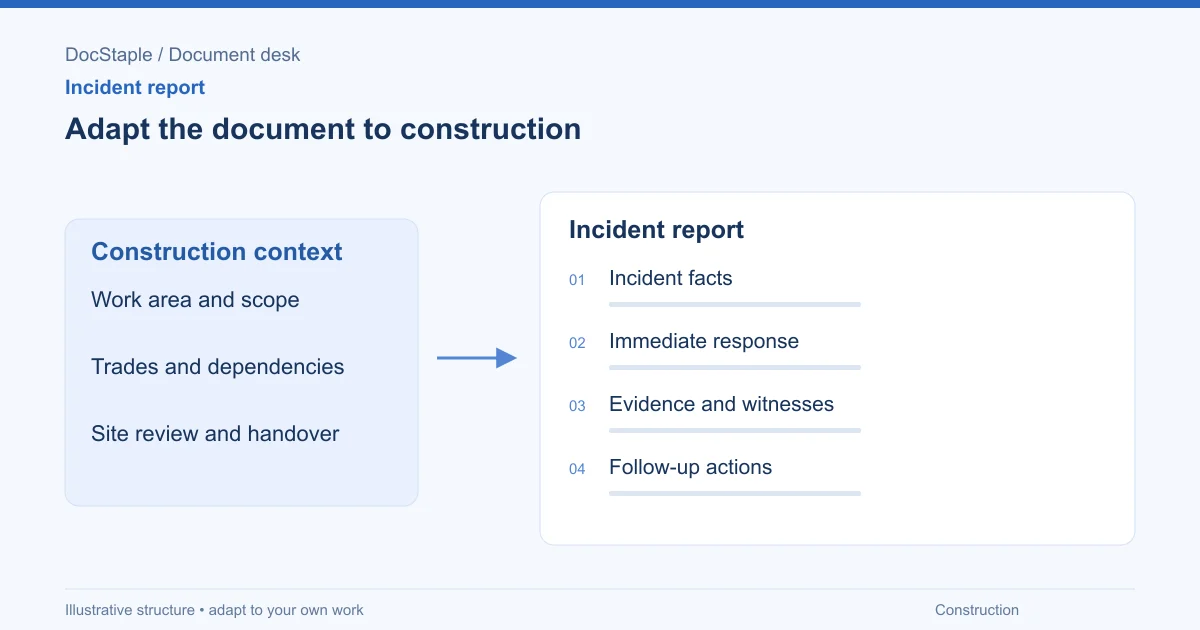
A construction incident report has to do more than describe "what happened." It must connect the event to the site, work activity, subcontractors, permits, drawings, method statements, immediate controls, evidence and follow-up actions. Otherwise the report becomes a diary entry instead of a usable project record.
This guide uses a realistic fictional scenario: during a commercial fit-out, a subcontractor damages an overhead sprinkler pipe while moving a mobile scaffold. Water enters a partially finished corridor. No injury is confirmed at the time of the initial report, but work stops in the area and the site manager needs a clear record.
Record Site Facts and Work Context
Construction incident facts should include the project, exact location, work package, subcontractor, permit or method statement and conditions at the time.
Draft language:
On [date] at approximately [time], during the commercial fit-out project at [site], a mobile scaffold being moved by [subcontractor] in Level 2 Corridor B contacted an overhead sprinkler pipe near Gridline C4. Water discharged into the corridor. The area was occupied by [trades present]. The work activity was being performed under [method statement or permit reference].
That language is more useful than "sprinkler pipe hit by scaffold." It tells a later reviewer where to look for drawings, permits, inspection records and subcontractor responsibilities.
OSHA's incident investigation overview says investigations should use a systems approach to identify and control underlying root causes to prevent recurrence (OSHA, United States). In construction, that means looking beyond the person moving the scaffold: access route, height clearance, coordination, permit controls, supervision and changes to the work area may all matter.
Document Immediate Response
Immediate response comes before paperwork. If there is danger to people, follow emergency arrangements first. The report then records what was done.
Draft language:
Immediate response: work stopped in Level 2 Corridor B at [time]. The site manager instructed workers to leave the affected area. [Name] isolated the water supply under site procedure [reference]. The subcontractor supervisor secured the mobile scaffold in place. Electrical contractor [name] checked nearby temporary power arrangements before re-entry. Wet materials were separated for assessment.
Notice the report names actions and actors. It does not say "the situation was made safe" without evidence. If a permit was suspended or an area restricted, record that:
The Level 2 Corridor B access route remains restricted pending inspection by [role]. Permit [number] is suspended until the site manager authorizes restart.
OSHA's recordkeeping rule has specific United States reporting requirements for some serious work-related incidents, including fatalities, in-patient hospitalizations, amputations and losses of an eye, with time limits stated in the rule (29 CFR 1904.39). Do not use a template to decide whether reporting is required. Follow the project, employer and jurisdiction-specific process.
Preserve Evidence and Witnesses
Construction evidence can disappear quickly because cleanup and repair are necessary. The report should preserve what can be preserved without delaying urgent controls.
Evidence list:
- Photos of the pipe, scaffold, route and surrounding work area.
- Scaffold inspection tag or record.
- Permit, task briefing or method statement.
- Site induction and toolbox-talk records if relevant.
- Drawings showing sprinkler route and ceiling zone.
- Access route plan or logistics plan.
- Statements from workers who saw the movement.
- Weather or lighting notes if relevant.
Draft language:
Evidence preserved: photographs P1-P8 taken by [name] at [time] before the scaffold was moved; permit [number]; subcontractor task briefing record dated [date]; marked-up drawing M-204 showing sprinkler route; witness statements from [names]. Photos are stored in [location] with access restricted to the project team.
Witness language should be careful:
[Witness] stated they saw the scaffold being moved toward Corridor B and heard contact with the pipe. [Witness] did not see who first noticed the sprinkler line.
Do not ask witnesses to agree with a conclusion. Record observations.
Record chain-of-custody style details for key evidence, even if the project does not use that term. For example, if the damaged pipe section is removed, state who removed it, where it went and whether anyone may inspect it later. If water-damaged materials are discarded, record the inspection decision first. If access-control footage exists, note who requested it and where it is stored.
Draft language:
The removed pipe section was tagged by [name] at [time] and stored in [location] pending review by the building-services contractor. Corridor photos were taken before cleanup and after temporary isolation. No materials were discarded before the package manager completed the damage inspection.
Those details are especially important where subcontractors, insurers or client representatives may later ask what changed after the incident.
Analyze Contributing Factors
A construction incident report should compare actual work with the approved method. That does not mean making unsupported findings on the day of the incident.
Possible contributing factors in the scenario:
- The scaffold route passed below exposed sprinkler pipework.
- The route plan did not mark overhead restrictions.
- The task briefing covered floor protection but not overhead clearance.
- Ceiling services had changed after the original coordination drawing.
- The subcontractor supervisor was coordinating two work areas at once.
Draft language:
Preliminary review indicates the approved route plan did not mark the sprinkler pipe as an overhead restriction. The task briefing reviewed the movement path but did not record a clearance check. The investigation will compare the current site condition with the approved drawings and any subsequent design change notices.
That wording is useful because it states what is known and what will be checked. It does not jump to "subcontractor failed to follow instructions" unless the evidence supports that conclusion.
OSHA's hazard-identification guidance says records of previous injuries and incident investigations can help identify hazards and that incident investigations should identify root causes to prevent future occurrences (OSHA). On a construction project, link the lesson back into permits, briefings, logistics plans and subcontractor coordination.
Assign Follow-Up Actions and Approval Check
Construction follow-up actions must be practical and assigned to the right party. Some actions belong to the subcontractor, some to the principal contractor or site manager, and some to design or building-services specialists.
Example action table:
| Action | Owner | Due | Evidence for closure |
|---|---|---|---|
| Inspect sprinkler pipe and confirm repair requirement | Building-services contractor | [date] | Inspection record and repair note |
| Review Level 2 scaffold movement route for overhead restrictions | Site manager | [date] | Updated logistics route plan |
| Re-brief subcontractors on overhead clearance checks | Subcontractor supervisor | [date] | Toolbox-talk attendance record |
| Confirm whether permits or method statements need revision | Project safety lead | [date] | Revised permit or decision note |
| Verify wet materials and affected finishes before restart | Package manager | [date] | Inspection photos and sign-off |
Approval check:
The incident report may be closed only when the site manager verifies corrective actions, records any remaining restrictions and confirms whether related permits, drawings or method statements have been updated. Closure does not remove separate contractual, insurance or regulatory reporting duties.
Use a Construction-Specific Draft
The construction incident report template is an editable Word document with sections for facts and immediate response, impact and evidence, investigation and contributing factors, actions and closure. It is tailored to construction examples such as unsafe work, property damage, approved drawings, permits, subcontractors and site closeout evidence.
A strong construction incident report lets a later reviewer answer five questions: what happened, what was done immediately, what evidence supports the account, what controls failed or need review, and who approved the restart or closure.
Last updated: September 26, 2026
Frequently Asked Questions
Related Articles
Audit Checklist Best Practices
Best practices for audit checklists, including scope, evidence, findings, actions, closure review, failure modes and sample wording.
Audit Checklist Checklist: Review Your Audit Form Before You Use It
A practical audit checklist checklist with decision gates for scope, evidence, findings, actions and closure review.
Audit Checklist Examples: Scope, Evidence, Findings and Closure
Audit checklist examples for consulting work, covering audit scope, evidence to inspect, findings and actions, closure review and practical draft wording.
Business Continuity Plan Best Practices for Consulting Teams
Business continuity plan best practices for consulting teams, including critical services, recovery priorities, communications, exercises and review criteria.
Business Continuity Plan Checklist for Consulting Teams
A practical business continuity plan checklist for consulting work, covering critical services, recovery priorities, communications, exercises and review criteria.
Business Continuity Plan Examples: Consulting Scenarios and Recovery Priorities
Business continuity plan examples for consulting teams, with critical services, recovery priorities, communications, exercises and review criteria.