How to Write a Construction Proposal: Scope, Exclusions and Approval Wording
How to write a construction proposal for a commercial fit-out: state the client's problem and objectives, recommend an approach, define deliverables and exclusions, and set fees, change handling and next steps, with draft wording.
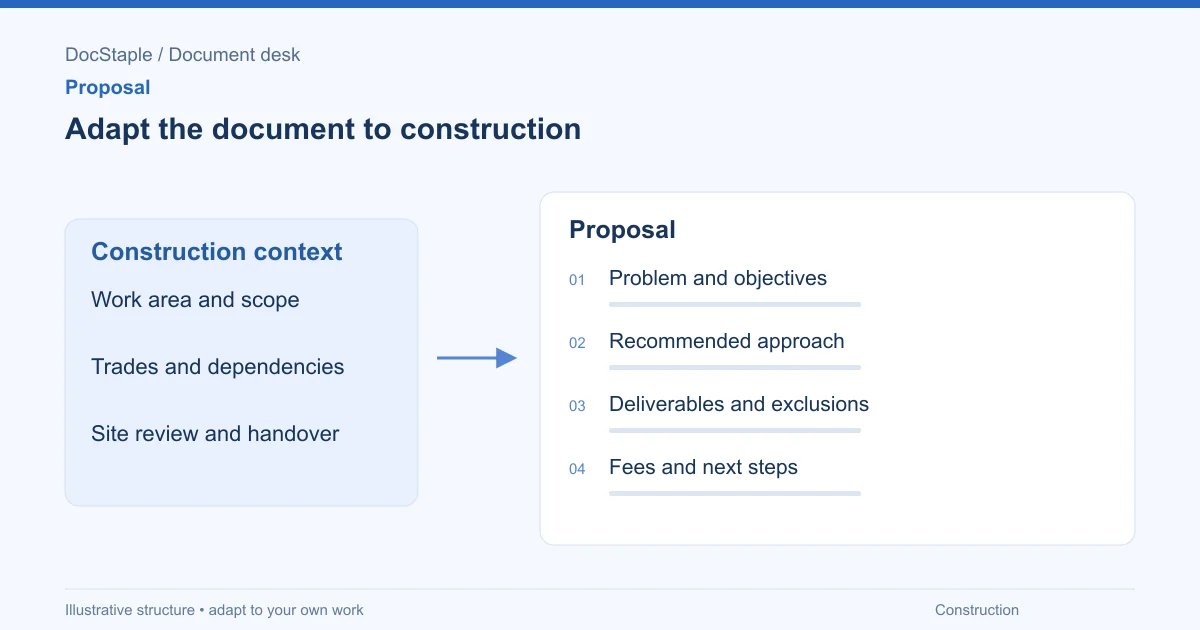
A construction proposal has to do two things at once. It must persuade a client that you understand the job, and it must describe the work precisely enough that nobody is surprised on site. The persuasive part is easy to overdo. The precise part is where most disputes begin.
This guide works through a fictional example: a contractor proposing the commercial fit-out of a leased office floor for a regional insurance broker. All names, figures and dates are invented, and anything in square brackets is a field you would replace with a verified fact. Requirements for licensing, insurance, permits and payment vary by country, state and project type, so treat the wording as drafting illustrations, not legal or safety advice.
Start with the client's problem, not your firm
The opening section should show that you understood the reason the work is happening. A weak version describes the contractor.
Weak draft
We are a trusted, fully licensed builder with decades of experience delivering exceptional interiors on time and on budget.
Nothing here refers to the client, and "on time and on budget" is a promise that depends on things you may not control, such as landlord access and approvals.
Stronger draft
Client need. [Client] has signed a lease on the [floor] of [building], starting on [date], and needs the space ready for [number] staff by [date]. The current fit is an open shell with [existing conditions confirmed at the site visit on date].
Objective. To complete the fit-out described in Section 3 and hand over the site with a closed punch list, so that [Client] can move in on [target date], subject to the dependencies listed in Section 4.
Notice the difference. The client need states the lease, the occupants and the deadline. The objective ends in a verifiable event: a closed punch list. It also ties the target date to dependencies instead of promising it unconditionally.
Describe the approach and its dependencies
The approach section should read as a sequence the client can follow and check. In a fit-out, that usually means preparation and approvals, the main trades, inspection, and closeout. The point is to show who does what and what each stage needs from the client or landlord.
Stage 1: Preparation (weeks 1 to 2). We confirm measured dimensions on site, issue the trade coordination programme, and submit [permits or building-management approvals that apply in your jurisdiction]. Client dependency: [Client] confirms the final layout and finishes schedule by [date].
Stage 2: Construction (weeks 3 to 8). Partitions, ceilings, [electrical and data first fix], floor finishes and joinery are carried out in the sequence shown in the programme. Client dependency: the landlord's contact provides out-of-hours lift and loading dock access.
Stage 3: Inspection and closeout (weeks 9 to 10). We walk the site with [Client]'s representative, record defects on a punch list, and correct them. The site manager signs the punch-list closeout when the listed items are complete.
Two habits keep this section honest. Every stage names a dependency, so a delay caused by late decisions or access is visible in writing. And every stage uses concrete verbs, not "assist" or "as required".
The Oregon Department of Transportation's Statement of Work Writing Guide was written for a public agency buying services, so its contract mechanics will not apply to a private construction proposal. Its drafting advice still transfers. It recommends that services which may or may not be needed be set out as contingency tasks, and that the provider performs them only when specifically authorized in writing. For a fit-out, that might be a client-requested upgrade to the reception joinery: describe it, price it separately and start it only after written approval.
Define deliverables and exclusions
Deliverables are what the client can point to when the work is done. The same Oregon guide describes best practice as defining deliverables for each task that are tangible and measurable. A construction proposal can borrow that discipline without adopting a public-procurement structure.
Weak draft
Includes all works necessary to complete the fit-out to a high standard.
"All works necessary" and "high standard" cannot be checked by either side.
Stronger draft
| Deliverable | Description | Location | Evidence of completion |
|---|---|---|---|
| Partitions and ceilings | [Specification reference], as shown on [drawing number and revision] | [Floor and zones] | Inspection record signed by site manager |
| Floor finishes | [Product and area] | Open-plan area and meeting rooms | Inspection record and defect list |
| Electrical and data works | [Scope stated by drawing reference] | As per drawing | Test certificates as required by local rules |
| Site completion pack | Punch-list closeout, inspection records, [as-built information if included] | Digital, in [format] | Handed to [Client] representative |
Not included. [Furniture supply and installation]; [audio-visual equipment]; [landlord base-building works]; [any structural changes not shown on the referenced drawings]; [hazardous material removal, if found]; out-of-hours work beyond [hours] unless agreed under Section 6.
Assumptions. Pricing is based on [drawings and revision numbers], the site conditions confirmed on [date], and access as described in Section 4.
The exclusions matter most for clients who are comparing several offers. A price that quietly leaves out items looks cheaper than one that includes them, and stating exclusions lets the client compare like with like. Write them as neutral facts, and name the likely misunderstandings, such as who supplies loose furniture or who handles concealed conditions above the ceiling.
Set fees, change handling and acceptance
A fee section that states a number and stops leaves three questions open: when it is paid, what happens if the scope changes, and what counts as done.
Fee. The fee for the work in Section 3 is [currency and amount], excluding [taxes, if applicable in your jurisdiction]. Invoices are issued [schedule, for example at stage completion] and are payable within [period].
Changes. Any change to the work, price or programme is requested in writing. Before starting the change, we confirm in writing what will change in the work, what it will cost, and whether the completion date moves. Work that has not been confirmed in this way is not part of the fee.
Acceptance. The work is accepted when the site manager signs the punch-list closeout and [Client]'s representative confirms in writing that the listed items are complete. Silence is not acceptance.
The change wording follows a well-known pattern in construction contracts. In the AIA general conditions, a change order is defined as a written instrument stating agreement on the change in the work, the adjustment to the contract sum and the adjustment to the contract time. AIA's own explanation adds that a construction change directive can instruct the contractor to start work before cost and time are settled, but the change must still be documented afterwards through a change order. A proposal is not an AIA contract, and you should not copy contract terminology into it without advice. The three questions of what changes, what it costs and what it does to the schedule are the useful part.
Payment terms, taxes, insurance, retention, liability and termination wording all have legal effect that varies by jurisdiction and by the contract that follows the proposal. Have those clauses reviewed by a qualified professional before the document is issued.
Add a short approval and next-steps section
Close by making the decision easy. Name who signs, by when, and what happens next.
To proceed. [Named client representative] signs and returns this proposal by [date]. We then confirm the start date, request the Stage 1 inputs listed in Section 4, and issue the trade programme.
Validity. The fee is held until [date]. If the site conditions or drawings change before acceptance, we will confirm in writing whether the fee changes.
If the proposal will become part of a contract, say so, and say which document prevails if the two differ. Do not leave that for the client to guess.
Review the draft before it goes out
Run these checks on the finished proposal, ideally with someone who did not write it and, where relevant, the site manager:
- Client focus: Does the opening describe the lease, deadline and occupants in terms the client would recognize?
- Objective: Does it end with something that can be checked, such as a signed closeout, and avoid promises that depend on other parties?
- Dependencies: Does each stage name what it needs from the client or landlord?
- Vague wording: Have "all works necessary", "high standard" and "as required" been replaced with drawing references, quantities and named decision-makers?
- Deliverables: Does each item point to a location, a specification or drawing, and a piece of evidence?
- Exclusions and assumptions: Are the likely misunderstandings named, and are drawing revisions and site conditions stated?
- Changes: Does the client know how a change is requested and confirmed before work starts?
- Fees: Are payment schedule, expenses and taxes stated, with legal clauses reviewed by a qualified professional?
- Leftovers: Have all names, quantities, dates and rates from a previous proposal been replaced?
- Approval: Is it clear who signs, by when and what happens next?
In Word, remove drafting instructions and comments before sending, and keep an editable master apart from the issued copy.
Start from an editable structure
If you would rather not rebuild the layout for each job, the construction proposal template is an editable Word file with sections for client need and proposed outcome, scope and deliverables, delivery approach and timetable, fees and acceptance, document preparation and review, and approval. If the scope needs its own detailed document, there is also a construction statement of work template. Both are starting drafts: you supply the facts, and neither guarantees that a proposal is complete, compliant or enforceable.
Sources: Statement of Work Writing Guide, Oregon Department of Transportation, Construction change orders: fundamentals, process and forms, AIA Contract Documents
Last updated: September 26, 2026
Frequently Asked Questions
Related Articles
Capability Statement Best Practices for Consulting Firms
Capability statement best practices for consulting firms, with fixes for vague competencies, weak past performance, generic differentiators and stale credentials.
Capability Statement Checklist for Buyer-Ready Consulting Drafts
A capability statement checklist for consulting firms, with review gates for core competencies, relevant experience, differentiators, credentials and contact details.
Capability Statement Examples: Four Sections Written Weak and Then Strong
Capability statement examples for a fictional consulting firm: core competencies, relevant experience, differentiators, and contact and credentials, each shown as weak and stronger draft wording with a review checklist.
Engagement Letter Best Practices
Best practices for engagement letters, including scope control, responsibility wording, limitation language and approval records.
Engagement Letter Checklist
Use this engagement letter checklist to review purpose, parties, responsibilities, limitations, approval and signature readiness.
Engagement Letter Examples: Purpose, Scope Limits and Signatures
Engagement letter examples for consulting work, with annotated wording for parties, responsibilities, scope limitations, approval and signatures.