How to Write a Consulting Proposal: Scope, Evidence Gates and Approval Wording
How to write a consulting proposal for a strategy review: frame the client's decision, plan discovery and analysis, define deliverables and exclusions, and set fees and next steps, with draft wording and an approval check.
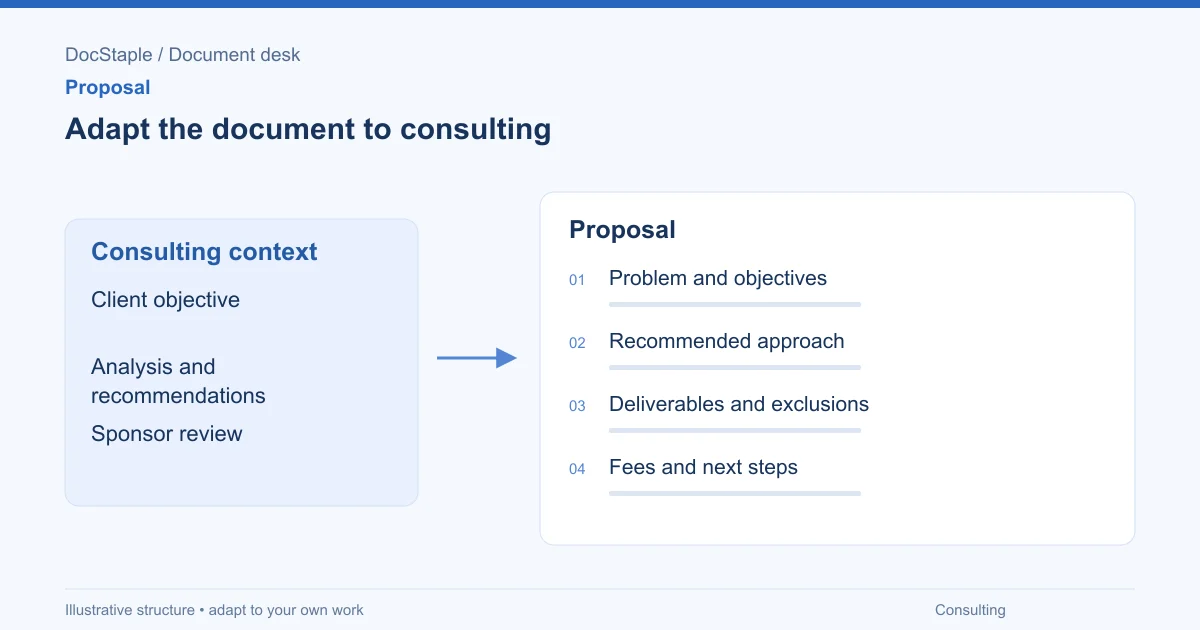
A consulting proposal is a promise about work that has not happened yet. The thing being sold is judgment: interviews, analysis and a recommendation. That makes vague wording expensive. If the proposal says "we will help you decide", client and consultant can each honestly disagree later about what was owed.
This guide walks through a fictional example: an independent strategy review for a small freight forwarder that must decide whether to lease a second warehouse. All names, figures and dates are invented, and anything in square brackets is a field you would replace with a verified fact. Requirements for contracts, tax and confidentiality vary by country and state, so treat the wording as drafting illustrations and not legal advice.
Frame the decision the client has to make
Consulting engagements usually exist because someone must make a decision. Open with that decision, then state the objective as an output you can actually deliver.
Weak draft
We are a results-driven advisory firm with deep experience helping growing companies unlock their potential.
Nothing here mentions the client, and "unlock their potential" cannot be checked by anyone.
Stronger draft
Client need. [Client] operates from a single warehouse at [location] and reports that [evidence gathered in the intake call, for example, peak-season storage is regularly over capacity]. The leadership team must decide by [date] whether to lease a second site.
Objective. By [date], the leadership team has a written recommendations report on whether and how to expand warehouse capacity. The report will state the options considered, the evidence for each, and the reasons for the preferred option.
The objective ends in a document the client can hold, not in an outcome such as "lower costs" that depends on decisions made after you leave. Committing to what you control keeps the proposal honest. Record where each claim about the client's situation came from, so a reader can tell what was told to you and what you observed.
Plan discovery, analysis and the decision gate
The approach section should read as a sequence the client can follow. For a strategy review that usually means discovery, analysis and recommendations, each with an owner and a dependency.
Phase 1: Discovery (weeks 1 to 3). We interview up to [number] stakeholders named by the sponsor and review the documents listed in Appendix A. Client dependency: the sponsor arranges interview access and shares the documents by [date].
Phase 2: Analysis (weeks 4 to 5). We compare the options against the criteria agreed at the end of Phase 1. The engagement lead shares the draft analysis with the sponsor for a factual accuracy check before it is finalized.
Phase 3: Recommendations (week 6). We present the recommendations to the leadership team and incorporate one consolidated round of written feedback.
Every phase names something you need from the client, so a delay caused by late access is visible in writing. The comparison criteria are agreed at the end of discovery, before anyone favours an option.
The Oregon Department of Transportation's Statement of Work Writing Guide was written for a public agency buying personal services, so its contract mechanics will not apply to a private proposal. Some of its drafting advice transfers well to consulting, though. For work where the outcome cannot be fully defined in advance, it suggests describing the process for reaching decisions and who is authorized to make them, using the example of a task to study alternatives and submit recommendations. The task should say the consultant cannot proceed with later tasks until the agency selects a preferred alternative.
That pattern is a decision gate. In a proposal it might read: "Any implementation support begins only after [named sponsor] selects an option in writing and the parties agree a separate scope." The same guide advises splitting large projects into phases and limiting the first contract to the known services and deliverables. For an engagement whose second half depends on what the first half finds, price Phase 1 firmly and describe later phases as options.
Define deliverables and exclusions
Deliverables are what the client can point to when the work is done. The Oregon guide describes best practice as defining deliverables for each task that are tangible and measurable, using a written report of findings as its example. It also notes that some services produce nothing tangible, such as facilitating a meeting, and suggests an agenda and attendee list as evidence that the work took place. Consulting workshops fall into this category.
A weak draft says "we will assist with the review and provide recommendations as needed". A stronger one lists each item:
| Deliverable | Format | Due | Reviewer |
|---|---|---|---|
| Interview summary | Word document, up to [number] pages | End of week 3 | Sponsor |
| Options analysis | Word document with comparison table | End of week 5 | Sponsor |
| Recommendations report | Word document and presentation | Week 6 | Leadership team |
| Workshop record (if a workshop is held) | Agenda and attendee list | Within [number] days of the session | Sponsor |
Not included. Implementation of the recommendations; supplier or landlord negotiations; system selection or configuration; interviews beyond the [number] stakeholders named in Phase 1; feedback rounds after the consolidated round in Phase 3.
Assumptions. The fee is based on [documents and data listed in Appendix A], access to the named stakeholders by [date], and a single consolidated set of client comments per deliverable.
The same guide lists words that carry more than one interpretation, including "assist", "help", "best efforts", "reasonable", "acceptable" and "necessary". Its advice is to ask how, by what standard and who decides. Scan your draft for those words and replace each with an action, a standard and a decision-maker. "We will assist with the roadmap" becomes "We will draft a roadmap of no more than [number] initiatives and revise it once following the sponsor's consolidated comments."
The guide also recommends listing your assumptions, because doing so can bring out obligations that might have gone unwritten.
Cover evidence and confidentiality
Two risks are specific to consulting: recommendations that are not supported by evidence, and client information handled carelessly. Give each a short clause.
Evidence. Each finding in the report will cite its source, such as an interview or a document supplied by [Client]. Where a finding rests on a single source or an assumption, the report will say so.
Confidentiality. We will use information supplied by [Client] only for this engagement. Confidentiality terms are set out in [the separate agreement, if one applies].
Confidentiality, intellectual property and liability wording has legal effect that varies by jurisdiction. Have it reviewed by a qualified professional before you rely on it.
Set fees, change handling and acceptance
A fee section that states a number and stops leaves three questions open: when it is paid, what happens if the scope changes, and what counts as done.
The Oregon guide connects the payment method to how definite the scope is. A fixed price requires a scope definitive enough for the consultant to determine the cost of performing it, while a time-and-materials approach fits a less definite scope and normally carries a not-to-exceed cap. If discovery might change the shape of the work, a fixed fee for the whole engagement may be the wrong structure.
Fee. The fee for Phases 1 to 3 is [currency and amount], invoiced [schedule]. Expenses are [included or billed at cost with prior approval]. Taxes are [treatment for your jurisdiction].
Changes. Any request to add to or alter the work is made in writing. Before we start the change, we confirm in writing what will change, what it will cost and whether the timetable moves. Work not confirmed in this way is not part of the fee.
Acceptance. Each deliverable is reviewed by the person named in the deliverables table. We treat it as accepted when that person confirms in writing, or when comments have been resolved and the document reissued. Silence is not acceptance.
The change wording is a small change-control process. Project Management Academy defines scope creep as adding unapproved requirements to a project over its life, and says that without a documented change request and a formal change control process to assess it, the risk of scope creep increases. A proposal cannot enforce that discipline by itself, but it can set the expectation before the first extra request arrives.
Close with next steps and run the approval check
End by making the decision easy: who signs, by when, and what happens next.
To proceed. [Named client representative] signs and returns this proposal by [date]. We then confirm the start date and request the Phase 1 access and documents listed in Appendix A.
Validity. The fee is held until [date]. If the assumptions above change before acceptance, we will confirm in writing whether the fee or timetable changes.
If the proposal will become part of a contract, say which document prevails if the two differ. Before sending, ask someone who did not write it to read it as the client would, and check the following.
- Decision and objective: Does the opening state the client's decision, and does the objective end in something checkable and within your control?
- Approach: Does each phase have a timeframe and a named client dependency, and do later phases start only after a written decision?
- Vague wording: Have "assist", "reasonable" and "as needed" been replaced with an action, a standard and a decision-maker?
- Deliverables: Does each have a format, a due date and a named reviewer?
- Exclusions and assumptions: Are interview numbers, feedback rounds and implementation addressed?
- Fees and changes: Does the fee structure match how definite the scope is, with a written route for changes?
- Leftovers: Have names, dates and rates from a previous proposal been replaced?
- Approval: Is it clear who signs, by when and what happens next?
In Word, resolve tracked changes and clear drafting comments before saving the version you send.
Start from an editable structure
If you would rather not rebuild the layout for each engagement, the consulting proposal template is an editable Word file with sections for client need and proposed outcome, scope and deliverables, delivery approach and timetable, fees and acceptance, document preparation and review, and approval. When the scope needs its own detailed document, the consulting statement of work template covers that step. Both are starting drafts: you supply the facts, and neither guarantees that a proposal is complete, compliant or enforceable.
Sources: Statement of Work Writing Guide, Oregon Department of Transportation, What is scope creep?, Project Management Academy
Last updated: September 26, 2026
Frequently Asked Questions
Related Articles
Capability Statement Best Practices for Consulting Firms
Capability statement best practices for consulting firms, with fixes for vague competencies, weak past performance, generic differentiators and stale credentials.
Capability Statement Checklist for Buyer-Ready Consulting Drafts
A capability statement checklist for consulting firms, with review gates for core competencies, relevant experience, differentiators, credentials and contact details.
Capability Statement Examples: Four Sections Written Weak and Then Strong
Capability statement examples for a fictional consulting firm: core competencies, relevant experience, differentiators, and contact and credentials, each shown as weak and stronger draft wording with a review checklist.
Engagement Letter Best Practices
Best practices for engagement letters, including scope control, responsibility wording, limitation language and approval records.
Engagement Letter Checklist
Use this engagement letter checklist to review purpose, parties, responsibilities, limitations, approval and signature readiness.
Engagement Letter Examples: Purpose, Scope Limits and Signatures
Engagement letter examples for consulting work, with annotated wording for parties, responsibilities, scope limitations, approval and signatures.