How to Adapt a Quality Assurance Plan for Construction
How to adapt a quality assurance plan for construction projects, with quality criteria, inspection points, nonconformance handling, release approval and draft language.
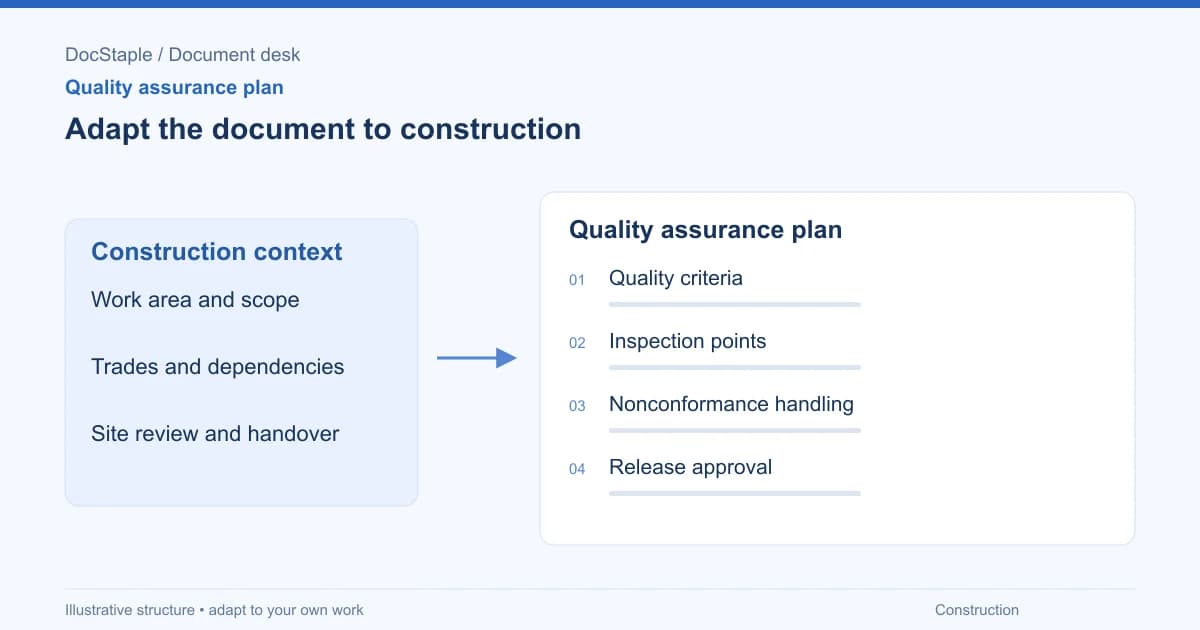
Adapting a quality assurance plan for construction means moving from general quality language to site-specific controls. Construction quality depends on drawings, specifications, permits, submittals, inspections, subcontractor coordination, field evidence and closeout decisions. A generic QA plan that says "review work before release" is not enough on a live site.
Use this scenario: a general contractor is managing a commercial office fit-out. The work includes framing, electrical rough-in, firestopping, finishes and final punch-list closeout. Several subcontractors are involved, the client wants evidence for the completion pack, and the site manager needs a QA plan that people can follow during the work, not after defects appear.
Anchor quality criteria in approved project documents
Construction quality criteria should come from approved drawings, specifications, permits, product data, method statements, inspection and test plans, and contract requirements. FHWA describes quality assurance in highway construction as planned and systematic actions that provide confidence a product or facility will perform satisfactorily in service FHWA. That highway context is specific, but the principle fits construction generally: quality is planned against requirements.
For the fit-out, criteria might include:
- framing layout matches approved drawings and tolerances;
- electrical rough-in is inspected before concealment;
- firestopping products and installation match approved submittals;
- finish samples are approved before bulk installation;
- punch-list items are closed with evidence and sign-off.
Draft language:
Quality criteria for each feature of work will be drawn from the approved drawings, specifications, submittals, permits and site instructions listed in the work package. Internal preferences must not override approved project requirements.
Approval check: before work starts, the site manager and subcontractor lead should confirm the current drawing revision, approved submittals and inspection requirements for the work package.
Do not treat a drawing set as current because it is printed and taped to a wall. The plan should say how current revisions are confirmed and how superseded drawings are removed from active use. On a busy fit-out, a wrong revision can travel through multiple trades before anyone notices. A simple revision check at the preparatory stage is often cheaper than rework after concealment.
Build inspection points around the site sequence
Inspection points should match the actual construction sequence. FHWA's contractor quality control plan guidance for federal lands roads refers to inspection and control procedures for phases of construction, including preparatory and startup activities FHWA Federal Lands. USACE also describes a three-phase inspection approach for each feature of work: preparatory, initial and follow-up USACE. Your project may use different terms, but the logic is useful.
For the fit-out:
- Preparatory: verify drawings, permits, materials, access, safety interfaces and inspection hold points.
- Initial: inspect first installation area before the method is repeated.
- Follow-up: inspect ongoing work and evidence records.
- Pre-concealment: inspect work before ceilings, walls or finishes hide it.
- Closeout: verify punch-list, tests, certificates and as-built records.
Draft language:
The subcontractor must request inspection before concealing any work identified as a hold point. Work may not proceed beyond the hold point until the required reviewer records acceptance or written authorization to continue.
Review criterion: every inspection point should say who requests it, who performs it, what evidence is recorded and what happens if it fails.
Subcontractor coordination belongs here too. If electrical, framing and firestopping work affect one another, the inspection point should identify interface checks. For example, the firestopping inspection may require confirmation that penetrations are complete and that no later trade is expected to disturb the sealed area. Otherwise one trade can pass its own check while the combined work remains incomplete.
Adapt nonconformance handling for subcontractors and site evidence
Construction nonconformance has consequences for sequence, safety, cost and schedule. Do not let site teams fix and cover issues without a record. Nonconformance handling should include location, drawing reference, photo evidence, affected trade, immediate containment, disposition and verification.
Examples:
- firestopping installed with an unapproved product;
- framing built to an outdated drawing revision;
- electrical rough-in concealed before inspection;
- finish material installed before sample approval;
- missing permit or inspection evidence.
Draft language:
A nonconformance report must identify the affected location, drawing or specification reference, trade owner, observed condition, immediate containment, proposed disposition and verification evidence. The work may be corrected, rejected, accepted by approved deviation or escalated for design review according to the authority matrix.
This language separates three decisions that are often confused: stop the problem from spreading, decide what to do with the defective work, and verify the outcome.
Approval check: the plan should identify who can accept a deviation. A subcontractor should not approve its own exception to the specification unless the contract expressly allows that route.
Keep the language neutral in the field record. "Installed different product" is better than "careless installation" unless the investigation supports that conclusion. The nonconformance record should make the condition visible, protect the sequence and route the decision to the right authority. Blame language rarely helps the work get corrected.
Include permits, safety interfaces and evidence reality
Quality assurance is not a substitute for safety compliance, permits or inspections by authorities. It should reference them and make sure the quality workflow does not bypass them. OSHA's construction and safety rules may apply depending on the jurisdiction and work, and OSHA emphasizes identifying hazards, evaluating severity and likelihood, and prioritizing corrective actions in safety management OSHA. For UK work, HSE describes risk assessment as identifying hazards, assessing risks, controlling risks, recording findings and reviewing controls HSE. Those are safety sources, not QA templates, but they show why quality checks cannot ignore site risk.
In the fit-out plan, add evidence fields:
- permit or inspection reference;
- drawing revision;
- location grid or room number;
- photo before concealment;
- test or certificate reference;
- inspector name and date;
- open restrictions.
Draft language:
QA evidence must be sufficient for a later reviewer to identify the location, approved requirement, inspection result and person authorizing continuation. Photos without location, date or requirement reference are not sufficient evidence by themselves.
Review criterion: if the site completion pack could not prove what was inspected, the evidence requirement is too weak.
Define release approval and closeout
In construction, "release" may mean allowing the next trade to proceed, closing a hold point, issuing a completion pack or handing over the space. Each release point needs authority.
For the fit-out:
- framing release allows electrical rough-in;
- rough-in release allows wall closure;
- finish release allows client walkthrough;
- punch-list closeout supports handover.
Draft language:
The site manager may close the work package only after required inspections, tests, nonconformance dispositions, permit evidence and punch-list actions are complete or listed as approved open items.
Approval check:
- current drawings and submittals verified;
- all hold points signed;
- nonconformances closed or accepted by authorized deviation;
- permits and required inspections recorded;
- completion pack evidence indexed;
- client or site manager sign-off recorded.
Use a construction-specific draft structure
For a practical starting point, the construction quality assurance plan template includes editable sections for quality objectives and scope, review and inspection activities, acceptance and nonconformance, corrective action, document preparation and approval. Adapt it to the contract, drawings, permits, subcontractor responsibilities and site evidence rules before issuing.
The final test is field usability. Ask a foreperson, subcontractor lead and site manager to walk through one feature of work using the plan. If they cannot identify the requirement, inspection point, evidence and approval authority, revise the plan before work proceeds.
Last updated: September 26, 2026
Frequently Asked Questions
Related Articles
How to Write a Consulting Quality Assurance Plan: Criteria, Reviews and Release Approval
How to write a consulting quality assurance plan for a strategy review engagement, including quality criteria, inspection points, nonconformance handling, release approval and draft wording.
How to Write a Construction Standard Operating Procedure
A construction-specific guide to adapting a standard operating procedure for site work, subcontractors, permits, escalation, evidence and approval checks.
How to Write a Consulting Standard Operating Procedure: Scope, Steps and Escalation
How to write a consulting standard operating procedure for a strategy review engagement, with purpose, owner, step-by-step workflow, exceptions, version review, draft wording and approval checks.
How to Write a Construction Training Manual: Site Workflow, Examples and Sign-Off
How to write a construction training manual for a commercial fit-out project, with learning objectives, practical workflow, worked examples, competency sign-off, draft wording and approval checks.
How to Write a Consulting Training Manual: Objectives, Workflow and Competency Sign-Off
How to write a consulting training manual for a strategy review engagement, including learning objectives, workflow, worked examples, competency sign-off, draft wording and approval checks.
How to Write a Quality Assurance Plan for Consulting Deliverables
Learn how to write a quality assurance plan with quality criteria, inspection points, nonconformance handling and release approval.