How to Write a Construction Training Manual: Site Workflow, Examples and Sign-Off
How to write a construction training manual for a commercial fit-out project, with learning objectives, practical workflow, worked examples, competency sign-off, draft wording and approval checks.
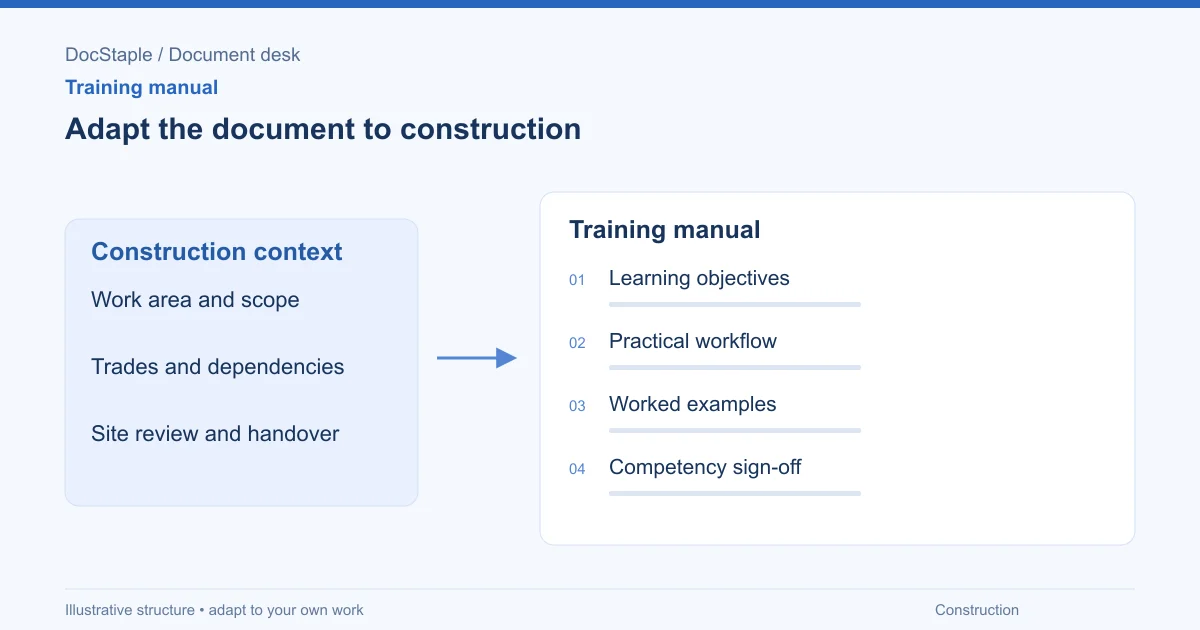
A construction training manual is most useful when it teaches a real site workflow. It should not be a pile of copied policies or a generic safety booklet with the project name on the cover. Workers and coordinators need to know what task they are being trained to perform, what evidence proves it was done correctly, and when they must stop and ask for a competent reviewer.
This guide uses a fictional scenario: a contractor is training a junior site coordinator on a commercial fit-out project. The coordinator will help prepare the site completion pack after inspection closeout. The training manual must explain the workflow from site induction records and trade coordination through inspection evidence, punch-list closeout and handover records.
Construction training has jurisdiction-specific requirements. In the United States, OSHA defines a competent person in construction as someone capable of identifying existing and predictable hazards and authorized to take prompt corrective measures OSHA competent person. OSHA also maintains a publication on training requirements in OSHA standards OSHA training requirements. A project training manual can support learning, but it does not automatically make someone competent or authorized for regulated tasks.
Define the learner and the site task
Start with the exact learner group and task. A manual for a coordinator compiling records is different from a manual for scaffold inspection, hot works or equipment operation.
Draft language:
Audience. This manual is for junior site coordinators assigned to the [Project name] commercial fit-out. Learners must complete site induction and document-control access before using this manual.
Training outcome. After training, the learner can assemble a site completion pack that links inspection records, approved drawing revisions, punch-list closeout and required handover evidence for review by the site manager.
Limits. This manual does not authorize the learner to inspect works, approve safety controls, sign statutory certificates or close defects without the required reviewer.
The limits are as important as the objectives. A manual should prevent overreach.
Turn the site workflow into teachable steps
Show the workflow in the order it happens. Include inputs, decision points and records.
Example workflow:
- Confirm current references. Check the latest approved drawing register and specification references.
- Gather inspection records. Collect records from the approved project folder, not informal messages.
- Match records to work areas. Link each inspection to floor, zone, drawing revision and subcontractor where applicable.
- Check punch-list status. Confirm each open item has evidence of correction or remains listed as open.
- Flag missing evidence. Do not fill gaps with assumptions. Record the missing item and owner.
- Submit pack for review. Site manager reviews before the pack is issued to the client or main contractor.
The manual should also say what the learner must not do:
If a required inspection record is missing, the coordinator records the gap and notifies the site manager. The coordinator must not recreate, backdate or alter inspection evidence.
That one instruction can prevent a serious records problem.
Use worked examples from project realities
Worked examples make the standard visible. Use approved sample records or fictional project data. Do not use live personal information unnecessarily.
Example completion record:
Accepted entry. Ceiling closeout, Zone 3B, drawing A-230 Rev D, inspection record IR-118 dated [date], subcontractor [name], defect item D-44 closed by site manager on [date], photograph reference P-118A.
Not accepted. "Ceilings done. Photos in WhatsApp."
Explain why. The accepted entry has location, drawing revision, inspection evidence, defect status and review. The rejected entry has no controlled source or approval.
Add an unsafe-work example:
During record collection, the coordinator sees that a trade has reopened a ceiling tile in an area marked closed. The coordinator does not inspect or instruct the trade. The coordinator notes the location, avoids entering the work area if not authorized and contacts the site manager.
This keeps the manual aligned with site authority. Training should tell learners when to step back.
Build practice tasks around evidence and stop conditions
A useful construction manual includes practice tasks, not just text. Use sample records:
- match five inspection records to drawing revisions
- identify two superseded drawings
- flag three missing pieces of handover evidence
- classify punch-list items as closed, open or unclear
- write an escalation note for a record that appears inconsistent
Practice should include a normal case and an exception case. OSHA's incident investigation materials encourage looking beyond immediate causes to underlying factors when problems occur OSHA incident investigation. Apply that training mindset to records: if evidence is repeatedly missing, the issue may be the inspection process, not the coordinator's filing habit.
Short draft practice instruction:
Complete the sample completion pack using the training records supplied. Mark any record you cannot verify as "unconfirmed" and write the question you would ask the site manager. Do not invent missing dates, signatures or drawing revisions.
Include at least one site-pressure scenario. For example, the client representative asks whether the pack can be issued while two minor defects are still open. The learner should not decide the commercial answer. The manual should train them to record the open items, identify the affected evidence and ask the site manager which exception wording, if any, is approved.
Also train the learner to preserve the trail of who answered. A completion pack assembled from memory is weak; a completion pack assembled from named records, dated approvals and logged exceptions gives the project team something it can review under pressure.
Record competency sign-off
Competency sign-off should say what the learner demonstrated. It should not be a blank signature line.
Use criteria like:
| Competency item | Evidence observed | Result |
|---|---|---|
| Finds current drawing register | Correct register identified | Pass or action |
| Matches inspection records | Sample pack completed | Pass or action |
| Flags missing evidence | Gap log prepared | Pass or action |
| Applies stop condition | Escalation note written | Pass or action |
| Uses controlled storage | Pack saved correctly | Pass or action |
Draft language:
The trainer signs off the learner only after observing the learner complete the sample pack, explain missing-evidence actions and submit the pack for review. If the learner may compile packs only under supervision, the restriction and review date are recorded.
If the task involves regulated safety work, sign-off may require a different process. Do not let the manual imply broader authorization than the employer can support.
Approval check before the manual is used
Before release, review:
- Scenario: Does the manual match the commercial fit-out project and completion pack?
- Learner: Is the audience specific and are prerequisites clear?
- Workflow: Are approved drawings, inspection records, permits and punch-list evidence included?
- Examples: Do examples show accepted and rejected evidence?
- Stop conditions: Does the manual tell learners when not to proceed?
- Competency: Is sign-off based on observed performance?
- Authority: Does the manual avoid granting inspection or safety authority by accident?
- Approval: Has the site manager, document-control owner and required safety or quality reviewer approved it?
The construction training manual template is an editable Word file with sections for audience and objectives, workflow and worked examples, practice and common errors, competency review, preparation checks and approval. Adapt it to the actual project records, site rules and reviewer responsibilities before use.
Last updated: September 26, 2026
Frequently Asked Questions
Related Articles
How to Adapt a Quality Assurance Plan for Construction
How to adapt a quality assurance plan for construction projects, with quality criteria, inspection points, nonconformance handling, release approval and draft language.
How to Write a Consulting Quality Assurance Plan: Criteria, Reviews and Release Approval
How to write a consulting quality assurance plan for a strategy review engagement, including quality criteria, inspection points, nonconformance handling, release approval and draft wording.
How to Write a Construction Standard Operating Procedure
A construction-specific guide to adapting a standard operating procedure for site work, subcontractors, permits, escalation, evidence and approval checks.
How to Write a Consulting Standard Operating Procedure: Scope, Steps and Escalation
How to write a consulting standard operating procedure for a strategy review engagement, with purpose, owner, step-by-step workflow, exceptions, version review, draft wording and approval checks.
How to Write a Consulting Training Manual: Objectives, Workflow and Competency Sign-Off
How to write a consulting training manual for a strategy review engagement, including learning objectives, workflow, worked examples, competency sign-off, draft wording and approval checks.
How to Write a Quality Assurance Plan for Consulting Deliverables
Learn how to write a quality assurance plan with quality criteria, inspection points, nonconformance handling and release approval.