How to Write a Consulting Quality Assurance Plan: Criteria, Reviews and Release Approval
How to write a consulting quality assurance plan for a strategy review engagement, including quality criteria, inspection points, nonconformance handling, release approval and draft wording.
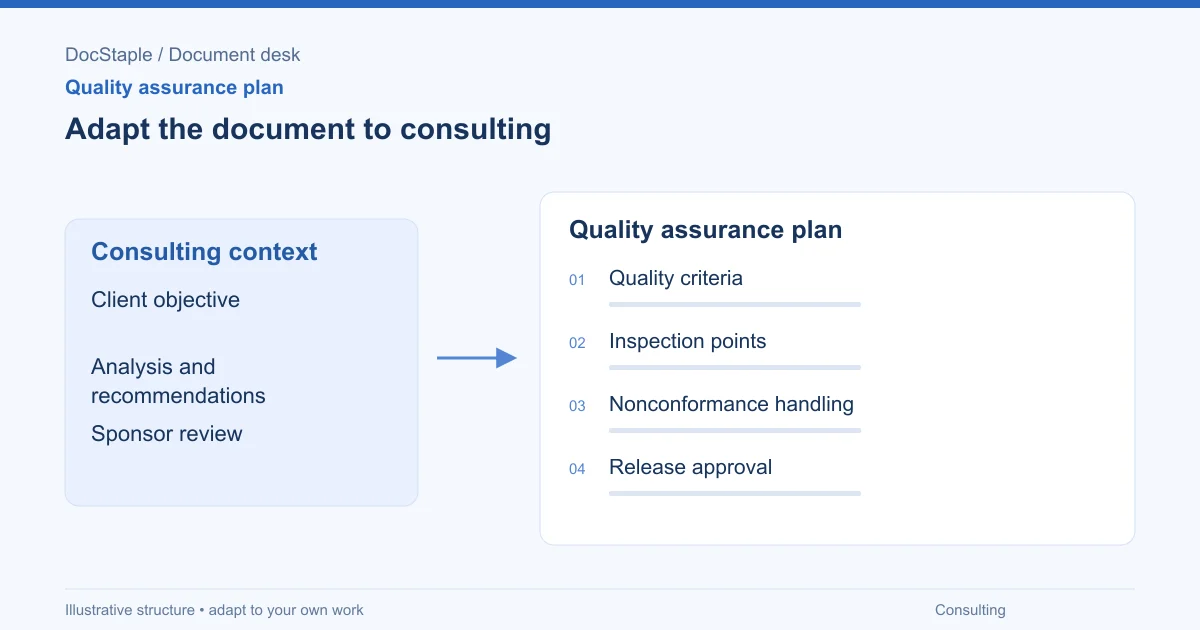
A consulting quality assurance plan should prevent unsupported recommendations from reaching the client. It should also protect the team from endless subjective review by defining quality criteria up front. The plan is not there to make every slide perfect. It is there to decide what must be checked, when, by whom and with what evidence before release.
This guide uses a fictional scenario: a consulting firm is delivering a strategy review engagement. The final output is a recommendations report supported by discovery interviews, client documents and analysis review. Recent projects have shown three recurring problems: recommendations outside the agreed scope, weak evidence trails and late confidentiality concerns. The QA plan is designed to catch those issues before the client workshop and final report.
EPA's quality management tools describe quality management plans as documenting how an organization will plan, implement and assess the effectiveness of quality assurance and quality control operations EPA quality management tools. A consulting QA plan can be simpler, but it should still explain how quality will be planned, checked and approved.
Define the output and quality criteria
Start with the output. "Strategy review engagement" is too broad. The QA plan should state what is being checked.
Draft language:
Output covered. This quality assurance plan applies to the recommendations report and supporting analysis review pack for the [Client] strategy review engagement.
Intended use. The report will be used by [client sponsor or decision group] to decide which operating model recommendations to take forward.
Quality objective. The report is released only when recommendations are within approved scope, supported by evidence or documented professional judgment, limitations are visible, and confidentiality restrictions have been checked.
Then define criteria:
| Criterion | Required evidence |
|---|---|
| Scope fit | Recommendation mapped to approved engagement question |
| Evidence support | Source in evidence index or documented expert judgment |
| Limitations | Known gaps and contrary evidence noted |
| Confidentiality | Approved storage and sharing route confirmed |
| Review completion | Engagement lead approval recorded |
| Sponsor acceptance | Sponsor approves recommendations and evidence, if required |
EPA's QAPP guidance emphasizes planning quality activities around stated performance criteria EPA QAPP guidance. For consulting, performance criteria should be written in language reviewers and consultants can apply.
Place inspection points in the engagement
The plan should say where quality checks happen. Do not rely on one heroic final review.
For the strategy review engagement, use four gates:
- Evidence gate. Discovery material is indexed and classified before analysis begins.
- Analysis gate. Findings are reviewed for support, limitations and scope fit.
- Recommendation gate. Draft recommendations are checked before client workshop.
- Release gate. Final report is approved for issue.
Draft language:
The engagement lead may not approve the recommendation workshop pack until the analysis gate is complete. If a recommendation lacks support, it is removed, revised as a hypothesis or escalated to the engagement partner with the limitation stated.
This gate prevents a common consulting trap: once an unsupported idea is shown to the client, it becomes politically harder to remove.
Each inspection point should have a different purpose. The evidence gate asks whether the team has reliable inputs. The analysis gate asks whether findings are supported. The recommendation gate asks whether advice follows from the findings and remains inside the approved scope. The release gate asks whether the client-ready document is complete, controlled and approved. If all four gates ask the same vague question, "Is this good?", the plan will not change behavior.
For a small engagement, the same person may perform more than one review, but the plan should still name the decision separately. For higher-risk work, consider adding a reviewer who was not responsible for drafting the section being checked.
Record nonconformance and corrective action
Nonconformance in consulting does not always look like a defect. It might be a recommendation outside scope, an unsupported claim, a confidentiality issue or an unreviewed data source. The plan should treat these as quality events, not personal failures.
Draft record:
| Nonconformance | Impact | Immediate action | Owner | Release decision |
|---|---|---|---|---|
| Recommendation 4 not mapped to approved scope | Could create unpaid work or client confusion | Remove from workshop pack pending scope decision | Engagement lead | Not released |
| Interview quote includes personal data not needed for decision | Confidentiality risk | Replace with anonymized summary | Analyst | Release after reviewer check |
EPA quality requirements include discussing corrective actions in response to assessment findings EPA QA requirements. Keep that logic: record what failed, what it affects, who corrects it and who accepts the correction.
Use plain labels. "Major" can mean release-blocking: the issue affects scope, evidence, confidentiality or client decision-making. "Minor" can mean correction required before final issue but not before internal review continues. "Observation" can mean an improvement for the next version. Define the labels in the plan so reviewers do not negotiate severity from scratch every time.
Make release approval a real decision
Release approval should be clear and documented. It is not the same as "the partner saw the deck."
Draft language:
Release approval. The engagement lead approves release when all quality criteria are met or approved deviations are recorded. The client sponsor approval condition is: sponsor approves recommendations and evidence. Silence, meeting attendance or lack of comments is not treated as approval unless the engagement terms expressly say so and the engagement lead records the basis.
Add a release checklist:
- recommendations map to approved scope
- evidence index is current
- limitations are stated
- confidentiality check is complete
- nonconformances are closed or approved as deviations
- client-ready version is saved separately from draft files
- approver, date and version are recorded
If the sponsor wants to move ahead despite a limitation, record the limitation and the decision. For example, "Client sponsor approved use of the market-sizing estimate for directional discussion only; final investment decision requires separate validation." That kind of wording protects the distinction between consulting advice, client judgment and further analysis.
The same principle applies internally. If the engagement partner accepts a deviation, the plan should record whether the deviation is one-off or whether the delivery method needs to change. Otherwise the exception becomes an unwritten new standard.
Review criteria for the finished plan
Before using the QA plan, ask:
- Output: Does the plan name the report and supporting pack?
- Criteria: Can reviewers check each criterion with evidence?
- Inspection points: Are quality gates placed before client exposure?
- Reviewer role: Does the engagement lead have authority and enough distance to challenge the work?
- Nonconformance: Are unsupported recommendations, scope drift and confidentiality issues covered?
- Corrective action: Are owners and release decisions recorded?
- Approval: Is release approval explicit and not implied by silence?
- Update trigger: Will the plan be reviewed after client complaints, rework or recurring issues?
If you want a structured draft, the consulting quality assurance plan template is an editable Word document with sections for quality objectives, review and inspection activities, acceptance and nonconformance, corrective action, preparation review and approval. Adapt it to the engagement scope and reviewer authority before relying on it.
Last updated: September 26, 2026
Frequently Asked Questions
Related Articles
How to Adapt a Quality Assurance Plan for Construction
How to adapt a quality assurance plan for construction projects, with quality criteria, inspection points, nonconformance handling, release approval and draft language.
How to Write a Construction Standard Operating Procedure
A construction-specific guide to adapting a standard operating procedure for site work, subcontractors, permits, escalation, evidence and approval checks.
How to Write a Consulting Standard Operating Procedure: Scope, Steps and Escalation
How to write a consulting standard operating procedure for a strategy review engagement, with purpose, owner, step-by-step workflow, exceptions, version review, draft wording and approval checks.
How to Write a Construction Training Manual: Site Workflow, Examples and Sign-Off
How to write a construction training manual for a commercial fit-out project, with learning objectives, practical workflow, worked examples, competency sign-off, draft wording and approval checks.
How to Write a Consulting Training Manual: Objectives, Workflow and Competency Sign-Off
How to write a consulting training manual for a strategy review engagement, including learning objectives, workflow, worked examples, competency sign-off, draft wording and approval checks.
How to Write a Quality Assurance Plan for Consulting Deliverables
Learn how to write a quality assurance plan with quality criteria, inspection points, nonconformance handling and release approval.