How to Write a Consulting Standard Operating Procedure: Scope, Steps and Escalation
How to write a consulting standard operating procedure for a strategy review engagement, with purpose, owner, step-by-step workflow, exceptions, version review, draft wording and approval checks.
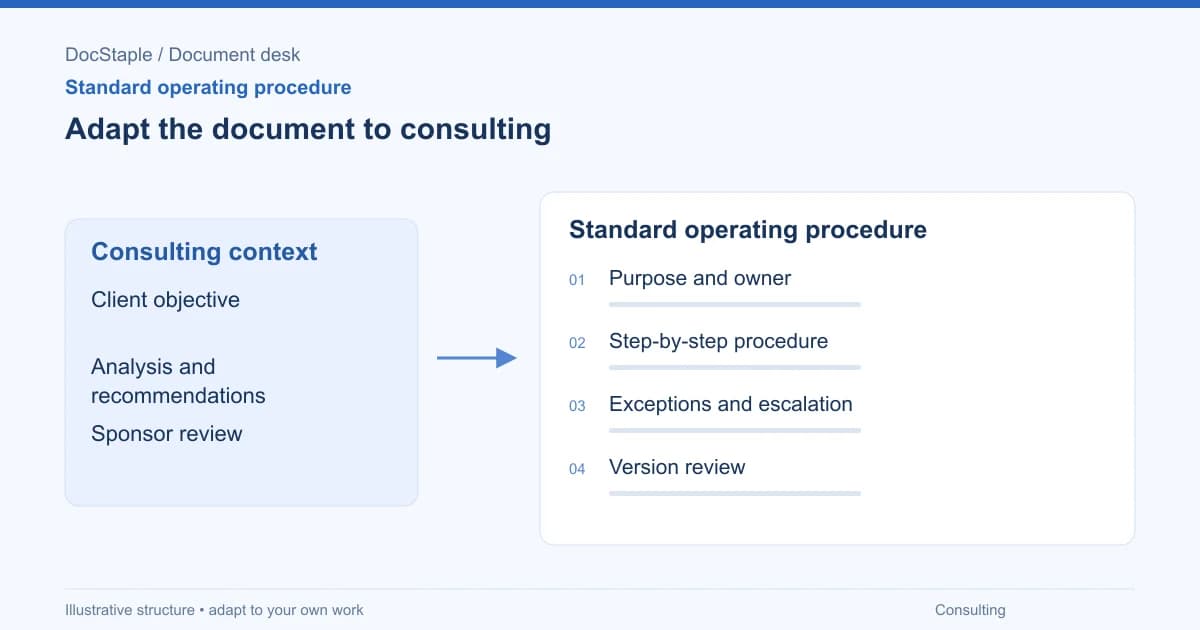
A consulting standard operating procedure should make a repeatable professional service easier to perform without pretending that every client situation is identical. The trick is to standardize the method, decision points and records while leaving room for professional judgment inside the approved scope.
This guide uses a fictional scenario: a boutique consulting firm delivers strategy review engagements for mid-market clients. Each engagement includes discovery interviews, document review, analysis, a recommendation workshop and a final recommendations report. The firm wants an SOP for the handoff from discovery to analysis review because quality has become uneven: some teams keep strong evidence trails, while others jump from interview notes to recommendations too quickly.
EPA's SOP guidance was written for quality systems, not consulting, but its core point transfers well: SOPs should provide enough detail to ensure the quality and integrity of the procedure being followed EPA SOP guidance. WHO's quality resources similarly warn that copied SOPs are not useful if they do not describe how the procedure actually happens locally WHO LQSI SOP management. For consulting, "locally" means your firm's delivery model and the client's approved engagement scope.
Define the purpose, owner and boundaries
Start by saying what the SOP controls and who owns it. Do not make the purpose a mission statement. Make it an operating boundary.
Weak wording:
This SOP ensures all consulting work is delivered to the highest professional standard.
That is too broad to follow or audit.
Stronger draft language:
Purpose. This SOP describes how the consulting team converts approved discovery material into an analysis review pack for the [strategy review engagement] before recommendations are drafted.
Owner. The engagement lead owns this SOP for each client engagement and confirms that the current version is used.
Scope. This procedure starts when discovery interviews and document collection are complete. It ends when the analysis review pack is approved for use in the recommendation workshop.
Out of scope. This SOP does not authorize additional client interviews, commercial scope changes, legal advice or disclosure of confidential client material outside the project team.
The out-of-scope line is important in consulting because process documents can accidentally expand authority. If the client has not approved extra interviews, the SOP should not imply the team can run them.
List prerequisites before the first step
An SOP should stop bad work before it starts. For the strategy review engagement, prerequisites might include an approved scope, current project folder, interview notes, client confidentiality classification, analysis framework and reviewer assignment.
Use a short table:
| Prerequisite | Evidence | Stop condition |
|---|---|---|
| Approved engagement scope | Signed proposal, SOW or change approval | Scope is missing or outdated |
| Discovery record complete | Interview log and document list | Material source is unclear |
| Confidentiality classification checked | Project folder label or client instruction | Material is marked restricted and access is not confirmed |
| Reviewer assigned | Engagement plan | No independent reviewer available |
| Analysis framework confirmed | Kickoff decision record | Team uses a framework not approved for this client |
This is where consulting SOPs differ from many operational SOPs. The raw material is often judgment-heavy: notes, stakeholder views, partial data and confidential client context. The SOP should require traceability from recommendation back to evidence.
Write step-by-step procedure with decision gates
The procedure should be written in the order work happens. Each step needs an owner, action, record and decision point where relevant.
Draft sequence:
- Engagement analyst prepares the evidence index. List every interview note, client document and data source used for the analysis. Save the index in [project folder].
- Engagement lead screens for scope fit. Mark items that support the approved questions, items that are useful but outside scope, and items that require clarification.
- Analyst builds the analysis review pack. Summarize findings by theme. Each finding must reference at least one source in the evidence index.
- Independent reviewer challenges the pack. Check whether findings are supported, whether contrary evidence is noted and whether confidentiality restrictions are respected.
- Engagement lead approves workshop use. Approve, approve with actions or return for revision.
The decision gate matters more than the prose. A common failure mode in consulting is the "beautiful unsupported slide." The SOP should make that slide fail review before it reaches the client.
Short example wording:
A finding may be included in the recommendation workshop only when the analysis review pack identifies the supporting source, notes any material limitation and records reviewer approval. If the evidence is incomplete, the finding is labeled "hypothesis for discussion" rather than presented as a conclusion.
Handle exceptions and escalation clearly
Consulting exceptions are often subtle. A client sponsor asks for a preview before the reviewer has approved the pack. A partner wants to include a recommendation based on experience rather than engagement evidence. An analyst discovers client material was shared into the wrong project channel.
Write escalation rules that are specific enough to use:
Scope drift. If the team identifies a question outside the approved engagement scope, the engagement lead records the question, decides whether it is excluded or requires a change request, and does not assign work until authority is confirmed.
Unsupported recommendation. If a recommendation cannot be traced to engagement evidence, approved methodology or documented professional judgment, it is removed, relabeled as a hypothesis or escalated to the engagement partner.
Confidential material. If confidential client material is shared outside the approved project workspace, the recipient must not forward it. The engagement lead and information security contact are notified under the firm's incident procedure.
For privacy and confidentiality, jurisdiction matters. For example, the UK ICO says organizations must assess the likely risk to people's rights and freedoms when a personal data breach occurs, and notifiable UK GDPR breaches must be reported to the ICO without undue delay and not later than 72 hours after awareness ICO personal data breach guide. A consulting SOP should point to the firm's approved incident process rather than trying to restate every legal deadline.
Control versions and reviews
Version control is not admin decoration. It tells consultants which method is current and lets reviewers understand what procedure applied when the work was done. EPA's SOP guidance notes that SOPs support historical records of procedures in use at a given time EPA SOP guidance. That is useful in consulting when a client later asks why a recommendation was reviewed a certain way.
Include:
- SOP title, owner and version number
- effective date and next review date
- change summary
- approver
- location of the controlled copy
- retirement rule for superseded versions
Set review triggers as well as dates. Review the SOP after a serious client complaint, confidentiality incident, recurring quality failure, new delivery model or material change to the engagement type.
Approval check before use
Before approving the SOP, ask:
- Purpose: Does it control one defined consulting workflow rather than all delivery work?
- Owner: Is one role accountable for the SOP and for engagement-level use?
- Prerequisites: Does the procedure stop when scope, confidentiality or evidence is unclear?
- Steps: Does each step name an owner, action and record?
- Decision gates: Can unsupported recommendations be caught before client presentation?
- Escalation: Are scope drift, confidentiality incidents and reviewer disagreement covered?
- Version control: Can the team identify the current copy and the procedure used for past work?
- Approval: Has the engagement lead, delivery owner and any required information security or legal reviewer signed off?
If you want a structured starting document, the consulting standard operating procedure template is an editable Word file with sections for purpose and prerequisites, step-by-step procedure, exceptions and escalation, quality checks, preparation review and approval. Treat it as a working draft to adapt, not a substitute for client-specific review.
Last updated: September 26, 2026
Frequently Asked Questions
Related Articles
How to Adapt a Quality Assurance Plan for Construction
How to adapt a quality assurance plan for construction projects, with quality criteria, inspection points, nonconformance handling, release approval and draft language.
How to Write a Consulting Quality Assurance Plan: Criteria, Reviews and Release Approval
How to write a consulting quality assurance plan for a strategy review engagement, including quality criteria, inspection points, nonconformance handling, release approval and draft wording.
How to Write a Construction Standard Operating Procedure
A construction-specific guide to adapting a standard operating procedure for site work, subcontractors, permits, escalation, evidence and approval checks.
How to Write a Construction Training Manual: Site Workflow, Examples and Sign-Off
How to write a construction training manual for a commercial fit-out project, with learning objectives, practical workflow, worked examples, competency sign-off, draft wording and approval checks.
How to Write a Consulting Training Manual: Objectives, Workflow and Competency Sign-Off
How to write a consulting training manual for a strategy review engagement, including learning objectives, workflow, worked examples, competency sign-off, draft wording and approval checks.
How to Write a Quality Assurance Plan for Consulting Deliverables
Learn how to write a quality assurance plan with quality criteria, inspection points, nonconformance handling and release approval.