How to Write a Construction Standard Operating Procedure
A construction-specific guide to adapting a standard operating procedure for site work, subcontractors, permits, escalation, evidence and approval checks.
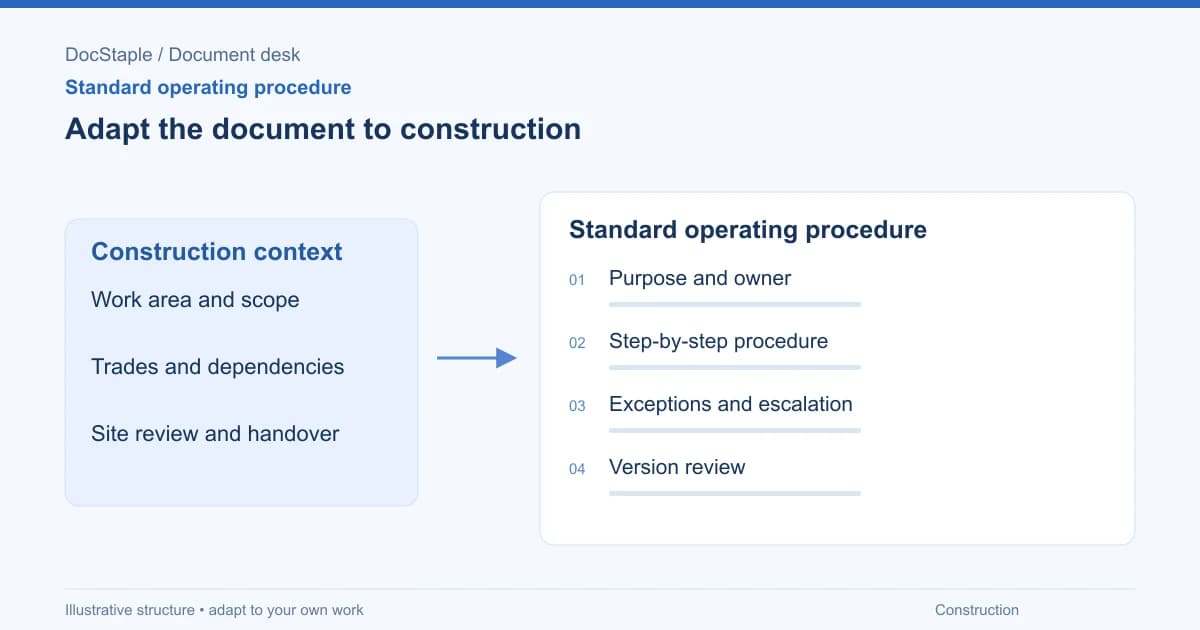
A construction standard operating procedure has to survive the site, not just the office. It should tell a competent worker or supervisor how a repeated activity is performed on this project, with the current drawings, permits, inspection points and escalation rules. If it reads like a generic policy, it will not help when a subcontractor arrives before access is approved or a ceiling closure is requested before inspection evidence is complete.
This guide uses a realistic scenario: a commercial fit-out project needs an SOP for closing out above-ceiling works before ceiling tiles are installed. The work involves electrical, mechanical and fire-stopping subcontractors, a site manager, inspection records, approved drawings and a punch-list closeout. Adapt the method to your project and jurisdiction. OSHA describes construction as a high-hazard industry with activities that can expose workers to serious hazards such as falls, struck-by equipment, electrocutions, silica dust and asbestos (OSHA construction industry); a written SOP does not itself make work safe or compliant.
Define the site scenario, purpose and owner
Start by naming the activity and boundary. "Ceiling closeout" is too broad if different floors, trades or permit conditions apply. A useful SOP says where it applies, when it starts, and who owns the document.
Draft language:
Purpose: This SOP explains how above-ceiling works are inspected, evidenced and approved before ceiling closure on the Level 3 commercial fit-out area. It applies after trade installation is complete and before ceiling tiles are installed. Owner: site manager. Backup owner: assistant site manager. Work may not proceed to closure until required inspections are recorded and open defects are accepted or cleared by the responsible reviewer.
Construction adaptation: name project documents directly. If the procedure depends on approved drawings, permit conditions, inspection and test plans, manufacturer instructions or client site rules, list them as prerequisites. Do not count a planned permit or pending drawing revision as an existing prerequisite.
Review criteria:
- The SOP identifies the project, area and activity.
- The owner has authority to stop or reroute the work.
- Prerequisites are current and locatable.
- Subcontractor responsibilities are named by role.
- The SOP states what happens before physical closure hides evidence.
Turn the work into step-by-step procedure
EPA SOP guidance says SOPs should be written as concise, step-by-step instructions and that there is no one correct format (EPA SOP guidance). On a construction site, the steps must also handle sequencing. A step that ignores trade coordination will fail even if the wording is neat.
Example sequence:
- The site manager confirms the current approved drawing revision and area boundary.
- Each trade supervisor confirms installation complete for their scope in the closeout log.
- The site manager checks required permits, hold points and inspection forms for the area.
- The responsible trade corrects visible defects before requesting inspection.
- The site manager or quality lead inspects the area against the approved checklist.
- Required photos are saved to the project record with location and date.
- Open items are marked as clear, accepted with written authorization, or not accepted.
- The site manager signs the closure approval before ceiling tiles are installed.
Each step has an actor. Each actor can tell whether the step is done. The SOP does not say "ensure quality" or "coordinate trades" without explaining the action that proves it.
Construction adaptation: include access and evidence. If the work will be concealed, photos, inspection forms and sign-offs are not administration after the fact; they are part of the work.
Add exceptions and escalation
Construction SOPs need stop conditions. OSHA's recommended practices for construction safety programs emphasize worker participation and reporting injuries, incidents and hazards without fear of retaliation (OSHA recommended practices for construction). A procedure should make reporting and escalation visible, not leave them to side conversations.
Draft language:
If a subcontractor requests ceiling closure before required inspection evidence is complete, the site manager marks the area "not approved for closure" in the closeout log and notifies the trade supervisor. If unsafe work or property damage is observed, affected work pauses, the area is made safe under approved site arrangements, and the site manager records the issue and permission to resume. Emergency situations follow the project emergency procedure.
Other exceptions:
- Drawing revision conflict discovered during inspection.
- Fire-stopping evidence missing or unclear.
- Trade supervisor unavailable to confirm completion.
- Permit condition not satisfied.
- Client representative requests closure despite open defects.
The SOP should not try to resolve specialist safety, engineering or legal questions by itself. It should route them to the competent reviewer and record the decision.
Record quality checks and approval
Construction SOPs often fail at the handoff between doing work and proving work. The quality check should say what evidence is required before release.
Draft language:
Release check: the site manager signs the punch-list closeout for the defined area after required trade confirmations, inspection records and location-stamped photos are complete. Open items may remain only if the responsible decision maker records written acceptance and any restrictions before closure.
Use an approval table:
| Area | Trade confirmations complete | Photos saved | Open items | Closure approved by | Date |
|---|---|---|---|---|---|
| Level 3 east corridor | Yes | Yes | 2 accepted with restrictions | Site manager | 26 Sep 2026 |
Review criteria:
- Inspection points happen before work is concealed.
- Required records have a storage location.
- Open items have an owner and decision.
- Restrictions are visible to later trades.
- Approval is active, not assumed from silence.
OSHA's job hazard analysis guidance says information from a hazard analysis is useless unless recommended controls are incorporated into the tasks (OSHA Job Hazard Analysis publication). Apply the same operational discipline here: if a quality or safety condition matters, it must appear in the task sequence or stop condition.
Maintain versions after site changes
Construction work changes. Drawings are revised, subcontractors change supervisors, access routes move, permit conditions are clarified, and repeated defects reveal that the old procedure is not working. Version review keeps the SOP from becoming site folklore.
Use draft language:
Review triggers: this SOP is reviewed after drawing revision affecting above-ceiling services, change in inspection hold points, recurring closeout defects, unsafe work or property damage on site, or replacement of the site manager or responsible trade supervisor. The owner records the review outcome even when no wording change is made.
Version control should be simple:
| Rev. | Date | Change | Approved by |
|---|---|---|---|
| 1 | 26 Sep 2026 | First issue for Level 3 ceiling closeout | Project manager |
Do not overwrite old site instructions without telling the people using them. Remove superseded copies from uncontrolled locations if your document system allows it, and make the current version available where supervisors actually work.
Approval check before issue
Before issuing the SOP, run an approval check with a site manager, trade supervisor and quality or safety reviewer. Ask them to walk a real area and answer:
- Can a supervisor tell when the SOP applies?
- Are prerequisites available before the first step?
- Does the sequence match the real order of work?
- Are subcontractor responsibilities clear?
- Are permits, inspections and evidence captured before concealment?
- Does the SOP say when to stop and who can restart?
- Does approval match the project authority matrix?
For a structured Word draft, the construction standard operating procedure template includes sections for purpose and prerequisites, step-by-step procedure, exceptions and escalation, quality checks, records and approval. Use it to organize the document, then replace the examples with project-specific facts, approved drawings, site rules and responsible roles.
Last updated: September 26, 2026
Frequently Asked Questions
Related Articles
How to Adapt a Quality Assurance Plan for Construction
How to adapt a quality assurance plan for construction projects, with quality criteria, inspection points, nonconformance handling, release approval and draft language.
How to Write a Consulting Quality Assurance Plan: Criteria, Reviews and Release Approval
How to write a consulting quality assurance plan for a strategy review engagement, including quality criteria, inspection points, nonconformance handling, release approval and draft wording.
How to Write a Consulting Standard Operating Procedure: Scope, Steps and Escalation
How to write a consulting standard operating procedure for a strategy review engagement, with purpose, owner, step-by-step workflow, exceptions, version review, draft wording and approval checks.
How to Write a Construction Training Manual: Site Workflow, Examples and Sign-Off
How to write a construction training manual for a commercial fit-out project, with learning objectives, practical workflow, worked examples, competency sign-off, draft wording and approval checks.
How to Write a Consulting Training Manual: Objectives, Workflow and Competency Sign-Off
How to write a consulting training manual for a strategy review engagement, including learning objectives, workflow, worked examples, competency sign-off, draft wording and approval checks.
How to Write a Quality Assurance Plan for Consulting Deliverables
Learn how to write a quality assurance plan with quality criteria, inspection points, nonconformance handling and release approval.