How to Write a Consulting Training Manual: Objectives, Workflow and Competency Sign-Off
How to write a consulting training manual for a strategy review engagement, including learning objectives, workflow, worked examples, competency sign-off, draft wording and approval checks.
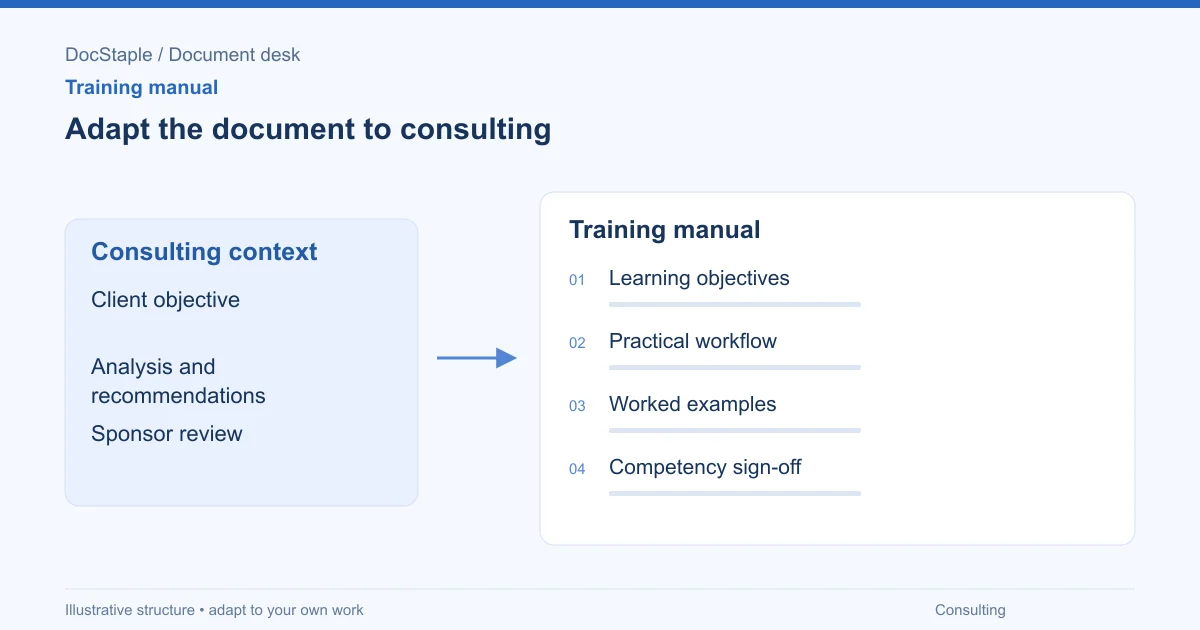
A consulting training manual should teach the way your firm actually delivers client work. It should not be a generic onboarding deck converted into Word. New consultants need to know how to move from client information to analysis, how to handle uncertainty, when to escalate and what evidence proves they are ready to work with less supervision.
This guide uses a fictional scenario: a consulting firm is training new analysts to support a strategy review engagement. The engagement produces a recommendations report after discovery interviews, analysis review and a recommendation workshop. The training manual focuses on one workflow: preparing an analysis review pack that is evidence-backed, reviewable and safe to share within the approved project team.
WHO's quality manual materials note that documents and records support consistent practice and that SOP-style templates must be customized to local circumstances WHO quality manual template. In consulting, that means the manual should reflect your engagement model, confidentiality rules and review standards, not an abstract view of "good consulting."
Define the learners and learning objectives
Start by naming who the manual is for and what they should be able to do. A manual for analysts will differ from one for engagement managers or partners.
Draft language:
Audience. This manual is for consultants joining the strategy review delivery team as analysts or senior analysts. Learners are expected to know the firm's document management system and confidentiality policy before training starts.
Learning objectives. After completing training, the learner can prepare an analysis review pack that links findings to the evidence index, identifies unsupported claims, flags confidentiality restrictions and submits the pack for engagement lead approval.
Not covered. This manual does not train commercial scoping, legal advice, client contracting or final partner approval of recommendations.
The objective is observable. A trainer can review the pack and decide whether the learner met the standard.
Map the practical workflow
Consulting work often looks ambiguous to new analysts because much of the knowledge sits in people's heads. The manual should make the flow visible from input to approval.
Use the strategy review sequence:
- Confirm inputs. Check that discovery interviews, document requests and client materials are listed in the evidence index.
- Check scope fit. Mark material that relates to the approved engagement questions.
- Draft findings. Write findings with source references, limitations and any contrary evidence.
- Prepare analysis review pack. Group findings into themes and identify decisions needed from the engagement lead.
- Run internal review. Reviewer checks support, confidentiality and client relevance.
- Record outcome. Pack is approved, returned for action or escalated.
Add decision points. For example, "If the source of a document is unknown, do not use it as evidence until the engagement lead confirms status." This is more useful than telling learners to "use judgment."
Include worked examples that show judgment
Worked examples should show both acceptable and unacceptable drafting. Use fictional or sanitized material.
Example:
Client note. Regional managers described three different approval paths for pricing exceptions. The policy folder includes two pricing matrices, one dated [date] and one undated.
Weak finding. Pricing governance is broken.
Better finding. Pricing exception approval appears inconsistent across regions. Evidence: three regional manager interviews and two conflicting pricing matrices in the client policy folder. Limitation: finance has not confirmed which matrix is current.
Reviewer question. Should the team request confirmation from finance before the recommendation workshop?
This example teaches three things at once: do not overstate, cite evidence, and flag limitations. It also prevents a common consulting failure mode: turning a plausible story into a conclusion too early.
For confidentiality, keep practice materials separate from live client records. If a training scenario involves personal data or confidential client material, use approved fictional content. The UK ICO's breach guidance is a reminder that organizations may have legal duties after unauthorized disclosure of personal data, including assessing likely risk to people's rights and freedoms ICO breach guide. Jurisdiction and contract terms matter, so the manual should point to the firm's incident route.
Design practice tasks around common errors
The manual should not end after explanation. Learners need practice tasks that resemble real work.
Use a three-part exercise:
- Normal case. Learner prepares three findings from clean sample interview notes and a document extract.
- Ambiguous case. Learner receives conflicting source material and must flag the limitation.
- Exception case. Learner finds a document marked for another project and must stop, protect the material and escalate.
Common errors to include:
- presenting hypotheses as findings
- omitting contrary evidence
- using client documents outside the approved scope
- failing to record reviewer comments
- saving drafts in the wrong project folder
- copying old recommendation language from another client
Short draft instruction:
Do not reuse recommendation wording from another client unless the engagement lead approves it and the wording is rewritten against the current client's evidence. Remove all previous client names, examples, metrics and context before review.
That sentence is simple, but it addresses a real consulting risk.
Add a short debrief after each practice task. The debrief is where the trainer asks how the learner decided what was evidence, what was a limitation and what needed escalation. Without that conversation, a learner can arrive at the right answer by luck and still miss the operating principle.
Keep the debrief notes short but consistent. Record the mistake pattern, the coaching given and whether the learner needs another sample before live work. Those notes help the training owner improve the manual when several learners struggle with the same decision.
Record competency sign-off
Competency sign-off should be practical and evidence-based. Attendance alone is not enough. OSHA's training resources make a useful distinction in safety contexts: general outreach training does not replace required training under specific standards OSHA outreach library. In consulting, a lunch-and-learn does not prove someone can produce a client-ready analysis pack.
Use sign-off criteria:
| Competency | Evidence | Result |
|---|---|---|
| Builds evidence index | Completed sample index | Pass or action |
| Distinguishes finding from hypothesis | Marked sample findings | Pass or action |
| Handles confidentiality exception | Escalation note | Pass or action |
| Completes review record | Approval log | Pass or action |
Draft language:
The trainer records competence only when the learner completes the approved practice task, explains the decision gates and corrects review comments. If the learner needs supervised practice, the sign-off states the supervision requirement and reassessment date.
Approval check before release
Review the manual before using it:
- Audience: Is the learner group specific?
- Objectives: Are outcomes observable and tied to the strategy review engagement?
- Workflow: Does the sequence match the firm's actual delivery method?
- Examples: Do worked examples show evidence, limitations and review questions?
- Practice: Are normal, ambiguous and exception cases included?
- Competency: Does sign-off record observed evidence rather than attendance only?
- Confidentiality: Are training materials sanitized and storage rules clear?
- Approval: Has the engagement lead, training owner and any required information security reviewer approved the manual?
The consulting training manual template is an editable Word starting point with sections for audience and objectives, workflow and examples, practice and common errors, competency review and approval. Adapt it to your firm's actual workflow and client obligations before training from it.
Last updated: September 26, 2026
Frequently Asked Questions
Related Articles
How to Adapt a Quality Assurance Plan for Construction
How to adapt a quality assurance plan for construction projects, with quality criteria, inspection points, nonconformance handling, release approval and draft language.
How to Write a Consulting Quality Assurance Plan: Criteria, Reviews and Release Approval
How to write a consulting quality assurance plan for a strategy review engagement, including quality criteria, inspection points, nonconformance handling, release approval and draft wording.
How to Write a Construction Standard Operating Procedure
A construction-specific guide to adapting a standard operating procedure for site work, subcontractors, permits, escalation, evidence and approval checks.
How to Write a Consulting Standard Operating Procedure: Scope, Steps and Escalation
How to write a consulting standard operating procedure for a strategy review engagement, with purpose, owner, step-by-step workflow, exceptions, version review, draft wording and approval checks.
How to Write a Construction Training Manual: Site Workflow, Examples and Sign-Off
How to write a construction training manual for a commercial fit-out project, with learning objectives, practical workflow, worked examples, competency sign-off, draft wording and approval checks.
How to Write a Quality Assurance Plan for Consulting Deliverables
Learn how to write a quality assurance plan with quality criteria, inspection points, nonconformance handling and release approval.