How to Write a Construction Risk Assessment
A construction-specific guide to writing a risk assessment with activity scope, hazards, existing controls, residual risk, action owners and approval checks.
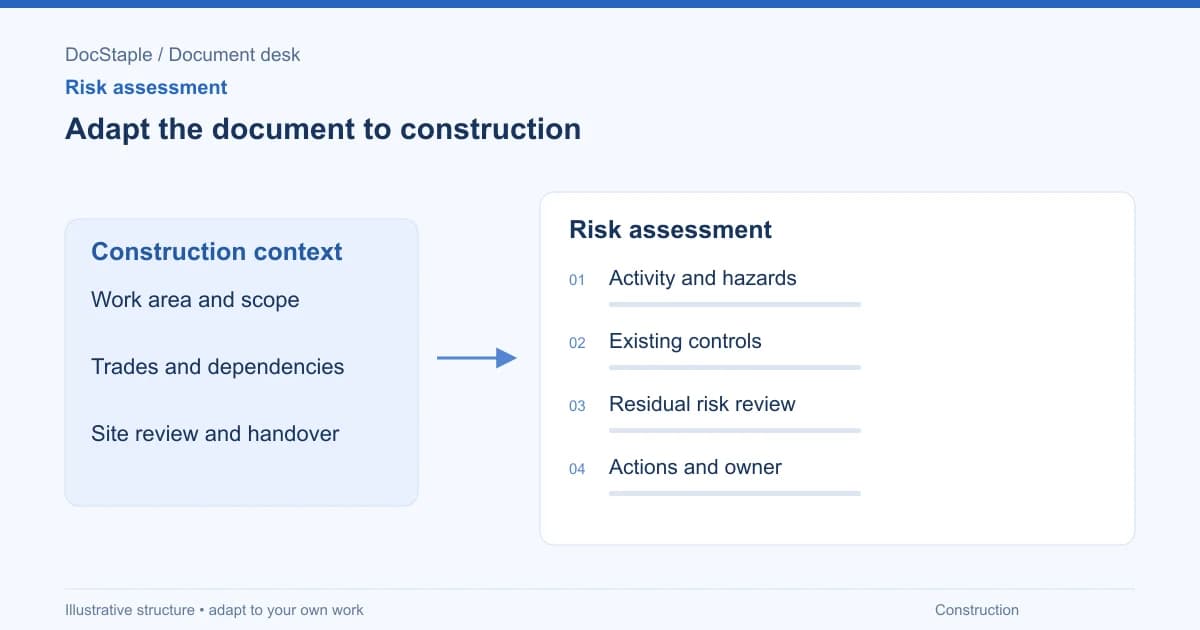
A construction risk assessment should describe the real activity, not a generic hazard list. It should show what can go wrong, which controls already exist, what risk remains, what further action is needed, and who has authority to accept or stop the work. A good assessment is uncomfortable in the right way: it exposes assumptions before the crew is on site.
This guide uses a realistic scenario: a subcontractor on a commercial fit-out project will install overhead services in a corridor while other trades are working nearby. The task involves access equipment, electrical interface, material movement, coordination with other trades and inspection before closeout. Adapt the structure to your jurisdiction and project. OSHA says construction includes high-hazard activities and lists examples such as falls, struck-by equipment, electrocutions, silica dust and asbestos (OSHA construction industry).
Define the activity and people affected
Start with a precise activity statement. "Fit-out works" is too broad. "Install overhead cable tray and associated supports in Level 2 east corridor before ceiling closure" is specific enough to assess.
Draft language:
Activity: Install overhead cable tray and supports in Level 2 east corridor of the commercial fit-out project. People affected: electrical subcontractor crew, adjacent mechanical trade, site visitors under escort, site manager, cleaners working after hours, and client representatives attending inspections. Assessment limits: this assessment covers installation and inspection only; energization and commissioning are covered by separate approved procedures.
The assessment should also list supporting records: approved drawings, permits, site induction requirements, access equipment inspection, coordination plan, and any method statement or safe work procedure. OSHA's hazard prevention guidance recommends reviewing sources such as OSHA standards and guidance, NIOSH publications, manufacturer literature and engineering reports to identify controls (OSHA hazard prevention and control).
Review criteria:
- The activity has a clear start and finish.
- People affected include other trades and visitors, not only the crew.
- Assessment limits are stated.
- Required records are current.
- Specialist topics are routed to competent reviewers.
Identify hazards and credible events
A useful construction risk assessment describes credible events, causes and consequences. Do not stop at nouns like "falls" or "electricity." Say what could happen in this activity.
Example hazard entries:
| Hazard | Credible event | Possible consequence |
|---|---|---|
| Working at height | Worker overreaches from access platform while fixing tray support | Fall or strain injury |
| Struck-by | Materials carried through active corridor contact another trade | Injury or property damage |
| Electrical interface | Crew works near unidentified live service | Shock or work stoppage |
| Coordination | Mechanical trade enters area during overhead fixing | Dropped object exposure |
OSHA's Construction Focus Four materials address major construction hazard groups including falls, struck-by, caught-in/between and electrocution (OSHA Focus Four training). Use that as a prompt, not as a complete assessment. Your project may also involve permits, hazardous materials, confined spaces, hot work, lifting plans, noise, dust or public interface.
Concrete failure mode: copying a standard hazard list and leaving out the most important project-specific risk, such as client staff walking through the work area during a phased handover.
Record existing controls honestly
Existing controls are controls already in place and verified. Planned controls go in the action plan. This distinction matters because a risk rating that assumes future controls can make unsafe work look acceptable.
Draft language:
Existing controls: site induction completed for named crew; Level 2 corridor work area shown on daily coordination plan; access platform inspection tag current; approved drawing revision C issued; exclusion zone barriers available at the workface; site manager has confirmed no client access through the corridor during planned work window.
Do not write "PPE to be worn" as if it resolves every hazard. OSHA's hazard prevention guidance points users to the hierarchy of controls and says interim controls may be necessary, but the overall goal is effective long-term control (OSHA hazard prevention and control). For construction drafting, that means considering elimination, substitution, engineering and administrative controls before relying on PPE alone.
Review criteria:
- Each existing control is observable or evidenced.
- Controls are linked to specific hazards.
- Planned actions are not counted as current protection.
- Control owners are named.
- Controls match the site and work sequence.
Review residual risk and actions
Residual risk is the exposure left after existing controls. The method can be numeric, descriptive or matrix-based, but it must be understood before people rate the work. An unexplained score is not evidence that work is safe.
Draft language:
Residual risk review: After existing controls, overhead fixing remains medium risk because the work occurs above a shared corridor and depends on maintaining the exclusion zone. Further action: site manager to confirm corridor closure in the daily briefing and record barrier check before work starts. Owner: site manager. Due: before shift start. Evidence: daily briefing record and barrier photo.
The action plan should be practical:
| Further action | Owner | Due | Evidence | Status |
|---|---|---|---|---|
| Confirm corridor closure in daily coordination briefing | Site manager | Before shift | Briefing record | Open |
| Verify access platform inspection tag | Trade supervisor | Before use | Photo in project record | Open |
If an action is required before work starts, say so. If work can proceed with a restriction, record the restriction. If the remaining risk is not acceptable, the assessment should stop the task rather than soften the wording.
Show approval and review triggers
Construction risk assessments need active approval from the responsible decision maker. They also need review triggers because the site changes quickly.
Draft language:
Approval check: The site manager and trade supervisor review residual risks and required controls before authorizing the work. Work does not start until actions marked "before start" are complete. Reassess after design change, change in work area, incident, near miss, control failure, new subcontractor crew, permit change or client access change.
Operational review criteria:
- Residual risks are visible to the approver.
- Actions have owners, due points and evidence.
- Restrictions are communicated to affected trades.
- Approval names a role and date.
- Review triggers reflect construction realities.
- The assessment aligns with the method statement, SOP, permits and current drawings.
OSHA's job hazard analysis publication says hazard analysis information is useful only if controls are incorporated into the tasks (OSHA Job Hazard Analysis). That is the final test: can someone see the controls in the actual work plan, briefing and supervision?
Approval check and template use
Before issuing the assessment, ask the site manager, trade supervisor and competent reviewer to walk through the task as planned. Ask: what changed since the assessment was drafted, who else is exposed, which controls are already verified, what must happen before work starts, and who can stop or restart the job?
Also check evidence timing. If the assessment relies on a permit, inspection tag, daily briefing or drawing revision, the approver should know where that evidence is before work begins. Construction assessments often look complete on paper while the proof sits in separate site systems, text messages or supervisor notebooks. Bring those records together or reference them clearly enough that a later reviewer can reconstruct the decision.
The construction risk assessment template provides an editable Word structure for activity and people affected, hazards and existing controls, evaluation and further action, approval and review. Use it as a working draft, then replace the sample text with project-specific records, drawings, permits, evidence and approval roles.
Last updated: September 26, 2026
Frequently Asked Questions
Related Articles
Audit Checklist Best Practices
Best practices for audit checklists, including scope, evidence, findings, actions, closure review, failure modes and sample wording.
Audit Checklist Checklist: Review Your Audit Form Before You Use It
A practical audit checklist checklist with decision gates for scope, evidence, findings, actions and closure review.
Audit Checklist Examples: Scope, Evidence, Findings and Closure
Audit checklist examples for consulting work, covering audit scope, evidence to inspect, findings and actions, closure review and practical draft wording.
Business Continuity Plan Best Practices for Consulting Teams
Business continuity plan best practices for consulting teams, including critical services, recovery priorities, communications, exercises and review criteria.
Business Continuity Plan Checklist for Consulting Teams
A practical business continuity plan checklist for consulting work, covering critical services, recovery priorities, communications, exercises and review criteria.
Business Continuity Plan Examples: Consulting Scenarios and Recovery Priorities
Business continuity plan examples for consulting teams, with critical services, recovery priorities, communications, exercises and review criteria.