How to Write a Construction Service Agreement: Responsibilities, Terms and Review
How to write a construction service agreement for a commercial fit-out support service, with draft language for responsibilities, commercial terms, termination, renewal and counsel review.
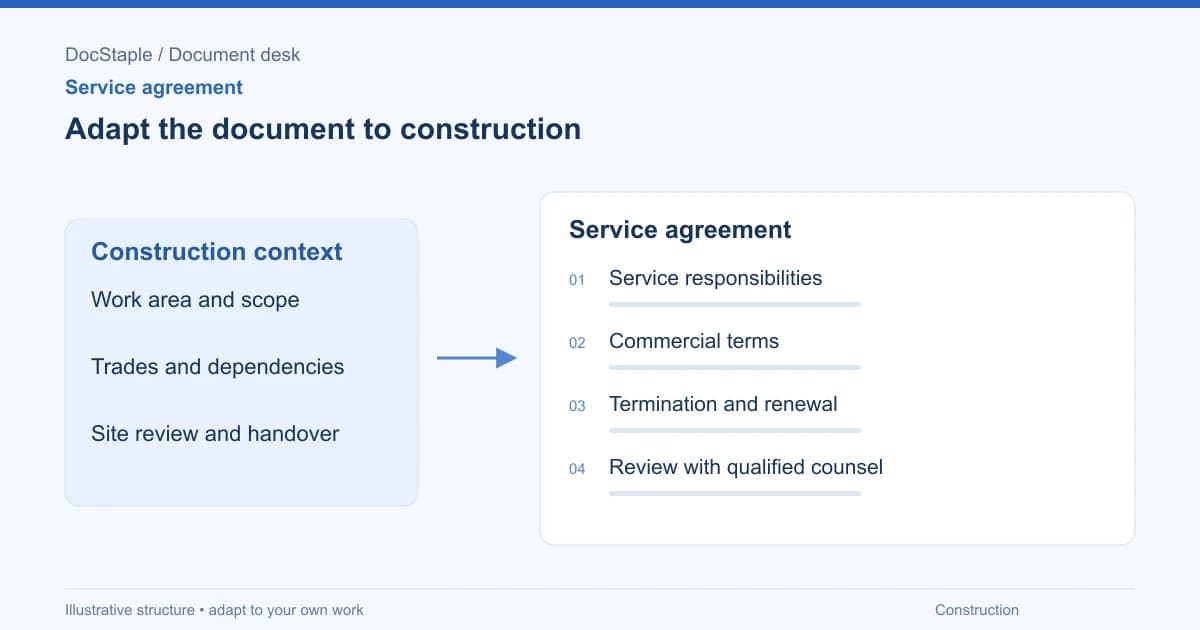
A construction service agreement has to be practical on site and precise enough for a dispute. If it only says "provide services as required", it will not help the site manager, the subcontractor or the person approving invoices. If it tries to become a full construction contract without legal review, it can create a different problem.
This guide uses a fictional scenario: a contractor is providing recurring closeout and small-works support during a commercial office fit-out. The services include scheduled defect checks, coordination with the site manager and a site completion pack. The project is in the United States for examples that reference U.S. federal contract sources, but private construction requirements vary by state and project. Treat the language as drafting illustration, not legal advice.
Identify Parties, Site And Service Boundaries
Open with the parties and site. Use legal names, not shorthand brand names.
This service agreement is between [provider legal name and address] and [client legal name and address] for services at [project name and site address]. The client's authorized representative is [name and title]. The provider's authorized representative is [name and title].
Then state the service boundary:
The provider will perform the services listed in Schedule 1 for the commercial fit-out project. The services support site closeout and minor defect coordination. They do not include design services, structural work, permit applications, hazardous material removal, or work outside the approved drawings unless added by written change.
Federal Acquisition Regulation guidance for service statements of work says service orders should include work description, location, period of performance, deliverable schedule, performance standards and special requirements (FAR 8.405-2). That rule governs federal orders, not your private agreement, but it is a useful completeness check for any service scope.
Write Service Responsibilities In Site Language
Responsibilities should tell the field team what to do. Avoid abstract phrases like "support the project".
Weak draft
Contractor will provide construction support services as needed.
Stronger draft
Provider responsibilities
- Attend the weekly site coordination meeting when closeout items are on the agenda.
- Inspect listed closeout items in zones [x] and [y] against approved drawings [numbers and revisions].
- Record each open item with location, description, photo reference if permitted, responsible trade and target date.
- Issue a weekly closeout summary to [site manager] by [day and time].
- Compile the site completion pack listed in Schedule 2.
Client responsibilities
- Provide site access during [hours].
- Maintain the current approved drawing set and trade contact list.
- Confirm decisions on disputed closeout items within [number] business days.
- Coordinate landlord or building-management approvals where required.
Annotate the wording:
- Drawing numbers and revisions prevent the team from using the wrong baseline.
- Weekly issue timing supports invoice and site coordination.
- Client decisions are timed because unresolved closeout items can delay completion.
- Landlord approvals are not silently assigned to the provider.
The Department of the Interior service-contract checklist asks whether a statement of work has a clear-cut division of responsibility between contracting parties (DIAR 1437.1). For construction services, that question is not bureaucratic. It is the difference between "we thought you owned that" and a usable site record.
Set Commercial Terms Without Hiding Legal Terms
Commercial terms should be clear enough for billing and reviewed enough for legal effect.
Charges. Services are charged at [fixed monthly fee, hourly rates or task prices], as set out in Schedule 3. Invoices are issued [frequency] and are payable [payment period] after receipt of a correct invoice.
Disputed amounts. The client must identify any disputed invoice amount in writing within [number] days, stating the reason and the affected line item. Undisputed amounts remain payable by the due date.
Changes. Work outside Schedule 1 requires written approval stating the changed work, price and schedule effect before the provider starts the changed work, unless emergency procedures in Section [x] apply.
Do not casually draft indemnity, limitation of liability, insurance, warranty, lien, delay damages or governing-law clauses. Those provisions vary by jurisdiction and can have serious consequences. Instead, mark them for counsel:
Legal terms for counsel review. Insurance, indemnity, warranties, limitation of liability, lien rights, governing law, dispute resolution and safety obligations must be reviewed by qualified counsel for the project jurisdiction before signature.
For U.S. federal contracts, FAR Part 43 explains policies and procedures for preparing and processing contract modifications, including construction and architect-engineer contracts (FAR Part 43). A private service agreement is different, but the drafting lesson is useful: a change should identify the affected work and be processed as a modification to the baseline, not as an informal side promise.
Cover Term, Termination And Renewal
Term and termination wording should answer practical questions: when the agreement starts, when it ends, how notice is given, what happens to open work and what remains payable. Use counsel for jurisdiction-specific legal wording.
Draft structure:
Term. This agreement starts on [date] and continues until [date or event], unless ended earlier under Section [x]. The parties may renew it only by written agreement signed by authorized representatives.
Termination for convenience. Either party may request termination for convenience by giving [number] days' written notice. Counsel should confirm whether this clause is suitable for the project and jurisdiction.
Effect of termination. On termination, the provider stops new work, protects site records in its possession, returns or transfers client materials as instructed, and submits a final invoice for approved services performed up to the termination date, subject to the agreement.
The U.S. Government Accountability Office explains that when a government contract is terminated, the contracting officer usually provides written notice including the effective date and whether termination is whole or partial (GAO). That is U.S. federal-contract context, not private construction law, but the practical point transfers: termination needs a date, scope and closeout process.
Add Approval Checks Before Signature
Before issuing the agreement, check:
- Legal names and addresses match company records.
- Site address and project name are correct.
- Scope references current approved drawings and schedules.
- Provider and client responsibilities are separated.
- Price basis, invoice timing and dispute process are stated.
- Change process covers work, cost and schedule effect.
- Term, renewal and termination have been reviewed by counsel.
- Insurance, indemnity, safety and lien wording are jurisdiction-appropriate.
- Signature blocks identify authorized representatives.
Use a short approval statement:
By signing, each party confirms that its signer is authorized to bind the party and that the attached schedules reflect the agreed services, responsibilities, commercial terms and review status.
Add a document-control line as well:
This agreement consists of the main terms, Schedule 1 services, Schedule 2 deliverables, Schedule 3 charges and any exhibits listed below. If a schedule is revised before signature, the revision number and date must be updated before either party signs.
That sentence sounds simple, but it prevents a common construction problem: the parties sign one document while different teams rely on different schedules. If the service agreement incorporates drawings, specifications or a separate scope, identify the exact revision. If a drawing is superseded after signature, use the agreed change process rather than silently swapping the reference.
Start From An Editable Structure
The construction service agreement template is an editable Word file with sections for parties and services, responsibilities, commercial terms, termination, renewal, review and execution. It is a starting draft. It does not guarantee enforceability, legal compliance or suitability for any state, country or project type.
Last updated: September 26, 2026
Frequently Asked Questions
Related Articles
Capability Statement Best Practices for Consulting Firms
Capability statement best practices for consulting firms, with fixes for vague competencies, weak past performance, generic differentiators and stale credentials.
Capability Statement Checklist for Buyer-Ready Consulting Drafts
A capability statement checklist for consulting firms, with review gates for core competencies, relevant experience, differentiators, credentials and contact details.
Capability Statement Examples: Four Sections Written Weak and Then Strong
Capability statement examples for a fictional consulting firm: core competencies, relevant experience, differentiators, and contact and credentials, each shown as weak and stronger draft wording with a review checklist.
Engagement Letter Best Practices
Best practices for engagement letters, including scope control, responsibility wording, limitation language and approval records.
Engagement Letter Checklist
Use this engagement letter checklist to review purpose, parties, responsibilities, limitations, approval and signature readiness.
Engagement Letter Examples: Purpose, Scope Limits and Signatures
Engagement letter examples for consulting work, with annotated wording for parties, responsibilities, scope limitations, approval and signatures.