How to Write a Consulting Service Agreement for a Retainer
How to write a consulting service agreement for a practical retainer scenario, including responsibilities, commercial terms, termination, renewal and approval checks.
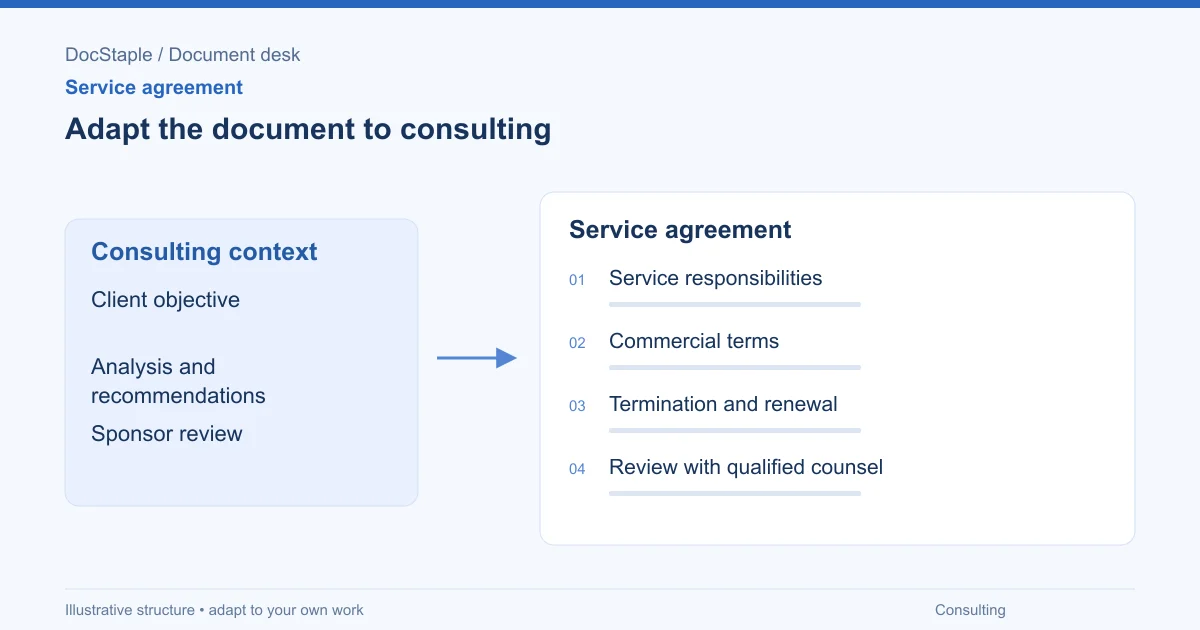
Writing a consulting service agreement is easier when you stop trying to cover every possible engagement and draft for the real one in front of you. This walkthrough uses a practical scenario: a consulting firm has completed a strategy review and will now provide a three-month operating cadence retainer for the client's leadership team.
The consultant is not implementing the recommendations, hiring staff or configuring systems. The service is advisory: prepare meeting materials, run monthly review calls and maintain a decision log. The examples below are drafting language, not legal advice. Contract requirements and enforceability vary by jurisdiction, so have qualified counsel review the agreement before it is signed.
Step 1: Name the parties and the real service
Start with legal identity and a short service purpose. Do not open with a long recital about partnership or transformation.
Draft language
This Consulting Service Agreement is between [Consultant legal name] and [Client legal name]. Consultant will provide advisory support for the operating cadence created from the strategy review dated [date]. The services are limited to the activities in Schedule 1.
Approval check: Confirm legal names, addresses, entity types and signer authority. If the client has multiple entities, ask which one receives the service and pays invoices.
Then add the practical context:
The intended outcome is a repeatable monthly leadership review supported by a decision log, issue list and advisory memo. Consultant does not make management decisions for Client.
That final sentence matters. Consulting advice can influence decisions, but the client still owns them unless the parties agree otherwise.
Step 2: Define service responsibilities and client inputs
Use a two-column responsibility table. It makes hidden assumptions visible.
Draft language
| Consultant responsibilities | Client responsibilities |
|---|---|
| Prepare one monthly advisory memo of up to [number] pages | Provide agreed operating data by [day] of each month |
| Facilitate one monthly leadership review call of up to [duration] | Ensure sponsor and decision owners attend or send delegates |
| Maintain a decision and action log | Review the log within [number] business days |
| Flag risks or unsupported assumptions identified during the retainer | Decide whether to accept, defer or reject recommendations |
Approval check: Read each row aloud and ask, "Can someone prove whether this happened?" If not, rewrite it.
FAR 8.405-2 says federal statements of work for certain service orders include work to be performed, location, period of performance, deliverable schedule, performance standards and special requirements when applicable (Acquisition.GOV, FAR 8.405-2). Your consulting agreement may be private and not subject to that rule, but the checklist is a useful way to test whether responsibilities are concrete.
Step 3: Write commercial terms without hiding the hard parts
Commercial terms should cover fees, billing, expenses, taxes, late payment, disputed amounts and extra work. Keep the language direct.
Draft language
Client will pay [currency and amount] per month, invoiced monthly in advance and due [number] days after invoice date. The fee includes the services in Schedule 1. Travel or out-of-pocket expenses require Client's written approval before they are incurred. Taxes are handled according to applicable law in [jurisdiction].
If Client disputes an invoice, Client will notify Consultant in writing within [number] days, describe the disputed amount and pay undisputed amounts when due.
Approval check: Make sure the billing method matches the work. A fixed monthly retainer is risky if the service list can expand without written approval.
Add change language:
Work outside Schedule 1 requires a written change that states the added service, fee, timing and effect on current responsibilities. Consultant is not required to start changed work until both parties approve the change.
The FTC advises small businesses to take time to read contracts, get terms in writing and keep the full document, especially when signing electronically (FTC small business contract alert). That warning came from payment-processing contracts, but it is directly relevant to service-agreement drafting: commercial terms should not depend on a sales call memory.
Step 4: Cover confidentiality and information handling
Consulting retainers often involve management data, personnel issues and client strategy. Confidentiality language should be operational, not decorative.
Draft language
Consultant will use Client confidential information only to perform the services and will limit access to personnel who need it for the engagement. Client will not provide regulated personal data, health information or payment-card data unless the parties first agree the required safeguards in writing.
Approval check: Ask what data will actually be shared. If sensitive information is involved, attach specific security, access and deletion requirements.
The FTC's business guidance on service providers says security expectations, performance standards and monitoring methods should be put in writing when a service provider has access to sensitive information (FTC business guidance). Do not promise controls your firm does not operate.
Step 5: Write term, termination and renewal
The term clause should say when the agreement starts, when it ends and how it renews. The termination clause should say how a party exits and what happens after exit.
Draft language
The agreement starts on [date] and ends on [date]. It renews only if both parties sign a written renewal before the end date.
Either party may terminate for convenience on [number] days' written notice. Client will pay fees earned and approved expenses incurred through the termination date. Consultant will provide completed advisory memos and the current decision log after payment of undisputed amounts.
Approval check: Confirm whether the business wants automatic renewal. If yes, counsel should review renewal notice and cancellation requirements for the governing jurisdiction.
For breach:
Either party may terminate for material breach if the breach is not cured within [number] days after written notice describing the breach in reasonable detail.
Keep remedies, liability limits and dispute clauses out of casual drafting. They need qualified review.
Step 6: Run legal and operational review
Before signature, check two things. First, can operations administer the agreement? Second, can counsel accept the legal-risk wording?
- Operational review: services, schedule, client inputs, meeting limits, deliverables and change process.
- Commercial review: fee, invoice dates, taxes, expenses, late payment and disputed invoices.
- Legal review: governing law, confidentiality, IP, liability, warranties, indemnity, termination, dispute process and signer authority.
- Document review: no old client names, no unresolved comments, no unaccepted tracked changes.
Microsoft Support explains that Word reviewers can accept or reject tracked changes and move through them in sequence (Microsoft Support). Before sending a signature copy, accept or reject changes intentionally and remove drafting comments that should not leave the firm.
One useful final pass is to read the agreement from the client's side. Ask what the client must do in the first ten business days after signature. If the answer is scattered across services, fees and attachments, add a short kickoff clause:
Within [number] business days after signature, Client will identify the sponsor, provide the agreed data sources and confirm the first leadership review date. Consultant will confirm the working file location, communication route and first advisory memo timetable.
This clause is not a legal replacement for the rest of the agreement. It simply turns the signed document into a first set of operating instructions, which is often what prevents a clean agreement from stalling after approval.
Start from an editable structure
The consulting service agreement template includes editable Word sections for parties and services, service obligations and client inputs, commercial provisions, term, termination, disputes and approval. Use it as a drafting frame for your retainer, then have the jurisdiction-specific legal terms reviewed before anyone signs.
Sources: FAR 8.405-2, Acquisition.GOV, FTC small business payment-processing contract alert, FTC service provider security guidance, Track changes in Word, Microsoft Support
Last updated: September 26, 2026
Frequently Asked Questions
Related Articles
Capability Statement Best Practices for Consulting Firms
Capability statement best practices for consulting firms, with fixes for vague competencies, weak past performance, generic differentiators and stale credentials.
Capability Statement Checklist for Buyer-Ready Consulting Drafts
A capability statement checklist for consulting firms, with review gates for core competencies, relevant experience, differentiators, credentials and contact details.
Capability Statement Examples: Four Sections Written Weak and Then Strong
Capability statement examples for a fictional consulting firm: core competencies, relevant experience, differentiators, and contact and credentials, each shown as weak and stronger draft wording with a review checklist.
Engagement Letter Best Practices
Best practices for engagement letters, including scope control, responsibility wording, limitation language and approval records.
Engagement Letter Checklist
Use this engagement letter checklist to review purpose, parties, responsibilities, limitations, approval and signature readiness.
Engagement Letter Examples: Purpose, Scope Limits and Signatures
Engagement letter examples for consulting work, with annotated wording for parties, responsibilities, scope limitations, approval and signatures.