How to Write a Business Continuity Plan for Consulting Work
A practical guide to writing a business continuity plan with critical services, recovery priorities, communications, workarounds, exercises and review.
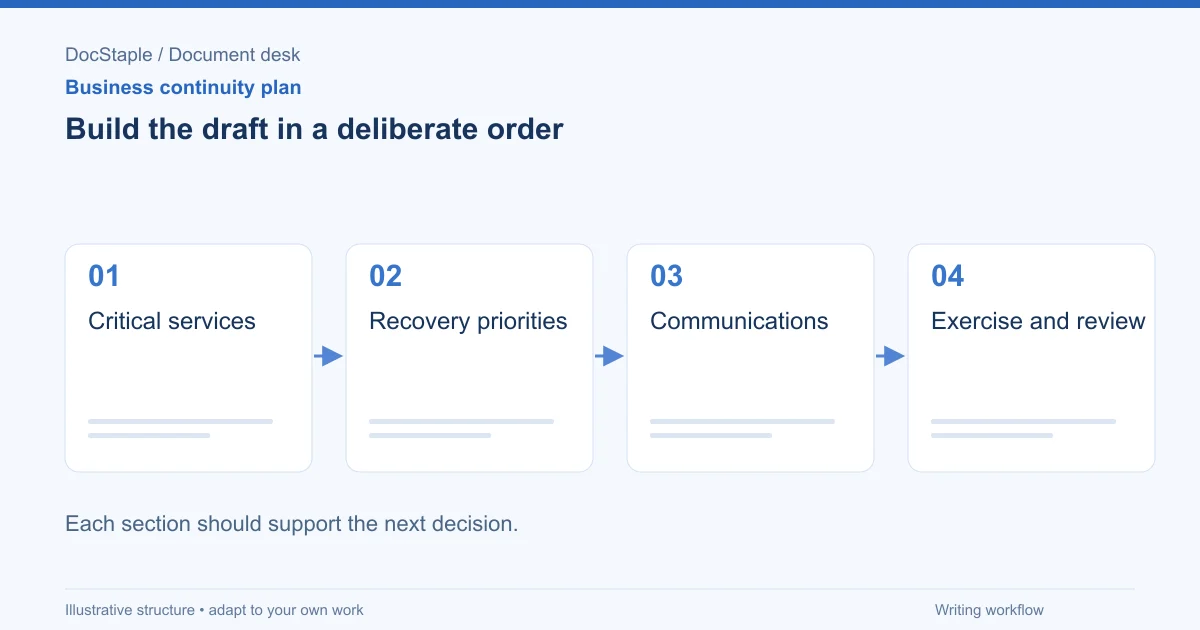
A business continuity plan explains how important work continues or recovers when normal arrangements fail. It is not a list of every bad thing that could happen. It is a practical plan for preserving critical services, choosing recovery priorities, communicating with the right people, using tested workarounds, and improving the plan after exercises.
This guide uses a consulting scenario: a strategy review engagement is two weeks from a board workshop. The team depends on interview notes, a recommendations report, the project repository, senior reviewer availability and the client sponsor's approval. A useful plan tells the team what to do if a system outage, key-person absence, confidentiality incident or office disruption threatens delivery.
Define critical services
Write the plan around critical services, not assets. Ready.gov says a business impact analysis predicts consequences of disruption and gathers information needed to develop recovery strategies (Ready.gov business impact analysis). For consulting, the critical service is rarely "email." It is more likely "maintain client communication and issue approved deliverables."
Draft language:
Critical service: maintain delivery of the strategy review engagement at a minimum acceptable level. Minimum acceptable operation: the engagement lead can contact the client sponsor, the team can access the latest approved scope and recommendations draft, and the client receives an approved status update if a scheduled milestone is affected.
Identify dependencies:
| Critical service | Dependencies | Minimum level |
|---|---|---|
| Client communications | sponsor contact list, engagement lead, backup approver | approved update within agreed window |
| Recommendations report | latest draft, evidence table, senior reviewer | draft preserved and review route confirmed |
| Discovery interviews | calendar, interview guide, secure notes location | interviews proceed, reschedule or pause by decision |
Review criteria: each service should be tied to a deliverable, obligation, person or decision. If it is only a system name, ask what business activity the system supports.
Set recovery priorities
Recovery priorities answer "what comes first?" during disruption. Ready.gov notes that IT disaster recovery should be developed with the business continuity plan (Ready.gov emergency plans). That matters because restoring every system at once may not match business urgency.
For the consulting scenario, a sensible sequence might be:
- Protect people and confidential client material.
- Establish activation authority and communication route.
- Confirm client-facing commitments due in the next 48 hours.
- Restore access to the latest approved scope, evidence table and report draft.
- Resume lower-priority internal reporting.
Draft language:
Recovery priority: if the project repository is unavailable, the engagement lead first confirms whether any confidential material was exposed or lost, then activates the approved backup contact route, then verifies the latest controlled copy of the recommendations draft before rescheduling non-critical internal work.
Avoid unsupported recovery promises. A plan can include desired recovery targets only after the responsible owner confirms they are realistic. NIST's contingency planning guide, written for U.S. federal information systems, uses business impact analysis and recovery strategies as part of contingency planning (NIST SP 800-34 Rev. 1). The broader lesson is to base recovery priorities on impact and dependencies.
Write activation and communication rules
Someone must be able to activate the plan. The plan should also say who approves messages, especially when clients, staff, suppliers or regulators may be involved.
Draft language:
Activation authority: the engagement lead activates this plan for disruptions affecting client milestones, project records, confidentiality or team availability. If the engagement lead is unavailable, the operations director may activate it. Client-facing messages must be approved by the engagement lead or operations director. Suspected confidentiality incidents are routed to the designated privacy or contract contact before external notification decisions are made.
Communication table:
| Audience | Message owner | Backup channel | Approval |
|---|---|---|---|
| Client sponsor | Engagement lead | phone or approved alternate email | engagement lead or operations director |
| Project team | Senior consultant | messaging app or phone tree | engagement lead |
| Subcontractor | Project manager | phone | engagement lead |
Review criteria: contact details need an accessible backup. Do not store the only copy of the continuity contact list inside a system that may be unavailable during the disruption.
Describe workarounds and recovery steps
A workaround should be tested and limited. It is not enough to say "use backup files." Say who creates them, where they are stored, when they are refreshed, who can access them, and what work is allowed while normal systems are unavailable.
Draft language:
Workaround: the engagement lead maintains an approved continuity folder containing the current scope summary, sponsor contact route, latest recommendations draft and recovery checklist. The folder is refreshed after each senior review. While using the continuity folder, the team may prepare status updates and preserve work, but it may not circulate new confidential interview notes outside the approved repository unless the designated reviewer authorizes the method.
Recovery steps:
- Confirm disruption type and affected critical services.
- Activate the plan and record the time.
- Contact named roles through backup route.
- Apply the relevant workaround.
- Record decisions, restrictions and client updates.
- Reconcile any offline work when normal systems return.
- Close the disruption record only after the owner confirms recovery.
Review criteria: every workaround should include owner, access method, permitted use, limits and reconciliation.
Exercise and review the plan
NIST says contingency plans should be kept ready by training personnel, exercising plans to validate content, and testing systems or components for operability (NIST SP 800-34 Rev. 1). You can apply that principle without turning a small consulting plan into a heavy compliance program.
Run a tabletop exercise:
Scenario: the project repository becomes unavailable four hours before the senior review meeting, and the engagement lead is traveling. The team must activate the plan, identify the current recommendations draft, decide whether to move the review, and send an approved client update if the milestone is affected.
Exercise record:
| Issue found | Action | Owner | Due |
|---|---|---|---|
| Backup contact list missing subcontractor phone | Update contact list | Project manager | 2 Oct 2026 |
| Continuity folder had old scope summary | Add refresh check after every scope change | Engagement lead | 2 Oct 2026 |
Review triggers:
- New client sponsor.
- Scope change.
- New project repository.
- Key role change.
- Confidentiality incident.
- Failed exercise.
- Major supplier or system change.
Approve and maintain the plan
Approval should confirm that the plan reflects real authority, current contacts and tested workarounds. Do not treat silence as acceptance.
Operational review criteria:
- Critical services are business activities, not only systems.
- Recovery priorities are justified by impact.
- Activation authority includes backups.
- Communication messages have owners and approval rules.
- Workarounds are tested and limited.
- Exercises produce actions and updates.
- The plan has an owner, approval date and next review.
The consulting business continuity plan template provides an editable Word structure for critical activities and priorities, activation and communication, workarounds and recovery, exercises, maintenance and approval. Use it as a starting draft, then replace the examples with verified services, contacts, records and decision roles.
Finally, keep the issued plan accessible in more than one approved place. If the only copy is stored inside the same repository named as a critical dependency, the team may lose the plan exactly when it is needed. Record where the controlled copy lives, where the contingency copy lives, and who is responsible for keeping both aligned after updates.
Last updated: September 26, 2026
Frequently Asked Questions
Related Articles
Audit Checklist Best Practices
Best practices for audit checklists, including scope, evidence, findings, actions, closure review, failure modes and sample wording.
Audit Checklist Checklist: Review Your Audit Form Before You Use It
A practical audit checklist checklist with decision gates for scope, evidence, findings, actions and closure review.
Audit Checklist Examples: Scope, Evidence, Findings and Closure
Audit checklist examples for consulting work, covering audit scope, evidence to inspect, findings and actions, closure review and practical draft wording.
Business Continuity Plan Best Practices for Consulting Teams
Business continuity plan best practices for consulting teams, including critical services, recovery priorities, communications, exercises and review criteria.
Business Continuity Plan Checklist for Consulting Teams
A practical business continuity plan checklist for consulting work, covering critical services, recovery priorities, communications, exercises and review criteria.
Business Continuity Plan Examples: Consulting Scenarios and Recovery Priorities
Business continuity plan examples for consulting teams, with critical services, recovery priorities, communications, exercises and review criteria.