How to Write a Capability Statement: Competencies, Experience and Proof
How to write a capability statement for consulting buyers, with practical wording for core competencies, relevant experience, differentiators, credentials and contact details.
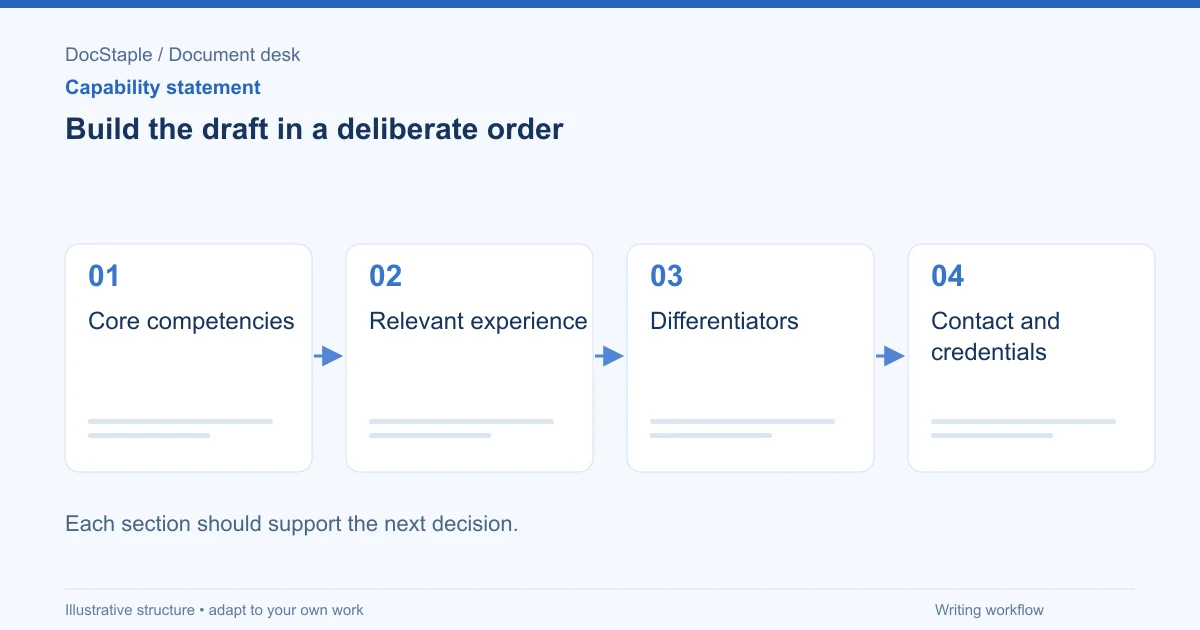
A capability statement is a buyer-facing snapshot of what your business can do. It is not a brochure, a resume or a proposal. Its job is to help a procurement lead, prime contractor or client sponsor quickly decide whether your firm looks relevant enough for the next conversation.
This guide uses a consulting example: a small advisory firm wants to pursue operational improvement work with public agencies and mid-sized logistics companies. The same structure can work for many services, but the evidence and identifiers should change for the buyer and jurisdiction.
Lead With Buyer-Relevant Core Competencies
Core competencies are not everything you have ever done. They are the specific capabilities that match the buyer's need.
The U.S. Department of Veterans Affairs capability statement packet says core competencies should relate the company's expertise to the agency's specific needs and should not list everything the firm can do (VA OSDBU Capabilities Statement Packet). That is the most important discipline in the whole document.
Weak draft
We provide consulting, strategy, operations, transformation, innovation, workshops, analytics, change management and advisory services.
This is a keyword pile. It does not tell the buyer where you are strongest.
Stronger draft
Core competencies
- Operational process review for service and logistics teams.
- Stakeholder interview design and evidence-based findings.
- Recommendations reports that compare practical implementation options.
- Project governance support for sponsor decisions and action tracking.
Each bullet is specific enough to connect with a procurement scope. If the target buyer is a government agency, use the language of the solicitation or agency need where accurate. Do not stuff the page with unrelated terms.
Show Relevant Experience Without Inventing Outcomes
Relevant experience should prove capacity and fit. It should not invent results you cannot substantiate.
Selected relevant experience
Regional distribution process review - Reviewed handoffs between customer service, warehouse and transport teams for a regional logistics operator. Delivered a recommendations report with process map, evidence log and priority actions.
Public-sector service intake assessment - Conducted stakeholder interviews and document review for a service intake team. Delivered findings summary and decision options for sponsor review.
Implementation readiness review - Assessed whether proposed operational changes had owners, dependencies and measurement plans before rollout.
Annotate your examples:
- Use client names only with permission.
- Replace precise claims with verified outcomes only.
- State your role, not the entire project if others delivered part of it.
- Keep confidential details out of the document.
The VA packet advises listing past customers for whom the business has done similar work and prioritizing related agency, federal, government and then commercial work when targeting government opportunities (VA OSDBU Capabilities Statement Packet). The hierarchy may differ for private buyers, but relevance still beats volume.
Write Differentiators That Are Actually Different
Most differentiator sections are weak because they say "quality", "experienced team" and "customer focus." Those are not differentiators unless you show how they change the buyer's outcome.
Weak draft
We are client-focused, flexible and committed to excellence.
Stronger draft
Differentiators
- Evidence log included with each recommendations report, so sponsors can trace findings to interviews or documents.
- Consulting deliverables written for executive decisions, with options, assumptions, risks and required approvals separated.
- Experience translating ambiguous service problems into scoped review plans before implementation work begins.
The VA packet asks differentiator questions such as how the company is best suited for the agency's needs and what about its people, services or products gives it an advantage (VA OSDBU Capabilities Statement Packet). Use those questions as a filter. If a competitor could paste the same sentence into their document, rewrite it.
Include Company Data, Credentials And Contact Details
The practical details matter because buyers may use them to route opportunities or check eligibility.
Include:
- Legal business name.
- Website.
- Primary contact name, email and phone.
- Service area.
- Business size, if relevant and verifiable.
- Procurement identifiers, such as UEI, CAGE, NAICS or local registration numbers where relevant.
- Certifications, licenses or memberships only if current and applicable.
The Washington Office of Minority and Women's Business Enterprises describes federal capability statement elements as company data, core competencies, experience and contact information, with state and local statements often adding differentiators and past performance (Washington OMWBE). That is event guidance, not a universal rule, but it matches what buyers need to scan quickly.
Use a verification pass before distributing:
Verification note: Confirmed [UEI or registration], [certification], [insurance statement if included] and contact details on [date]. Removed expired certification reference.
Do not include "fully compliant", "certified" or "approved vendor" unless you can prove exactly what that means.
Adapt The Statement To The Opportunity
You may need more than one capability statement. A logistics buyer and a public health agency may both need process review, but the examples and terms should differ.
For each target, adjust:
- Opening summary.
- Core competency order.
- Relevant experience examples.
- Codes and keywords.
- Differentiators.
- Contact or business development owner.
Do not change facts to flatter the buyer. Change emphasis. If the buyer asks for onboarding process improvement, put that experience first. If the buyer asks for governance support, lead with decision records, status reporting and sponsor alignment.
Here is a practical adaptation pass. Start with your master statement, then mark every sentence with one of three labels: keep, move down or remove. Keep sentences that match the opportunity. Move down useful but secondary proof. Remove claims that are true but irrelevant.
For a buyer seeking customer onboarding improvement, your opening might be:
[Firm] helps service organizations diagnose onboarding delays, map handoffs and turn findings into sponsor-ready recommendations. Our work combines stakeholder interviews, process evidence and decision records so leaders can choose practical next steps.
For a buyer seeking governance support, the same firm might write:
[Firm] helps project sponsors create clear decision records, status reports and action tracking for operational change projects. Our deliverables show owners, assumptions, risks and approval points so teams can manage scope and next steps.
Both statements can be true. The difference is focus. The capability statement should make the buyer feel that the document was assembled for their problem, not broadcast to everyone.
Approval Check Before Sending
Run this check:
- Does the first line say what you do for this buyer?
- Are core competencies focused, not exhaustive?
- Is each experience example relevant and permission-safe?
- Are differentiators specific enough to be compared?
- Are credentials current and verifiable?
- Are procurement identifiers accurate?
- Is there one obvious contact person?
- Has confidential client information been removed?
Have someone outside the sales team read it. If they cannot tell what work you want to win after thirty seconds, the statement is too broad.
Keep the approved version dated, so outdated claims can be retired deliberately.
Start From An Editable Structure
The consulting capability statement template is an editable Word file with sections for organization and capabilities, relevant experience, differentiators, business details, contact information and approval. It is a starting structure: you provide the verified facts, and it does not guarantee acceptance by any buyer or procurement process.
Last updated: September 26, 2026
Frequently Asked Questions
Related Articles
Capability Statement Best Practices for Consulting Firms
Capability statement best practices for consulting firms, with fixes for vague competencies, weak past performance, generic differentiators and stale credentials.
Capability Statement Checklist for Buyer-Ready Consulting Drafts
A capability statement checklist for consulting firms, with review gates for core competencies, relevant experience, differentiators, credentials and contact details.
Capability Statement Examples: Four Sections Written Weak and Then Strong
Capability statement examples for a fictional consulting firm: core competencies, relevant experience, differentiators, and contact and credentials, each shown as weak and stronger draft wording with a review checklist.
Engagement Letter Best Practices
Best practices for engagement letters, including scope control, responsibility wording, limitation language and approval records.
Engagement Letter Checklist
Use this engagement letter checklist to review purpose, parties, responsibilities, limitations, approval and signature readiness.
Engagement Letter Examples: Purpose, Scope Limits and Signatures
Engagement letter examples for consulting work, with annotated wording for parties, responsibilities, scope limitations, approval and signatures.