How to Write an Employee Handbook for a Consulting Workplace
Learn how to write an employee handbook with working arrangements, conduct and reporting, leave and benefits placeholders, and local policy review.
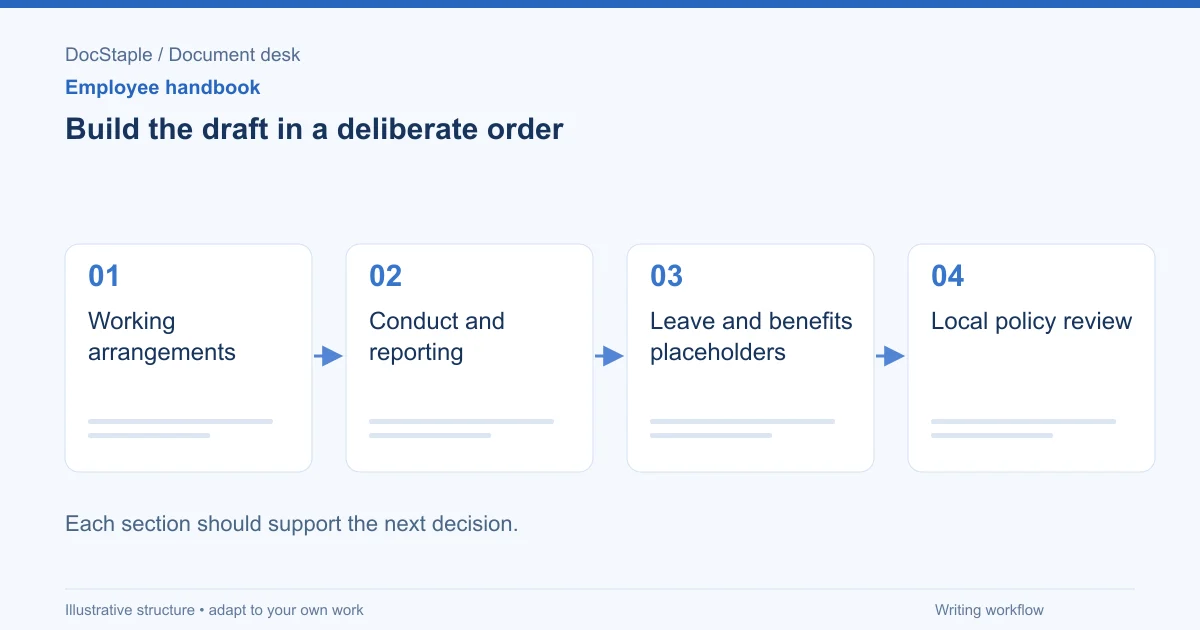
Writing an employee handbook is less about filling pages and more about making everyday employment rules clear. A useful handbook tells employees how work is arranged, how concerns are reported, where leave and benefits information comes from, and who approved the policies. A risky handbook promises things the organization does not do, copies laws from the wrong jurisdiction or buries reporting routes in vague wording.
This guide uses a consulting workplace scenario. A 35-person advisory firm has employees in two US states and a small UK client delivery team. Consultants work from home, client sites and occasional internal workshops. The firm wants one handbook that explains shared company practices while leaving room for local employment review.
Define the workplace the handbook actually covers
Start by writing the scope. Which workers, locations and arrangements does the handbook cover? A consulting firm may have employees, contractors, interns, subcontractors and partner staff. Do not treat them all as one group unless the policy truly applies to all of them.
Draft a short context section:
This handbook summarizes employment practices for employees of [Company] working in consulting delivery, operations and management roles in [locations]. It does not replace an employment contract, offer letter, benefit plan document or locally required policy. Where local law or an approved local policy gives a different right or process, the local requirement controls.
That language is not a magic shield, but it prevents the handbook from pretending to be the only source of rules. It also signals that local review is part of the process.
Review criteria:
- Does the handbook identify covered employee groups and locations?
- Does it distinguish employees from contractors where needed?
- Does it point to contracts and local policies without contradicting them?
- Does HR own the document and the update process?
Write working arrangements in operational terms
Working arrangements should answer questions employees ask weekly: where do I work, when am I expected to be available, how do I report absence, what happens at client sites, and how are remote work expectations handled?
For consulting, avoid rigid office language if the real work happens across home offices, client workshops and travel. Also avoid promising total flexibility if project commitments require availability.
Draft language:
Consultants are expected to maintain working arrangements that support client commitments, internal collaboration and wellbeing. Employees must keep their calendar current, attend agreed client and team meetings, follow client-site rules when visiting a client location, and notify their manager as soon as practicable if illness, emergency or other circumstances affect scheduled work.
Include decision points:
- Who approves remote or hybrid arrangements?
- What equipment and security rules apply?
- How are travel, client-site access and expenses handled?
- How should employees report sickness, lateness or inability to attend a client commitment?
Do not write a handbook like a contract template. Write it like a controlled internal guide. For example, "ask your manager" is too loose for absence reporting; "notify your manager and People Operations through [channel] before [time] where practicable" is more usable.
Review criterion: a new consultant should know what to do before missing a client workshop, working from a client site or requesting a change in schedule.
Cover conduct and reporting without vague promises
Conduct sections should set expectations and give reporting routes. The EEOC explains that employees should report harassment to management at an early stage to prevent escalation EEOC. The EEOC also describes promising practices that include multiple accessible reporting avenues and a prompt, impartial and thorough investigation statement EEOC promising practices. Those are US federal employment resources; state and local requirements may add more.
For consulting, conduct policies should cover internal behavior and client-facing behavior. A consultant may experience or witness misconduct at a client site, in a virtual workshop or during a project dinner. The handbook should not assume concerns happen only in the office.
Draft language:
Employees are encouraged to report conduct they believe may violate company policy, including concerns involving client meetings, travel, virtual collaboration or internal events. Reports may be made to a manager, People Operations or [alternate contact]. The company will review concerns promptly and will keep information confidential to the extent possible and consistent with a fair review.
Include:
- respectful conduct and anti-harassment expectations;
- conflicts of interest and gifts;
- confidentiality and client information;
- information security basics;
- health, safety and incident reporting;
- non-retaliation language reviewed for the applicable jurisdiction.
Review criteria:
- Are there multiple reporting channels, including one outside the direct manager chain?
- Does the handbook avoid promising absolute confidentiality?
- Does it tell employees how to report client-site concerns?
- Does the wording match the company's actual investigation process?
Use leave and benefits placeholders until verified
Leave and benefits are where handbooks often go stale. Rules vary by country, state, employer size, employee eligibility and benefit plan terms. In the United States, the Department of Labor says the FMLA provides eligible employees of covered employers with job-protected leave for qualifying family and medical reasons and continuation of group health benefits under the same conditions as if the employee had not taken leave DOL Fact Sheet 28. DOL also says employers must include the FMLA general notice in employee handbooks or other written guidance about benefits, or distribute it to new employees if no such materials exist DOL FMLA FAQ. These are US federal points, not a complete handbook rule.
Use placeholders while drafting:
Leave and benefit provisions are maintained in the approved benefits summary and local policy appendices. Employees should contact [HR contact] for eligibility questions. This section will be completed only after HR and legal review for each covered location.
Then create a verification table:
- Vacation or paid time off: source, eligibility, approval route.
- Sickness absence: notice process, certification rules, pay source.
- Family and medical leave: jurisdiction, eligibility, required notices.
- Holidays: location-specific list.
- Benefits: plan document owner and conflict rule.
Review criterion: no leave or benefit statement should be published unless HR can point to the source document or legal requirement supporting it.
Add development, acknowledgment and update rules
The handbook should explain onboarding, required training, performance conversations and policy updates. Keep this practical. A consulting employee needs to know what training is required before handling client data, leading workshops or supervising others.
Draft language:
Employees must complete required onboarding and role-specific training before performing restricted duties, including access to confidential client material, supervision of employees or approval of client deliverables. Completion records are maintained by [owner].
Acknowledgment wording should be reviewed carefully. Do not ask employees to waive rights casually, and do not imply the handbook is a contract unless counsel intends that result.
Simple acknowledgment draft:
I acknowledge that I received access to the current employee handbook and understand that I am responsible for reading it and asking questions about policies that apply to my role.
Review criteria:
- Does the acknowledgment avoid waiving statutory rights?
- Does it identify the version received?
- Does the handbook say who can update policies?
- Is there a clear process for notifying employees about material changes?
Complete local policy review before distribution
Local review is not a final cosmetic step. It changes the content. A handbook covering employees in multiple locations may need jurisdiction-specific appendices or separate versions. A single global sentence can accidentally understate local rights or overpromise benefits in another location.
Run this review sequence:
- HR verifies the company's actual practices.
- Managers confirm operational work arrangements.
- Finance or benefits administrators verify benefit references.
- Legal or qualified employment counsel reviews jurisdiction-specific wording.
- Leadership approves the final version and rollout plan.
For a structured starting point, the consulting employee handbook template includes editable sections for employment context, working arrangements, conduct, safety, confidentiality, reporting, development, acknowledgment and approval. Use it to organize the draft, then replace placeholders with verified local policy language.
Final check: if the handbook cannot answer "what should an employee do next?" for a schedule issue, conduct concern, leave question and policy update, it is not ready to publish.
Last updated: September 26, 2026
Frequently Asked Questions
Related Articles
Audit Checklist Best Practices
Best practices for audit checklists, including scope, evidence, findings, actions, closure review, failure modes and sample wording.
Audit Checklist Checklist: Review Your Audit Form Before You Use It
A practical audit checklist checklist with decision gates for scope, evidence, findings, actions and closure review.
Audit Checklist Examples: Scope, Evidence, Findings and Closure
Audit checklist examples for consulting work, covering audit scope, evidence to inspect, findings and actions, closure review and practical draft wording.
Business Continuity Plan Best Practices for Consulting Teams
Business continuity plan best practices for consulting teams, including critical services, recovery priorities, communications, exercises and review criteria.
Business Continuity Plan Checklist for Consulting Teams
A practical business continuity plan checklist for consulting work, covering critical services, recovery priorities, communications, exercises and review criteria.
Business Continuity Plan Examples: Consulting Scenarios and Recovery Priorities
Business continuity plan examples for consulting teams, with critical services, recovery priorities, communications, exercises and review criteria.