How to Write an Engagement Letter
Learn how to write an engagement letter with clear parties, responsibilities, scope limits, approval language and consulting examples.
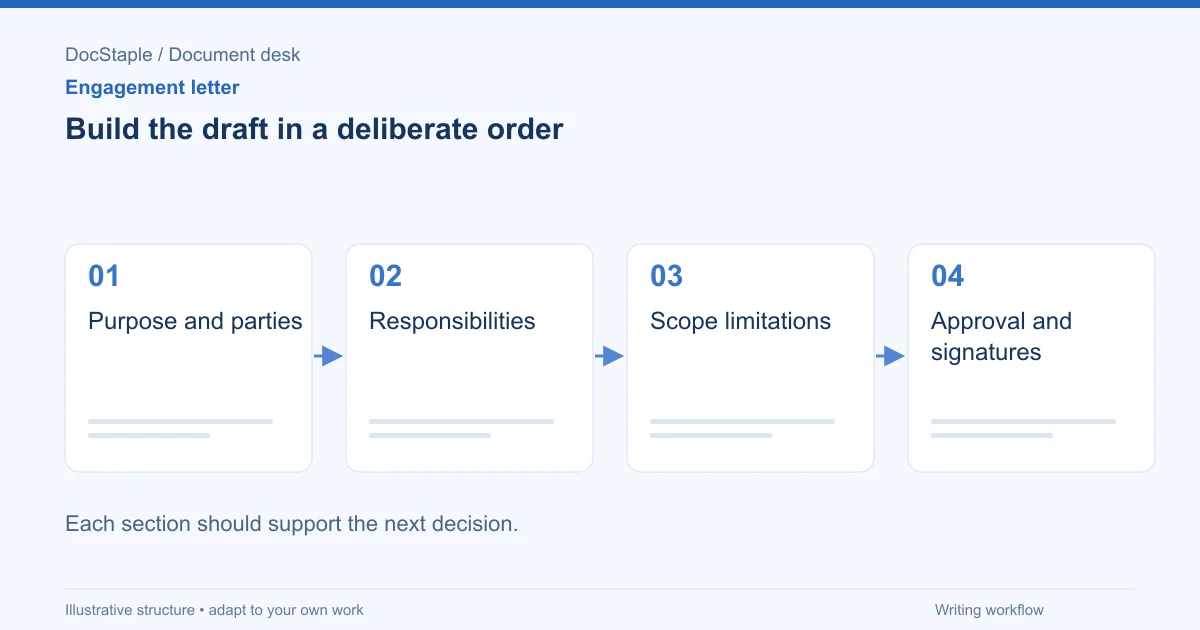
An engagement letter records the work both sides believe they are approving. For a consulting firm, it is often the bridge between a sales conversation and delivery. The letter should make the purpose, parties, responsibilities, scope limits and acceptance route plain enough that the engagement lead, client sponsor and reviewer can all point to the same record.
Use this article for a practical drafting sequence. The examples follow a consulting strategy review for a regional retailer that wants a recommendations report on store operations. The letter is not trying to be a master services agreement. It is the document that says what this assignment covers, what it does not cover and who can approve changes.
Start with the purpose and parties
Open with the client entity, your entity, the authorized contact and the work being commissioned. A weak opening says, "We are pleased to help with your project." A stronger opening says what project, for whom and for what decision.
Annotated sample language:
Dear Maya Chen, this engagement letter records the agreement between Northline Advisory LLC and Ridgeway Retail Inc. for a strategy review of Ridgeway's store operations. The work will support the executive team's decision on whether to standardize regional inventory routines before the 2027 planning cycle.
Why it works: the parties are named, the work is not abstract and the decision context is visible. If the client later asks for customer research or software selection, the opening makes it easier to ask whether that work is inside the assignment.
Add the authority line early:
Ridgeway confirms that Maya Chen, Chief Operating Officer, is authorized to provide instructions, approve changes and accept the final recommendations report for this engagement.
Do not bury authority in a signature block alone. The delivery team needs to know whose approval counts during the work, not only at the end.
Define the responsibilities on both sides
An engagement letter should not read as if only the service provider has duties. Most consulting assignments depend on client access, records and timely review. If those responsibilities are vague, delays can look like delivery failure even when the missing input came from the client.
For a strategy review, split responsibilities into provider work and client inputs:
Northline will conduct discovery interviews, review supplied operating documents, prepare an analysis summary and present a recommendations report. Ridgeway will provide current inventory procedures, regional performance summaries, interview availability and one sponsor decision meeting within five business days of receiving the draft.
This is better than saying "client will cooperate." It tells the sponsor what cooperation means.
Decision analysis example: suppose the client wants the consultant to validate financial savings. If Northline will only review management-provided numbers, say so. If it will test source records, say so. The difference changes staffing, timing and risk.
Possible wording:
Northline will use financial figures supplied by Ridgeway for directional analysis. Northline will not audit, verify or certify those figures unless the parties approve a separate written scope.
That sentence is not decorative. It prevents the recommendations report from being mistaken for assurance work.
Write scope in results, not effort
Scope should describe the expected output and acceptance basis. Time and activities matter, but the client usually approves the letter because of the result. In US federal service contracting, performance-based acquisition guidance favors describing work by required results and measurable standards rather than by the method used to perform it (FAR Subpart 37.6). A private consulting letter does not need to copy federal procurement rules, but the drafting principle is useful.
Weak scope:
We will review operations and make recommendations.
Stronger scope:
The engagement covers discovery interviews with up to twelve Ridgeway managers, review of current inventory routines for eight stores, an analysis summary and one recommendations report identifying practical changes, implementation considerations and open decisions.
Now test the scope against two questions. Can the delivery team tell what to produce? Can the client tell what evidence the recommendation will rely on?
If the answer is no, add a deliverables table:
| Deliverable | Content | Review point |
|---|---|---|
| Discovery summary | Interview themes and document gaps | Sponsor confirms factual corrections |
| Recommendations report | Proposed operating changes and decision options | Sponsor accepts, requests revision or defers |
This keeps the engagement letter from becoming a loose promise.
State scope limitations before they become disputes
Scope limitations are not pessimistic. They are how the letter stays honest. List exclusions, reliance limits, assumptions and change triggers.
For the Ridgeway example, two limitations matter:
Excluded work: store-level implementation, software procurement, labor relations advice, financial audit procedures and customer research are outside this engagement.
Reliance limit: Northline will rely on records and explanations supplied by Ridgeway. Northline will identify apparent inconsistencies discovered during the engagement, but the engagement does not include independent verification unless added by written change approval.
Worked example: the COO asks during week two, "Can you also compare inventory software vendors?" Without an exclusion, the consultant may either absorb the work or disappoint the sponsor. With an exclusion, the answer is straightforward: vendor comparison is possible, but it needs a change approval because it adds market research, selection criteria and likely stakeholder interviews.
Avoid legal overreach. Do not claim the letter eliminates all liability or guarantees enforceability. If the engagement touches regulated advice, local licensing rules, tax positions or legal rights, state the jurisdiction and get appropriate review.
Add fees, timing and change approval
Fees and timing should connect to assumptions. A flat fee is not just a number; it is a number based on a defined scope, access pattern and review cycle.
Sample language:
The fee for the engagement is USD [amount], invoiced [schedule]. The timetable assumes Ridgeway provides requested records by [date], confirms interview availability within three business days and returns consolidated draft comments within five business days.
Then add a change rule:
Work outside the scope, additional deliverables or material changes to the review population require written approval from both parties before Northline begins the additional work.
In US federal contracting, contract modifications and change orders have formal procedures, including written change orders and supplemental agreements in defined circumstances (FAR Part 43). Private consulting work is different, but the same discipline helps: record who approved the change, what changed and how fee or timing changed.
Do not rely on silence. A useful engagement letter says whether the client must approve in writing, approve by signature or approve through an agreed system.
Prepare the signature and review version
The signature block should confirm role, authority, date and attachments. If the engagement letter refers to terms and conditions, a proposal, fee schedule or data handling appendix, list those attachments by title and date.
Signature language:
By signing below, each party confirms that it has reviewed this engagement letter, understands the scope and limitations, and authorizes the engagement described above.
Before sending, run a Word review pass. Microsoft explains that tracked changes can be accepted or rejected from the Review tab and that hidden markup is not removed simply by hiding it (Microsoft Support: Track changes in Word). For an engagement letter, that matters because unresolved comments may expose negotiation notes or uncertain wording.
Final drafting pass:
- Confirm legal names and authorized contacts.
- Match the scope to the proposal or decision record.
- Remove bracketed instructions.
- Check exclusions against likely client requests.
- Resolve comments and tracked changes.
- Save an editable master and an issued PDF or signed copy.
For a reusable starting point, the consulting engagement letter template includes editable sections for engagement purpose, scope limitations, information responsibilities, fees, authorization and approval records. Use it as a drafting structure, then replace every example with the facts of your engagement.
Last updated: September 26, 2026
Frequently Asked Questions
Related Articles
Capability Statement Best Practices for Consulting Firms
Capability statement best practices for consulting firms, with fixes for vague competencies, weak past performance, generic differentiators and stale credentials.
Capability Statement Checklist for Buyer-Ready Consulting Drafts
A capability statement checklist for consulting firms, with review gates for core competencies, relevant experience, differentiators, credentials and contact details.
Capability Statement Examples: Four Sections Written Weak and Then Strong
Capability statement examples for a fictional consulting firm: core competencies, relevant experience, differentiators, and contact and credentials, each shown as weak and stronger draft wording with a review checklist.
Engagement Letter Best Practices
Best practices for engagement letters, including scope control, responsibility wording, limitation language and approval records.
Engagement Letter Checklist
Use this engagement letter checklist to review purpose, parties, responsibilities, limitations, approval and signature readiness.
Engagement Letter Examples: Purpose, Scope Limits and Signatures
Engagement letter examples for consulting work, with annotated wording for parties, responsibilities, scope limitations, approval and signatures.