How to Write a Proposal: A Four-Part Structure With Draft Wording
Learn how to write a proposal that a client can approve: state the problem and objectives, recommend an approach, define deliverables and exclusions, and close with fees and next steps, with draft wording for each.
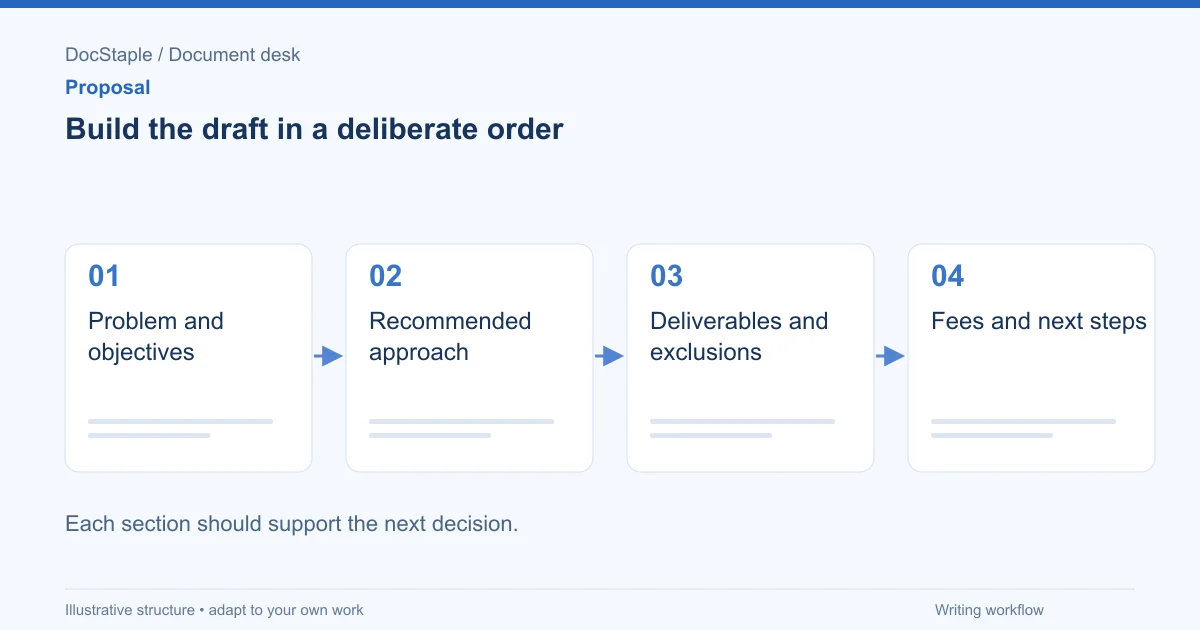
A proposal has one job: to let a client say yes, no, or "yes, if" with a clear picture of what they would be agreeing to. Most weak proposals fail because they describe the writer's firm instead of the client's decision. This guide sets out a four-part structure, draft wording for each part, and a review checklist you can apply before anything is sent.
The worked example is a fictional consulting engagement: a strategy review for a regional building-supplies distributor. The names and figures are invented for illustration. Replace them with your own verified facts.
Start from the reader's decision
Before drafting, list who will read the proposal and what each reader must decide: a sponsor approving the fee, an operations lead checking the timetable, a finance colleague comparing offers.
Cornell's engineering service design course describes a proposal as an offer to carry out research or to provide a product or service. The page is written for student teams presenting to advisers, so it is a teaching outline rather than a professional standard. Still, its contents list is a useful reference: a purpose statement, a problem statement with background, the scope of work including tasks, budget and schedule, and the qualifications of those proposing the work.
The four parts below cover the middle of that list in the order a client usually needs it. Put a short purpose statement first, and place your qualifications after the substance or in an appendix so they do not delay the decision.
Part 1: Problem and objectives
Begin with the client's situation in their own terms. If you cannot summarise the problem in two or three sentences that the client would recognise, you are not ready to propose a solution.
Good problem statements say what is happening, what it affects and why it matters now. Good objectives say what will be different if the work succeeds. Keep the two separate: the problem is the current state, and the objective is the intended change.
Draft wording for the distributor example:
Client need. Over the past two budget cycles, [Client] has opened two new branches while keeping a single head-office purchasing team. Branch managers report [describe evidence from discovery, for example inconsistent stock levels], and the leadership team has asked for an independent view before the next planning round.
Objectives. By [date], the leadership team has a written set of recommendations, supported by the evidence gathered, on how to organise purchasing across branches. The recommendations will state the options considered and the reasons for the preferred option.
Cite where your evidence came from, and avoid promising outcomes the client controls. "The team will produce recommendations" is a commitment you can keep. "Purchasing costs will fall" depends on decisions taken after you deliver.
Part 2: Recommended approach
The approach section explains how you will reach the objectives, in enough detail that the client can judge whether the plan is realistic, and no more. Oregon's Statement of Work Writing Guide was written for a state transportation agency buying services, but its list of drafting questions transfers well. It asks what the work will consist of, who is responsible for specific tasks, and what a successful outcome will be, and it lists a schedule with milestones among the components of a good statement of work.
For a consulting proposal, turn that into a short sequence of phases, each with an owner and a dependency:
Phase 1: Discovery (weeks 1–3). We interview up to [number] stakeholders named by the sponsor and review the documents listed in Appendix A. Client dependency: the sponsor arranges interview access and shares the documents by [date].
Phase 2: Analysis (weeks 4–5). We compare the options against the criteria agreed at the end of Phase 1.
Phase 3: Recommendations (week 6). We present the recommendations to the leadership team and incorporate one consolidated round of client feedback.
Naming client dependencies matters as much as naming your own tasks. The Oregon guide suggests listing your assumptions, because doing so can surface obligations that might have gone unwritten, and validating them can bring out things believed to be true that later turn out differently.
The guide also advises splitting a large project into manageable phases rather than drafting one document without a solid basis for tasks and costs. If your engagement has an uncertain second half, say so and price the first phase firmly.
Part 3: Deliverables and exclusions
This section prevents most later disagreements, so it deserves the most careful wording.
The Oregon guide says the best practice is to define deliverables for each task that are tangible and measurable, and gives the example of an assessment task whose deliverable is a written report of findings. It also notes that some services produce nothing tangible, such as facilitating a meeting, and suggests a supporting record, such as an agenda and attendee list, to show the work took place.
Apply that to the example:
| Deliverable | Format | Due | Reviewer |
|---|---|---|---|
| Interview summary | Word document, up to [number] pages | End of week 3 | Sponsor |
| Options analysis | Word document with comparison table | End of week 5 | Sponsor |
| Recommendations report | Word document and presentation to leadership | Week 6 | Leadership team |
Then state what is out of scope. Exclusions are not pessimism: they let the client compare offers on equal terms and give you a neutral reference when a new request arrives.
Not included. Implementation of the recommendations; system selection or configuration; supplier negotiations; interviews beyond the [number] stakeholders in Phase 1; additional feedback rounds after the consolidated round in Phase 3.
Additional work. Work outside this scope is quoted and agreed in writing before it begins.
Watch for vague verbs
The Oregon guide lists words to avoid because they have more than one interpretation, among them "assist", "help", "best efforts", "reasonable", "acceptable" and "necessary". Its advice is to ask how, by what standard and decided by whom. Scan your deliverables section for those words and replace each with an action, a standard and a decision-maker. "We will assist with the roadmap" becomes "We will draft a roadmap of no more than [number] initiatives and revise it once following sponsor comments."
Part 4: Fees and next steps
State the fee, what it covers and how it is invoiced. The Oregon guide notes that the compensation method shapes how definite the scope must be: a fixed price needs a scope precise enough for the provider to estimate the cost of performance, while a time-and-materials approach suits a scope that is less definite and normally carries a not-to-exceed cap. That is a useful check on your own draft. If your scope is still uncertain, a fixed fee may be the wrong choice.
Draft wording:
Fees. The fee for Phases 1 to 3 is [currency and amount], invoiced [schedule]. Expenses are [included / billed at cost with prior approval]. Taxes are [treatment for your jurisdiction].
Acceptance. Each deliverable is reviewed by the person named in the table above. We treat a deliverable as accepted when that person confirms in writing, or when comments have been resolved and reissued. Silence is not acceptance.
Next steps. To proceed, [named person] signs below by [date]. We then confirm the start date and request the Phase 1 access and documents.
Fee, tax, termination and liability wording carries legal consequences and varies by jurisdiction and by contract. If your proposal will form part of a binding agreement, have those clauses reviewed by a qualified professional. Nothing in a template or a blog example does that for you.
Review the proposal before it leaves your desk
If you prepare the proposal in Word, use tracked changes for the internal review so the author can see every edit. Microsoft's guide to tracking changes in Word lists Word for Microsoft 365, 2024, 2021, 2019 and 2016, plus Word for iPad, the web app and Word for iPhone. It says to go to the Review tab, choose Tracking, then Track Changes, and pick For Everyone or Just Mine. To resolve edits, use Tracking > Next and then Accept or Reject.
Resolve every change and clear drafting comments before saving the version you send, then run the checklist below.
Review checklist
- Problem: Could the client read the first paragraph and say, "Yes, that is our situation"?
- Objectives: Does each objective describe a change or output, and is each within your control to deliver?
- Approach: Does each phase have an owner, a timeframe and any client dependency?
- Assumptions: Are the things you are relying on written down, and have you checked them with someone who knows?
- Deliverables: Is each one tangible, with a format, a due date and a named reviewer?
- Exclusions: Are the likely misunderstandings named, with a route for additional work?
- Language: Have you replaced words such as "assist", "reasonable" and "acceptable" with a specific action or standard?
- Fees: Does the pricing approach match how definite the scope is, and are expenses and taxes addressed?
- Approval: Is it clear who signs, by when, and what happens next?
- Review: Has a colleague who did not write it read it as the client would?
Start from a structured Word draft
If you would rather not build the layout each time, the consulting proposal template is an editable Word file with sections for client need and proposed outcome, scope and deliverables, delivery approach and timetable, fees and acceptance, and approval. It is a starting draft, not a guarantee that any proposal is complete, compliant or enforceable.
Sources: Design Proposals & Reports, Cornell Engineering Service Design, Statement of Work Writing Guide, Oregon Department of Transportation, Track changes in Word, Microsoft Support
Last updated: September 26, 2026
Frequently Asked Questions
Related Articles
Capability Statement Best Practices for Consulting Firms
Capability statement best practices for consulting firms, with fixes for vague competencies, weak past performance, generic differentiators and stale credentials.
Capability Statement Checklist for Buyer-Ready Consulting Drafts
A capability statement checklist for consulting firms, with review gates for core competencies, relevant experience, differentiators, credentials and contact details.
Capability Statement Examples: Four Sections Written Weak and Then Strong
Capability statement examples for a fictional consulting firm: core competencies, relevant experience, differentiators, and contact and credentials, each shown as weak and stronger draft wording with a review checklist.
Engagement Letter Best Practices
Best practices for engagement letters, including scope control, responsibility wording, limitation language and approval records.
Engagement Letter Checklist
Use this engagement letter checklist to review purpose, parties, responsibilities, limitations, approval and signature readiness.
Engagement Letter Examples: Purpose, Scope Limits and Signatures
Engagement letter examples for consulting work, with annotated wording for parties, responsibilities, scope limitations, approval and signatures.