How to Write a Service Agreement: Responsibilities, Terms and Review
How to write a service agreement with clear responsibilities, commercial terms, termination, renewal and qualified review before signature.
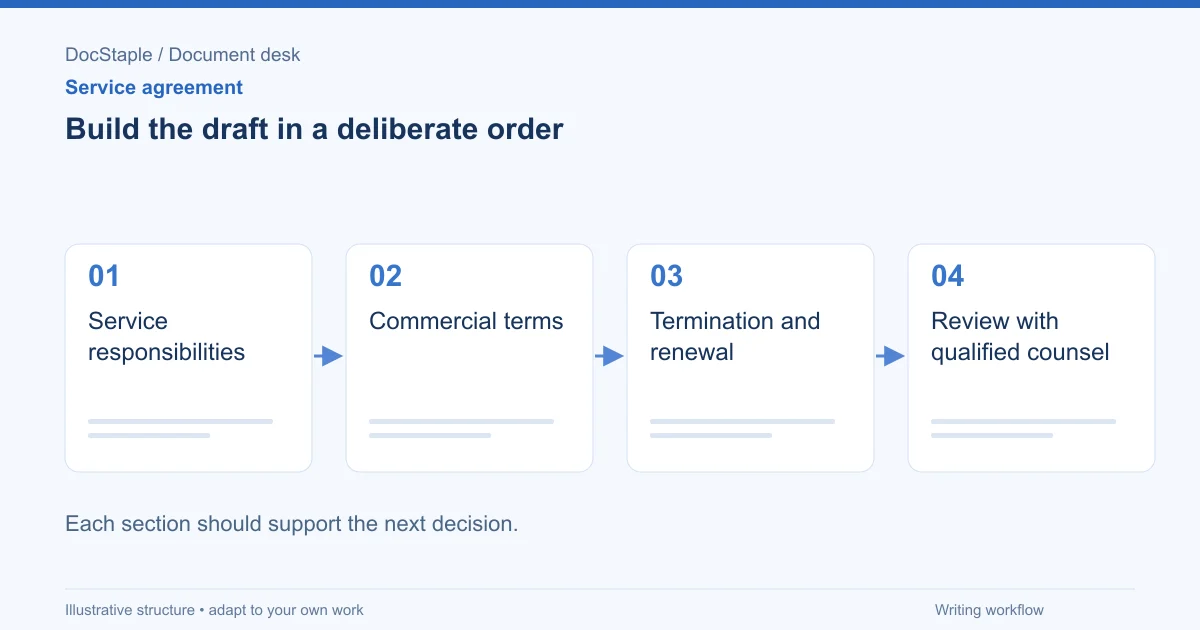
A service agreement turns a commercial understanding into working rules. It should answer the questions that become expensive later: what service is included, what the client must provide, how payment works, how changes are approved and how either party can exit.
This guide uses a simple consulting example, but the drafting sequence works for many business services. A consultant will provide quarterly business-process review support to a client. The agreement must be clear enough for the delivery lead to administer and complete enough for counsel to review. It is not legal advice. Contract requirements vary by jurisdiction, and U.S. state law can affect enforceability, remedies and required notices.
1. Identify the parties and authority
Use the legal names of the parties, not shorthand. Confirm who can sign.
Draft language
This Service Agreement is entered into by [Provider legal name] and [Client legal name] as of [effective date]. Each person signing confirms they are authorized to sign for the party identified below.
Add addresses and entity details if your form requires them. If a parent company negotiates but a subsidiary receives the services, resolve that before signature.
The FTC advises small businesses to get agreement terms in writing before agreeing and to keep a copy of the whole document, especially when signing electronically (FTC small business contract alert). That advice arose from payment-processing contracts, but it is a good baseline for any service agreement.
2. Describe services as actions, outputs and limits
The services section should be specific enough that a neutral reader can tell whether the provider performed.
Weak draft
Provider will deliver consulting support as needed.
Stronger draft
Provider will conduct one quarterly process review meeting, prepare one written findings memo of up to [number] pages, and maintain an action log for decisions assigned during the review. The services do not include implementation, staffing decisions, software configuration or legal advice.
This stronger version states actions, outputs and exclusions. It also avoids the phrase "as needed," which invites different interpretations.
For federal service orders under FAR 8.405-2, statements of work include the work to be performed, location, period of performance, deliverable schedule, performance standards and special requirements when applicable (Acquisition.GOV, FAR 8.405-2). A private agreement can use the same checklist even when the FAR does not apply.
3. Add responsibilities on both sides
Do not write the agreement as if the provider controls everything. If the client must supply data, access or decisions, include those obligations.
Draft language
Client will provide process documents, performance reports and access to agreed stakeholders at least [number] business days before each quarterly review. Client will nominate one sponsor to consolidate comments and approve factual corrections.
Pair each provider deliverable with a client input:
| Provider service | Client input |
|---|---|
| Quarterly review meeting | Sponsor confirms attendees |
| Findings memo | Client provides current process documents |
| Action log | Decision owners review assigned actions |
This table helps prevent delay blame. If the client input does not arrive, the provider can point to the written dependency rather than negotiating from memory.
4. Set commercial terms clearly
Fees need more than a price. Include invoice timing, due date, expenses, taxes, disputed amounts and late-payment consequences if used.
Draft language
Client will pay [currency and amount] per quarter. Provider will invoice on [schedule], and payment is due [number] days from invoice date. Expenses require Client's written approval before they are incurred. Taxes are handled according to applicable law in [jurisdiction].
If Client disputes an invoice, Client must notify Provider within [number] days, identify the disputed amount and pay undisputed amounts when due.
If pricing depends on assumptions, write them:
The fee assumes one review meeting, one findings memo and one consolidated comment round per quarter.
Without that assumption, extra meetings can become a billing dispute.
5. Address confidential information and service-provider risk
If the service provider touches confidential or sensitive information, say how it may be used and protected.
Draft language
Each party will use the other party's confidential information only for the agreement. Provider will restrict access to personnel who need the information to perform the services and will return or delete confidential information at the end of the agreement, except for copies retained under legal, insurance or professional obligations.
If sensitive customer, employee or security data is shared, add specific safeguards. The FTC says companies should put service-provider security expectations, performance standards and monitoring methods in writing when sensitive information is involved (FTC business guidance on service providers). Do not rely on a vague promise if the data risk is concrete.
6. Write term, termination and renewal
Term language answers when the agreement starts and ends. Termination language answers how it can end early.
Draft language
This agreement starts on [date] and continues until [date]. It renews only by written agreement signed by both parties.
Either party may terminate for convenience on [number] days' written notice. Client will pay for services performed and approved expenses incurred through the termination date.
For breach:
Either party may terminate for material breach if the breach is not cured within [number] days after written notice describing the breach.
Renewal and cancellation rules can vary by jurisdiction and customer type, especially for automatic renewals. Have counsel review the final mechanism.
7. Review legal terms and clean the signature copy
Business teams can draft facts: service description, timing, names, fees and operational responsibilities. Legal terms need qualified review: governing law, liability, indemnity, warranties, IP ownership, confidentiality, data protection, dispute process and remedies.
Before signature, run this checklist:
- Parties and authority: legal names and signers confirmed.
- Service scope: included services and exclusions are specific.
- Responsibilities: provider and client duties are both stated.
- Commercials: fees, invoicing, taxes, expenses and disputed amounts are clear.
- Term: start, end, renewal and termination are written.
- Changes: extra work requires written approval.
- Legal review: jurisdiction-specific clauses reviewed by qualified counsel.
- Document cleanup: old names, comments and tracked changes removed.
Microsoft Support notes that Word tracked changes can be accepted or rejected from the Review tab (Microsoft Support). Use that before creating the version for signature.
Finally, do a "day-two" test. Imagine the agreement has been signed and the first request arrives: the client asks for a meeting, sends a file or requests extra work. The agreement should tell the delivery lead what to do next. If it does not, add operating detail in a schedule rather than stretching legal clauses to do project-management work.
For example:
Requests for additional meetings are sent to [role]. Provider will confirm whether the meeting is included in the current fee or requires a written change before scheduling.
That kind of sentence can prevent a small favor from quietly becoming a new service line.
Start from an editable agreement
The consulting service agreement template gives you editable Word sections for parties, services, service obligations, client inputs, fees, commercial provisions, term, termination, disputes and approval. Use it to draft the business structure, then route legal-effect wording for jurisdiction-specific review.
Sources: FTC small business payment-processing contract alert, FAR 8.405-2, Acquisition.GOV, FTC service provider security guidance, Accept tracked changes, Microsoft Support
Last updated: September 26, 2026
Frequently Asked Questions
Related Articles
Capability Statement Best Practices for Consulting Firms
Capability statement best practices for consulting firms, with fixes for vague competencies, weak past performance, generic differentiators and stale credentials.
Capability Statement Checklist for Buyer-Ready Consulting Drafts
A capability statement checklist for consulting firms, with review gates for core competencies, relevant experience, differentiators, credentials and contact details.
Capability Statement Examples: Four Sections Written Weak and Then Strong
Capability statement examples for a fictional consulting firm: core competencies, relevant experience, differentiators, and contact and credentials, each shown as weak and stronger draft wording with a review checklist.
Engagement Letter Best Practices
Best practices for engagement letters, including scope control, responsibility wording, limitation language and approval records.
Engagement Letter Checklist
Use this engagement letter checklist to review purpose, parties, responsibilities, limitations, approval and signature readiness.
Engagement Letter Examples: Purpose, Scope Limits and Signatures
Engagement letter examples for consulting work, with annotated wording for parties, responsibilities, scope limitations, approval and signatures.