How to Write a Statement of Work: Four Steps From Scope Boundaries to Change Control
How to write a statement of work for a consulting engagement: set scope boundaries, define work packages, write testable acceptance criteria and agree change control, with draft wording and a pre-issue check.
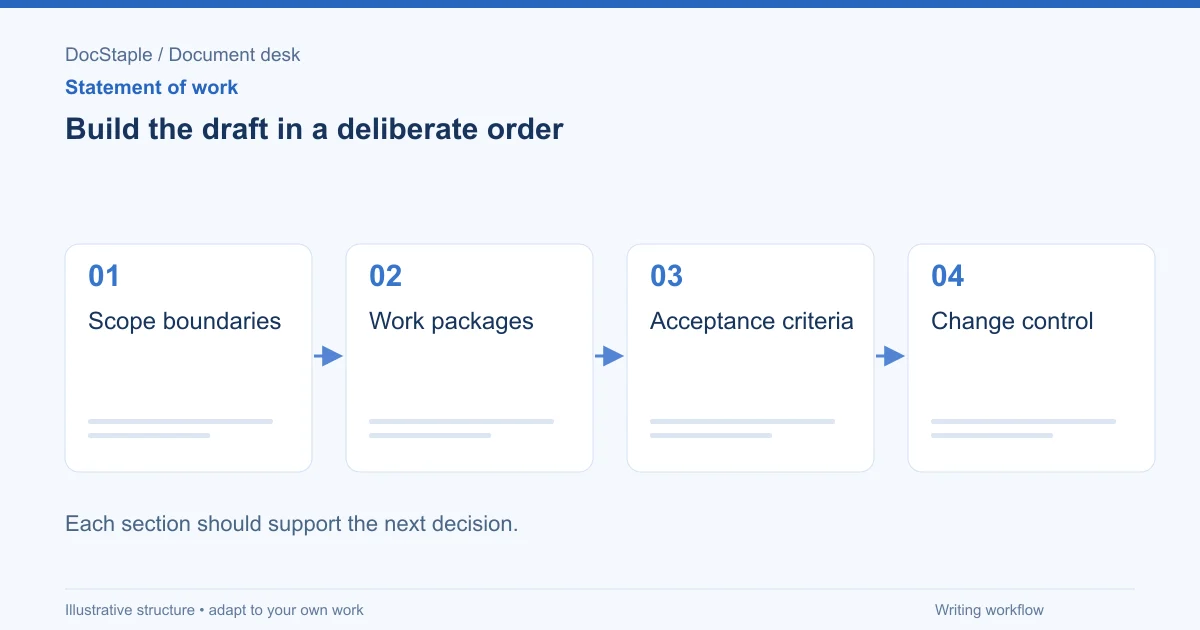
A statement of work (SOW) fails in one of two ways. It is too vague, so each side remembers a different promise, or it is written after the sales conversation from memory, so it records enthusiasm rather than agreement. Writing it in a fixed order avoids both problems.
This guide walks through four working parts: scope boundaries, work packages, acceptance criteria and change control. Each includes draft wording and a check.
The scenario is fictional: a consultant hired by a regional freight carrier to review its customer onboarding process and produce an assessment report. Names, dates and quantities are placeholders. Replace them with facts you have verified.
Gather the facts before you write a sentence
Oregon's transportation department publishes a Statement of Work Writing Guide for its own purchases of personal services. It is written for a public agency, so treat it as drafting practice, not a requirement for your engagement. Its pre-drafting questions still make a handy intake form: what is the purpose of the service, who is responsible for specific tasks, what are the deliverables and when are they due, what will a successful outcome be, and what problems might be encountered and how should they be resolved.
Answer those with the client sponsor first. Two more decisions shape everything that follows:
- Fixed fee or time and materials. The guide points out that a fixed price requires an SOW definitive enough for the consultant to determine the cost of performance, while a less definitive SOW fits labour-hours pricing with a not-to-exceed cap. Choose the pricing model first, because it decides how precise the work packages must be.
- Results or effort. The guide prefers a performance-based SOW, structured around outputs, and calls a level-of-effort SOW, where the deliverable is basically hours of work, the least desirable. The federal rule on performance work statements, FAR 37.602(b), likewise says to describe work in terms of required results rather than how it is done or the number of hours provided. That is a federal contracting rule, not a private-sector obligation, but "describe the result" suits any consulting SOW.
Step 1: Draw the scope boundaries
Start with what the engagement covers and where it stops. The federal rule for ordering services from Federal Supply Schedules, FAR 8.405-2(b), says an SOW must include a description of the work, location of work, period of performance, deliverable schedule, applicable performance standards and any special requirements. Private engagements are not bound by that list, but it is a useful minimum to test a draft against.
Draft wording:
Purpose. This statement of work authorises [Consultant] to assess the customer onboarding process at [Client] under [governing agreement, date]. It authorises only the work described here.
In scope. Observation of up to [number] onboarding cases selected by the sponsor; interviews with up to [number] named staff; review of the documents in Appendix A; one assessment report and one presentation to the operations leadership team.
Out of scope. Changes to any system or process; selection of software; training of client staff; interviews or case reviews beyond those named above.
Location and period. Work is performed remotely, plus [number] on-site days at [location], between [start date] and [end date].
Precedence. If this statement conflicts with the governing agreement, [state which document prevails].
Check: Could someone who was not in the sales conversation read the two lists and predict what will and will not be delivered?
Step 2: Break the work into work packages
A work package is a piece of work one person can be accountable for. For each, record the activity, the owner, the output and what the client must supply.
| Work package | Activity | Owner | Output | Client dependency |
|---|---|---|---|---|
| 1. Observation | Shadow selected onboarding cases; interview named staff | [Consultant lead] | Findings log | Sponsor approves the case list by [date] |
| 2. Analysis | Compare observed steps with the documented process | [Consultant analyst] | Gap analysis | Client supplies Appendix A documents by [date] |
| 3. Report | Draft assessment; present; revise once after consolidated comments | [Consultant lead] | Assessment report; presentation | Sponsor returns one set of comments within [number] working days |
Each dependency names a person and a date. The Oregon guide recommends listing your assumptions and validating them with subject matter experts, because unstated expectations can turn out to be wrong, and if additional effort is then needed, a contract amendment may be required. Where a client commitment is not yet confirmed, write it as an assumption and say what follows if it fails:
Assumption. [Client] provides the Appendix A documents by [date]. If they arrive later, the dates in the table move by the same number of working days and the parties agree any fee effect through Section 4.
If the second half of the work depends on what the first half finds, the guide suggests avoiding one SOW for a large project unless there is a solid basis for its tasks and costs. Draft the known first phase in detail and add later phases by amendment.
Check: Does every package have one accountable owner, an output someone can inspect and a stated consequence if a dependency is late?
Step 3: Write acceptance criteria you can test
Acceptance criteria are how both sides will know a deliverable is finished. The Oregon guide's best practice is to define tangible, measurable deliverables for each task; its example is an assessment task whose deliverable is a written report of findings.
Draft wording:
Deliverable: Assessment report.
Accepted when: (a) the report contains each section listed in Appendix B; (b) each finding cites the case, interview or document it rests on; (c) the sponsor confirms in writing that the findings and evidence are approved.
Reviewer: [name, role]. Review window: [number] working days from delivery.
If rejected: the reviewer lists each shortfall against (a) to (c). [Consultant] corrects and reissues within [number] working days, and the review window restarts. Silence is not acceptance; [Consultant] escalates to [named person] before treating the deliverable as accepted.
Criterion (c) follows the starting point in our consulting template, "sponsor approves recommendations and evidence". Replace it if your approved scope needs a different test.
Then hunt for vague verbs. The Oregon guide lists words that have more than one interpretation, including "assist", "work with", "help", "best efforts", "reasonable", "acceptable", "necessary" and "good", and suggests asking how the party will assist, what the minimum acceptable standard is and who decides when something is necessary. "We will support the onboarding redesign" becomes "[Consultant] drafts up to [number] recommended process changes and revises them once after the sponsor's consolidated comments".
Check: For each deliverable, can you name the reviewer, the test, the review window and what happens on rejection?
Step 4: Agree change control before you need it
Change control is the route for altering scope, fee, timetable or acceptance criteria after signature. Write it while the relationship is friendly.
Change process. Either party may request a change by written notice describing the change and the reason. Within [number] working days, [Consultant] states the effect on scope, fee, timetable and acceptance criteria. No change takes effect until [client authoriser] and [Consultant authoriser] approve it in writing. Approved changes are recorded in the change log, and the current version of this statement is kept with the project records.
For work that may or may not be needed, the Oregon guide describes "contingency tasks": tightly defined by subject, extent and a fixed price or not-to-exceed amount, and started only after a written notice to proceed. It notes that authorising such a task is quicker than amending the whole contract. Adapted:
Optional work. Additional case reviews, up to [number] at [rate or fixed amount], are performed only after written notice to proceed from [client authoriser].
Check: Can you point to who may request a change, who assesses it, who approves it and where the approved version is kept?
Test the draft before it goes out
Hand the finished draft to a colleague who did not attend the negotiation and ask them to explain back what will be delivered, by whom and by when. The Oregon guide's specificity rule of thumb is to ask whether the SOW could be handed to two different consultants and get about the same quality of services and deliverables. Then run this list:
- Boundaries and ownership: Are in-scope and out-of-scope items listed, and does every package have one owner?
- Assumptions: Are unconfirmed client commitments written as assumptions with a consequence?
- Acceptance: Does each deliverable have a reviewer, a test, a review window and a rejection route?
- Change and precedence: Is there a named change route, and does the text say which document wins in a conflict with the governing agreement?
- Professional review: Have fee, liability and termination terms been reviewed by a qualified professional where they carry legal weight?
Finally, review the draft with the client before signature. The Oregon guide recommends a review meeting to discuss tasks, deliverables and schedule, and says expectations promised by either party must be captured in the document. That describes its own contracting practice, but the principle travels: if it is not in the text, it is not agreed.
Start from a structured Word draft
The consulting statement of work template is an editable Word file organised around work authorisation and boundaries, deliverables and acceptance criteria, responsibilities and dependencies, and change control and completion, with preparation and approval sections. It is a starting draft, not a guarantee that any statement of work is complete, compliant or enforceable. If the SOW follows a proposal, the consulting proposal template covers the commercial framing that comes first.
Sources: Statement of Work Writing Guide, Oregon Department of Transportation, FAR 8.405-2, Acquisition.GOV, FAR 37.602, Acquisition.GOV
Last updated: September 26, 2026
Frequently Asked Questions
Related Articles
Capability Statement Best Practices for Consulting Firms
Capability statement best practices for consulting firms, with fixes for vague competencies, weak past performance, generic differentiators and stale credentials.
Capability Statement Checklist for Buyer-Ready Consulting Drafts
A capability statement checklist for consulting firms, with review gates for core competencies, relevant experience, differentiators, credentials and contact details.
Capability Statement Examples: Four Sections Written Weak and Then Strong
Capability statement examples for a fictional consulting firm: core competencies, relevant experience, differentiators, and contact and credentials, each shown as weak and stronger draft wording with a review checklist.
Engagement Letter Best Practices
Best practices for engagement letters, including scope control, responsibility wording, limitation language and approval records.
Engagement Letter Checklist
Use this engagement letter checklist to review purpose, parties, responsibilities, limitations, approval and signature readiness.
Engagement Letter Examples: Purpose, Scope Limits and Signatures
Engagement letter examples for consulting work, with annotated wording for parties, responsibilities, scope limitations, approval and signatures.