Proposal Best Practices for Consulting Work That Needs a Clear Yes
Proposal best practices for consulting teams: write the problem and objectives, recommended approach, deliverables and exclusions, and fees and next steps without overpromising.
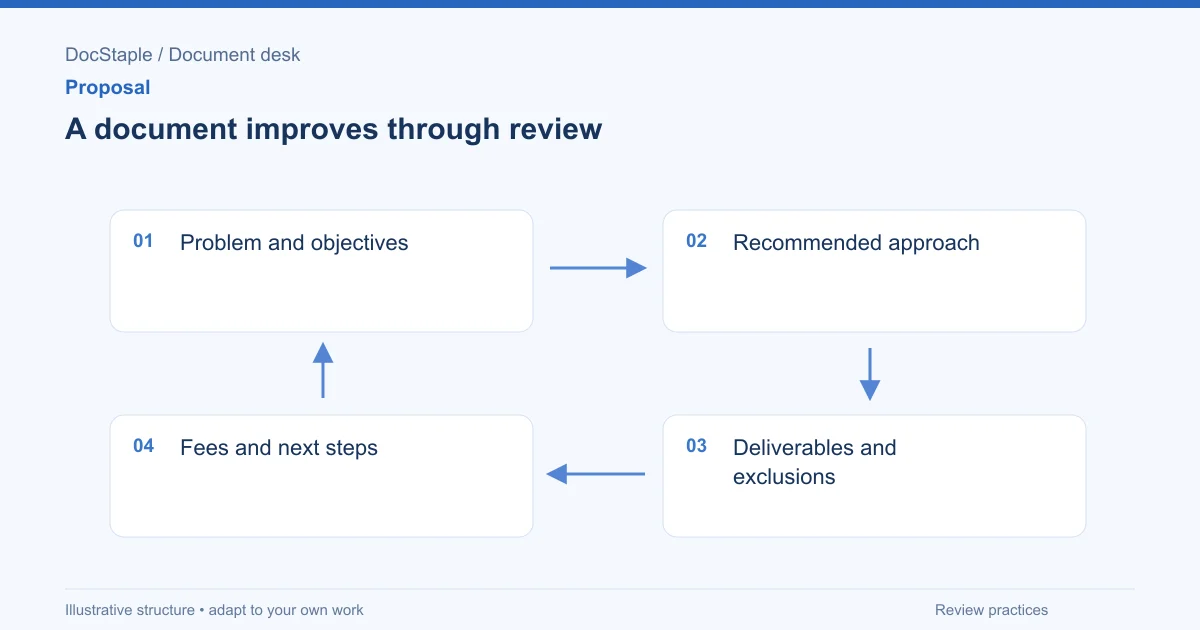
A polished proposal can still fail if it reads like a brochure. The reader is not trying to admire your firm; they are deciding whether the proposed work solves a specific problem at an acceptable cost and risk. Good proposal practice is therefore less about decoration and more about decision quality.
Use this scenario: a consulting team is proposing a six-week operations review for a regional manufacturer whose customer service team is losing track of returned-product cases. The proposal will be read by the operations director, finance lead and customer service manager. The goal is not to sell a fantasy transformation. The goal is to make a clear offer the client can accept, reject or revise.
Federal procurement rules do not govern a private consulting proposal, but they offer useful drafting discipline. FAR guidance for service statements of work says a statement should include work description, location, period of performance, deliverable schedule, performance standards and special requirements where relevant FAR 8.405-2. FAR performance-work-statement guidance also favors describing required results rather than the provider's method or hours FAR 37.602. Treat those as checklist prompts, not legal rules for your private engagement.
Start with the problem and objectives
The opening should prove you listened. A weak opening starts with the consultant: "We are delighted to submit this proposal and bring deep expertise." A stronger opening starts with the client's decision:
Client problem. [Client] has a backlog of [number] returned-product cases, and case ownership changes when work moves between customer service, warehouse and finance. The operations director needs a verified picture of the current process before approving system or staffing changes.
Objectives. By [date], the leadership team will have a current-state process map, a findings report and a prioritized options table showing expected operational effort, dependencies and decision points.
Annotation: the stronger version names the current problem, the audience and the work product. It does not promise that backlog will fall by a specific amount unless that result is already supported and within the consultant's control.
Recommend an approach the client can test
A proposal should describe the route from start to finish, not merely list activities. Oregon's SOW guide, written for public contracting, warns against vague verbs such as assist, help, reasonable, acceptable and as needed because they can be read in more than one way ODOT SOW Writing Guide. That advice travels well to consulting proposals.
Draft approach:
Phase 1: Discovery. Interview up to [number] staff named by the sponsor; review the current intake form, case notes and refund approval record; observe up to [number] cases from intake to closure.
Phase 2: Analysis. Map the current workflow, identify duplicated steps and compare options against criteria agreed with the sponsor.
Phase 3: Recommendation. Deliver a report and one decision meeting. One consolidated comment round is included.
Annotation: each phase has a visible output and a limit. If the client asks for a workshop, system configuration or training, the proposal can say those are optional tasks quoted separately.
Make deliverables and exclusions impossible to miss
Deliverables are the buyer's evidence that the fee buys something concrete. Write them in a table so the reviewer can compare format, due date and reviewer.
| Deliverable | Format | Timing | Reviewer |
|---|---|---|---|
| Current-state process map | Word document with diagram and notes | End of week 2 | Operations director |
| Findings report | Word document with evidence references | End of week 4 | Sponsor and service manager |
| Options table and decision meeting | Word document and meeting notes | Week 6 | Sponsor |
Then list exclusions without apology:
Excluded unless agreed in writing: software selection, configuration, staff training, customer communications, legal review of refund terms, and interviews beyond the named participants.
Annotation: exclusions are not negative; they make the offer comparable. They also protect the client from assuming that a low fee includes later implementation.
Connect fees to scope and next steps
The fee section should tell the reader what is included, when payment is due, what is not included and exactly how to proceed.
Fee. The fee for Phases 1 to 3 is [amount and currency], invoiced [schedule]. Expenses are [included / billed only after written approval]. Taxes are handled according to [jurisdiction and tax treatment].
Additional work. Work outside the listed scope is not started until both parties approve a written change describing scope, timing and fee impact.
Approval. To proceed, [authorized person] signs by [date]. The kickoff is scheduled after signature and receipt of the Phase 1 documents.
If the proposal will form part of a contract, have legal terms such as liability, termination, intellectual property and payment remedies reviewed for the jurisdiction that applies. Do not bury those terms under friendly sales copy.
Before quoting the fee, check the delivery costs behind it. Stackrows’ consulting project budget provides a spreadsheet for the financial calculation; carry the agreed fee and payment schedule into the proposal while keeping internal cost assumptions in the workbook.
Avoid proposal habits that create later disputes
The most common failure mode is enthusiasm without boundaries. "We will partner with your team" sounds pleasant but says nothing about time, output, acceptance or owner. Replace it with an action and a limit: "We facilitate one 90-minute options workshop with up to [number] participants and record agreed decisions in the meeting notes."
The second failure mode is hiding uncertainty. If access to staff, data quality or sponsor availability is uncertain, write it as a dependency: "The timetable assumes the sponsor provides the case list by [date]. If the list is delayed, milestone dates move by the same number of working days unless the parties agree another recovery plan."
The third failure mode is allowing the pricing model to fight the scope. A fixed fee needs tight boundaries. A time-and-materials fee still needs a cap, rate card and reporting rhythm. Do not offer a fixed fee for work whose volume is unknowable unless the first phase is only discovery and later work needs a new approval.
Worked decision: fixed fee or diagnostic phase first
In the manufacturer scenario, the tempting proposal is a fixed-fee "returns transformation" package. It sounds decisive, but the evidence in the sales conversation is thin: the team knows cases are lost between customer service, warehouse and finance, but it does not yet know whether the bottleneck is process ownership, data quality, refund policy, staffing, or the returns system itself.
That leaves two defensible choices. One option is a broad fixed fee that includes discovery, recommendations and implementation planning. The other is a narrower six-week diagnostic with a later option for implementation support. The better choice follows from the uncertainty. If the client cannot yet show a reliable case list, decision log or handoff map, price the diagnostic only. Then name the later work as optional instead of quietly promising it.
Example wording:
This proposal covers a diagnostic operations review only. It will identify the current returned-product workflow, evidence gaps and decision options. It does not include system configuration, revised refund policy, staff training or backlog clearance. If the sponsor wants implementation support after reviewing the options table, the parties will agree a separate scope, fee and schedule.
Why this works: the wording respects the client's real business goal without pretending the consultant controls every cause of the backlog. It also makes the fee easier to defend. The buyer can approve a contained investigation now, while finance can see that unknown implementation volume has not been hidden inside a friendly fixed price.
From cost estimate to client decision
Consider an illustrative six-week diagnostic engagement. The team expects 60 delivery hours at an internal cost of $80 per hour, plus $400 in approved travel costs. That gives an estimated delivery cost of $5,200. A proposed fee of $8,000 leaves $2,800 before overhead, taxes and any unbudgeted work; it is not a promise of net profit. Keep the calculation in the project budget referenced above and test the effect of extra interview hours before committing to the fee.
The Word proposal should carry the client-facing commitment: the $8,000 fee, the diagnostic deliverables, the six-week timetable and the access assumptions. It should not silently expand that commitment into implementation support. If the client needs an internal approval meeting, prepare a short presentation from the same approved proposal version.
| Working file | What belongs there | Check before sending |
|---|---|---|
| Cost workbook | Hours, cost rates, expenses and scenarios | The fee still covers the agreed delivery assumptions |
| Written proposal | Deliverables, exclusions, fee and approval step | The offer matches the priced scope |
| Decision presentation | Recommendation, supporting reasons and the decision requested | Every promise can be traced to the proposal |
Deckary’s guide to executive summary slides explains how to present the recommendation and supporting evidence. Use that structure to summarize the offer, then retain the written proposal as the commercial record. A positive reaction to a slide is not a substitute for the agreed approval process.
Start from an editable Word draft
Use the consulting proposal template to turn the operations-review offer into a clear draft with problem, approach, deliverables, exclusions, fee and next step. When the work has been accepted and needs delivery detail, move the agreed scope into the consulting statement of work template.
Last updated: September 26, 2026
Frequently Asked Questions
Related Articles
Capability Statement Best Practices for Consulting Firms
Capability statement best practices for consulting firms, with fixes for vague competencies, weak past performance, generic differentiators and stale credentials.
Capability Statement Checklist for Buyer-Ready Consulting Drafts
A capability statement checklist for consulting firms, with review gates for core competencies, relevant experience, differentiators, credentials and contact details.
Capability Statement Examples: Four Sections Written Weak and Then Strong
Capability statement examples for a fictional consulting firm: core competencies, relevant experience, differentiators, and contact and credentials, each shown as weak and stronger draft wording with a review checklist.
Engagement Letter Best Practices
Best practices for engagement letters, including scope control, responsibility wording, limitation language and approval records.
Engagement Letter Checklist
Use this engagement letter checklist to review purpose, parties, responsibilities, limitations, approval and signature readiness.
Engagement Letter Examples: Purpose, Scope Limits and Signatures
Engagement letter examples for consulting work, with annotated wording for parties, responsibilities, scope limitations, approval and signatures.