Proposal Examples: Four Sections Written Weak and Then Strong
Proposal examples you can learn from: a fictional consulting engagement with the problem and objectives, recommended approach, deliverables and exclusions, and fees and next steps each shown as weak and stronger draft wording.
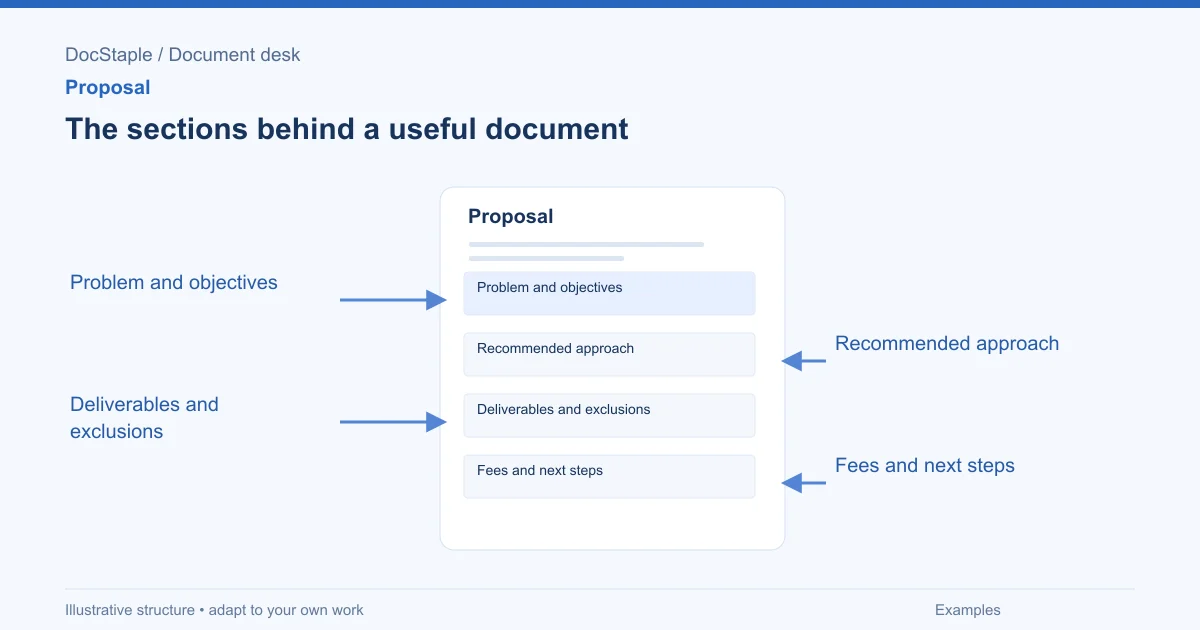
Proposal examples are most useful when they show the reasoning behind the wording, not just a finished page to imitate. A sample that reads well can still fail your client if it promises things you do not control or leaves the scope open to interpretation.
This article works through one fictional consulting engagement and shows four sections twice: first as a weak draft, then as a stronger one. The scenario is a review of client onboarding at a 60-person accounting practice. Every name and detail is invented for illustration, and bracketed items are fields you would replace with verified facts.
What a proposal example needs to show
Guidance from different sources agrees on the basic contents. Purdue's project management certification site lists an executive summary, project background, an explanation of the proposed project, a list of deliverables, success metrics, a schedule and resource requirements. It also advises tailoring the proposal to the audience and placing requests for resources toward the end. Cornell's engineering service design course, written for student teams, describes a proposal as an offer to carry out research or to provide a product or service, with a purpose statement, a problem statement, a scope of work covering tasks, budget and schedule, and the proposer's qualifications.
Neither page is a professional standard for consulting, so treat them as checklists of what readers tend to expect. The four sections below cover the middle of those lists, which is where most proposals succeed or fail.
Example 1: Problem and objectives
The problem section proves you understood the client's situation. A weak version describes the provider instead.
Weak draft
We are a full-service consultancy with a passion for helping firms grow. We will review your processes and deliver best-in-class recommendations that transform your onboarding experience.
Nothing here can be checked. "Transform" is a hope, and the client's own situation never appears.
Stronger draft
Client need. [Client] has added [number] new clients per quarter since [date], and onboarding is handled by whoever is available. Partners have described [evidence from discovery, for example repeated requests for the same documents], and the managing partner wants an independent view before the next planning meeting.
Objectives. By [date], the partners have a written report describing how onboarding works today, the options for changing it, and a recommended option with the reasons for it. The report will state what evidence each recommendation rests on.
The stronger version separates the problem (the current state) from the objective (what will exist when the work ends). It also commits only to outputs the consultant controls. "The team will produce a report" is a promise you can keep. "Onboarding time will fall" depends on decisions taken after you leave.
Example 2: Recommended approach
The approach section shows the client that the plan is realistic. A weak version lists activities without owners or conditions.
Weak draft
We will conduct interviews, analyze the findings, and assist with implementation as needed.
Oregon's Statement of Work Writing Guide was written for a state transportation agency buying services, so its contract details will not apply to a private proposal. Its writing advice does transfer. It lists "assist", "help", "best efforts", "reasonable", "acceptable" and "necessary" among the words that can be read more than one way, and asks how, by what standard and decided by whom. In the weak draft, how much "assist" means is anyone's guess.
Stronger draft
Phase 1: Discovery (weeks 1 to 3). We interview up to [number] staff nominated by the managing partner and review the onboarding documents listed in Appendix A. Client dependency: the managing partner arranges interview access and shares the documents by [date].
Phase 2: Analysis (weeks 4 to 5). We map the current onboarding steps and compare options against the criteria agreed at the end of Phase 1.
Phase 3: Recommendations (week 6). We present the recommendations to the partners and revise the report once after one consolidated set of comments.
Optional task, not included in the fee. If the partners ask us to run a follow-up workshop with the operations team, we will quote a fixed fee and agree it in writing before starting.
Three habits make this work. Each phase names an owner and a client dependency. The wording of every task is a concrete action instead of a soft verb. And the uncertain part, the workshop, is described but priced separately.
That last point follows the Oregon guide, which suggests splitting large projects into phases and describes "contingency tasks" for services that may or may not be needed. Such tasks should be tightly defined, with their own price or cap, and started only on written authorization. The guide notes it is quicker to authorize a defined contingency task than to amend a whole contract. You can borrow the idea for a private engagement without borrowing the contract mechanics.
Example 3: Deliverables and exclusions
Deliverables are where scope disputes start. The Oregon guide recommends defining a deliverable for each task that is tangible and measurable, for example a written report of findings. For work that produces nothing tangible, such as a facilitated meeting, it suggests a supporting record like an agenda and attendee list.
Weak draft
Deliverables will include documentation and recommendations as appropriate.
Stronger draft
| Deliverable | Format | Due | Reviewer |
|---|---|---|---|
| Current-state onboarding map | Word document, up to [number] pages | End of week 3 | Managing partner |
| Options comparison | Word document with comparison table | End of week 5 | Managing partner |
| Recommendations report and presentation | Word document and slides | Week 6 | Partners |
Not included. Implementation of the recommendations; software selection or configuration; interviews beyond the [number] named in Phase 1; additional rounds of comments after the consolidated round in Phase 3.
Additional work. Work outside this scope is quoted and agreed in writing before it begins.
The exclusions read as neutral facts, not as defensiveness. When a partner later asks for help choosing software, both sides can point to the same sentence.
Example 4: Fees and next steps
A weak fees section states a number and stops.
Weak draft
Our fee is [amount]. Payment terms are standard.
"Standard" means different things to different readers. The Oregon guide also makes a point worth checking against your own draft: a fixed price needs a scope definite enough for the provider to estimate the cost of performance, while a time-and-materials arrangement suits a less definite scope and normally carries a cap. If your scope is still uncertain, a fixed fee may be the wrong choice, or the fixed fee should cover only the first phase.
Stronger draft
Fees. The fee for Phases 1 to 3 is [currency and amount], invoiced [schedule]. Expenses are [included / billed at cost with prior approval]. Taxes are [treatment for your jurisdiction].
Acceptance. Each deliverable is reviewed by the person named in the table above. We treat it as accepted when that person confirms in writing, or when comments have been resolved and the document reissued. Silence is not acceptance.
Next steps. To proceed, [named person] signs below by [date]. We then confirm the start date and request the Phase 1 access and documents.
Fee, tax, termination and liability wording has legal effect that varies by jurisdiction and contract. If the proposal will become part of a binding agreement, have those clauses reviewed by a qualified professional. A blog example cannot do that for you.
Review any proposal example before you reuse it
Whether the example comes from this article, a colleague or a past engagement, run the same checks before adapting it:
- Client focus: Does the opening describe the client's situation in terms they would recognise?
- Objectives: Does each objective describe an output or change, and is it within your control to deliver?
- Approach: Does each phase have a timeframe, an owner and any client dependency?
- Vague verbs: Have "assist", "reasonable", "acceptable" and "as needed" been replaced with an action, a standard and a decision-maker?
- Deliverables: Is each one tangible, with a format, due date and named reviewer?
- Exclusions: Are the likely misunderstandings named, with a route for extra work?
- Fees: Does the pricing approach match how definite the scope is?
- Leftovers: Have names, figures and claims from the original example all been replaced or removed?
- Approval: Is it clear who signs, by when, and what happens after?
The Oregon guide also recommends reviewing the draft with the other party before signing and capturing any promised or agreed expectations in the written document. For a proposal, that means a short call to walk the client through scope and exclusions, with anything agreed on the call added to the text.
Turn the examples into your own draft
If you prefer not to rebuild the layout each time, the consulting proposal template is an editable Word file with sections for client need and proposed outcome, scope and deliverables, delivery approach and timetable, fees and acceptance, and approval. It is a starting draft: you still supply the facts, and it does not guarantee that a proposal is complete, compliant or enforceable.
Sources: Purdue project management certification: creating a project proposal, Design Proposals & Reports, Cornell Engineering Service Design, Statement of Work Writing Guide, Oregon Department of Transportation
Last updated: September 26, 2026
Frequently Asked Questions
Related Articles
Capability Statement Best Practices for Consulting Firms
Capability statement best practices for consulting firms, with fixes for vague competencies, weak past performance, generic differentiators and stale credentials.
Capability Statement Checklist for Buyer-Ready Consulting Drafts
A capability statement checklist for consulting firms, with review gates for core competencies, relevant experience, differentiators, credentials and contact details.
Capability Statement Examples: Four Sections Written Weak and Then Strong
Capability statement examples for a fictional consulting firm: core competencies, relevant experience, differentiators, and contact and credentials, each shown as weak and stronger draft wording with a review checklist.
Engagement Letter Best Practices
Best practices for engagement letters, including scope control, responsibility wording, limitation language and approval records.
Engagement Letter Checklist
Use this engagement letter checklist to review purpose, parties, responsibilities, limitations, approval and signature readiness.
Engagement Letter Examples: Purpose, Scope Limits and Signatures
Engagement letter examples for consulting work, with annotated wording for parties, responsibilities, scope limitations, approval and signatures.