Risk Assessment Best Practices for Consulting Work
Risk assessment best practices covering activity and hazards, existing controls, residual risk review, actions and owners for consulting teams.
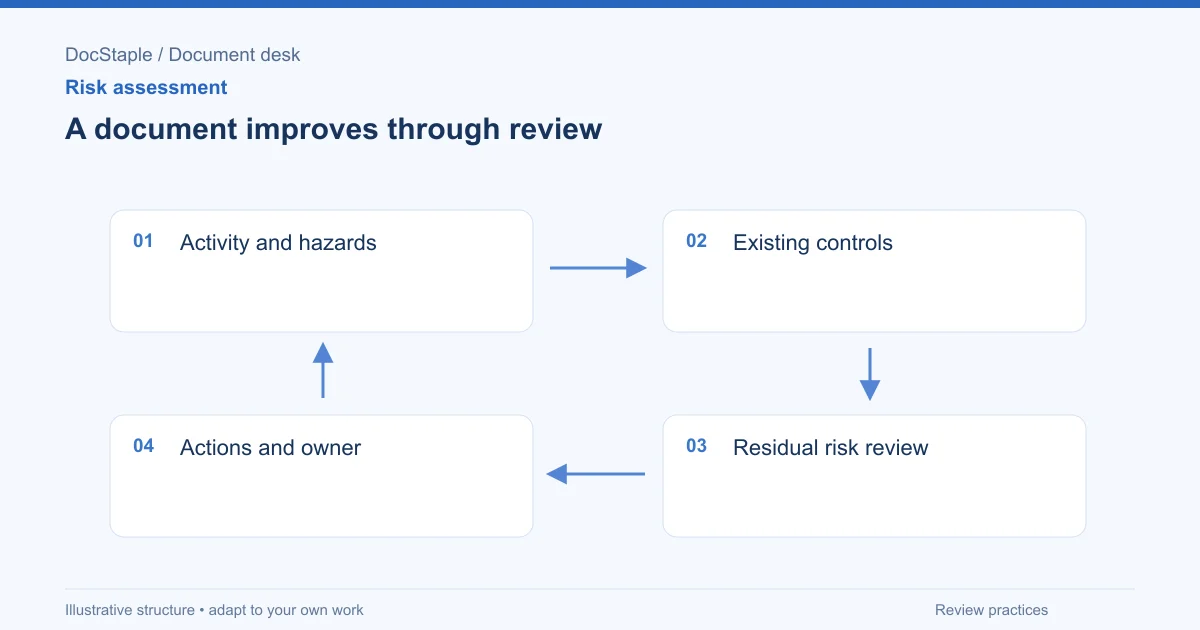
Risk assessment best practices are easy to say and harder to apply: describe the work, identify credible hazards, check existing controls, review residual risk and assign actions. The discipline is in being honest about what is actually controlled today.
Use this consulting scenario. A strategy team is running interviews, handling confidential client material, traveling to a client site and preparing recommendations that may affect staff roles. The risks are not only physical. They include confidentiality failures, unsupported advice, travel disruption, wellbeing concerns and client-site safety.
Define the activity before naming hazards
Start with the activity. A risk assessment for "consulting" is too broad. A risk assessment for "two-week discovery phase involving remote interviews, one client-site workshop and analysis of confidential sales data" is much more useful.
The UK government's Orange Book treats risk identification, assessment, treatment, monitoring and reporting as connected organizational activities. Its formal requirements apply to relevant government bodies, not to every private consultancy. It is a useful organizational-risk reference for this guide because the scenario concerns delivery decisions, information and reputation. The consulting practices below are our worked recommendations: make the event specific, test the evidence for controls and identify who can accept the remaining exposure.
Activity description:
Strategy review discovery phase, including remote employee interviews, one on-site workshop at the client's warehouse office, analysis of sales and staffing data, and preparation of internal findings for the engagement lead.
Review criterion: the activity description should be narrow enough that hazards and controls are meaningful.
Define boundaries as well. If the assessment covers the discovery phase only, say that later implementation advice, restructuring decisions or technical system changes will need separate review. Boundary statements prevent a completed assessment from being reused for work it never considered.
Identify hazards and affected people
Hazards are sources of harm or loss. In consulting, include people, information, operations and decision quality.
Scenario hazards:
- client-site slips, trips or emergency procedures unfamiliar to visiting consultants;
- fatigue from travel and late workshops;
- confidential material sent to the wrong recipient;
- interview notes containing sensitive employee information;
- recommendations based on incomplete evidence;
- scope drift leading to advice outside competence;
- subcontractor access to data without approval.
Affected people and assets:
- consultants;
- client employees being interviewed;
- client sponsor and leadership team;
- subcontractor analyst;
- confidential client records;
- project schedule and deliverable quality.
Draft language:
The assessment covers risks to project personnel, client employees, confidential information, deliverable quality and client decision-making during the discovery phase.
Review criterion: if the affected people list includes only employees, check whether visitors, contractors, clients and information assets were missed.
For consulting, also include people affected by the advice. A recommendation about staffing, process ownership or system access can create operational and employee-relations risks even when the consultants are physically safe. The assessment should not become a legal memo, but it should flag when HR, legal, privacy or specialist review is needed before advice is issued.
Record existing controls honestly
Existing controls are controls that are in place and working. Planned training, a future access review or a policy nobody follows should not be counted as current protection.
Examples:
- approved document workspace with access restricted to named team members;
- client-site induction before workshop attendance;
- interview guide approved by the engagement lead;
- two-person review for recommendations;
- subcontractor confidentiality agreement signed before data access;
- escalation route for scope changes.
For the information-security part of the engagement, NIST SP 800-30 Revision 1 addresses assessing risks to information systems and organizations. Keep that scope distinct from commercial project risk. In the confidential-file example, examine the event that could expose information and the weaknesses that permit it. Our practical control-design recommendation is to restrict unnecessary access before relying on reminders: a consultant who cannot open an unrelated client folder is less dependent on remembering which files they may use.
Draft language:
Existing control: client interview notes are stored only in the approved project workspace with access limited to the engagement team. Planned control: quarterly access audit. The planned audit must not be counted in the residual risk rating until implemented.
Review criterion: challenge every control with "show me." If there is no evidence it exists, move it to the action plan.
Use evidence that fits the control. A policy may support a confidentiality control, but an access-control screenshot, workspace permission list or signed subcontractor agreement is stronger evidence that the control exists on this project. For travel controls, evidence may be a journey plan or client-site induction record. The point is to avoid treating intentions as protection.
Review residual risk after controls
Residual risk is what remains after existing controls. It is not a score invented to make the table look complete. Decide how the organization rates likelihood and consequence, then explain the judgment.
For the confidential email hazard:
- hazard: client sales extract sent to wrong recipient;
- existing controls: approved workspace, no email attachments rule, restricted access;
- residual risk: medium if team members still export files for offline analysis;
- further action: disable external sharing for the folder and brief analysts before data review.
Draft language:
Residual risk remains medium because analysts can export the sales file from the workspace. The engagement lead will restrict export permissions before analysis begins and record confirmation in the project log.
Review criterion: residual risk should change when controls change. If every row is "low" regardless of controls, the assessment is probably performative.
Assign actions and owners
A risk assessment without actions is only a description. Each further control needs an owner, due date and evidence.
Action examples:
- site manager to provide visitor induction before workshop;
- engagement lead to confirm subcontractor access approval;
- project manager to update travel plan for late workshop finish;
- data owner to restrict export permissions;
- technical reviewer to sample evidence links before recommendations are drafted.
Record the decision and the evidence that made it reasonable. In this consulting example, the reviewer should see which workspace permissions were checked, which assumptions still need client confirmation and who approved the remaining delivery exposure. This is an operational recommendation, not a claim about a statutory workplace-safety recording threshold. If the engagement also involves physical site work, keep the applicable workplace-safety assessment and its legal requirements separate from this project-risk record.
Draft language:
Further action: confirm the subcontractor is approved for access to sales data before any file is shared. Owner: engagement lead. Due: before analysis starts. Evidence: approval email stored in project workspace.
Review criterion: every action should be specific enough that someone can close it with evidence.
Do not overload one owner with every action. If all actions belong to the engagement lead, the assessment may hide responsibilities that sit with IT, HR, the client sponsor or the subcontractor. Assign ownership to the person who can actually change the control, then name the person who verifies completion.
Review after change, incident or control failure
Risk assessment is not a once-per-project form. Review it when the scope changes, the team changes, a control fails, a client adds a site visit, new data is shared or an incident occurs.
For example, if the client asks the consultants to interview warehouse shift workers on site instead of managers by video, the risk profile changes. Travel, site induction, worker participation, confidentiality and scheduling controls may need revision.
For a structured starting point, the consulting risk assessment template includes editable sections for activity and people affected, hazards and existing controls, evaluation and further action, approval and review. Use it to organize the record, then replace examples with the actual engagement and controls.
Final test: the assessment should help a responsible person decide whether work can proceed, what must change first and who owns the next action.
Last updated: September 26, 2026
Frequently Asked Questions
Related Articles
Audit Checklist Best Practices
Best practices for audit checklists, including scope, evidence, findings, actions, closure review, failure modes and sample wording.
Audit Checklist Checklist: Review Your Audit Form Before You Use It
A practical audit checklist checklist with decision gates for scope, evidence, findings, actions and closure review.
Audit Checklist Examples: Scope, Evidence, Findings and Closure
Audit checklist examples for consulting work, covering audit scope, evidence to inspect, findings and actions, closure review and practical draft wording.
Business Continuity Plan Best Practices for Consulting Teams
Business continuity plan best practices for consulting teams, including critical services, recovery priorities, communications, exercises and review criteria.
Business Continuity Plan Checklist for Consulting Teams
A practical business continuity plan checklist for consulting work, covering critical services, recovery priorities, communications, exercises and review criteria.
Business Continuity Plan Examples: Consulting Scenarios and Recovery Priorities
Business continuity plan examples for consulting teams, with critical services, recovery priorities, communications, exercises and review criteria.