Risk Assessment Examples: Consulting Scenarios With Controls and Actions
Risk assessment examples for consulting work, showing activities, hazards, existing controls, residual risk review, actions, owners and review criteria.
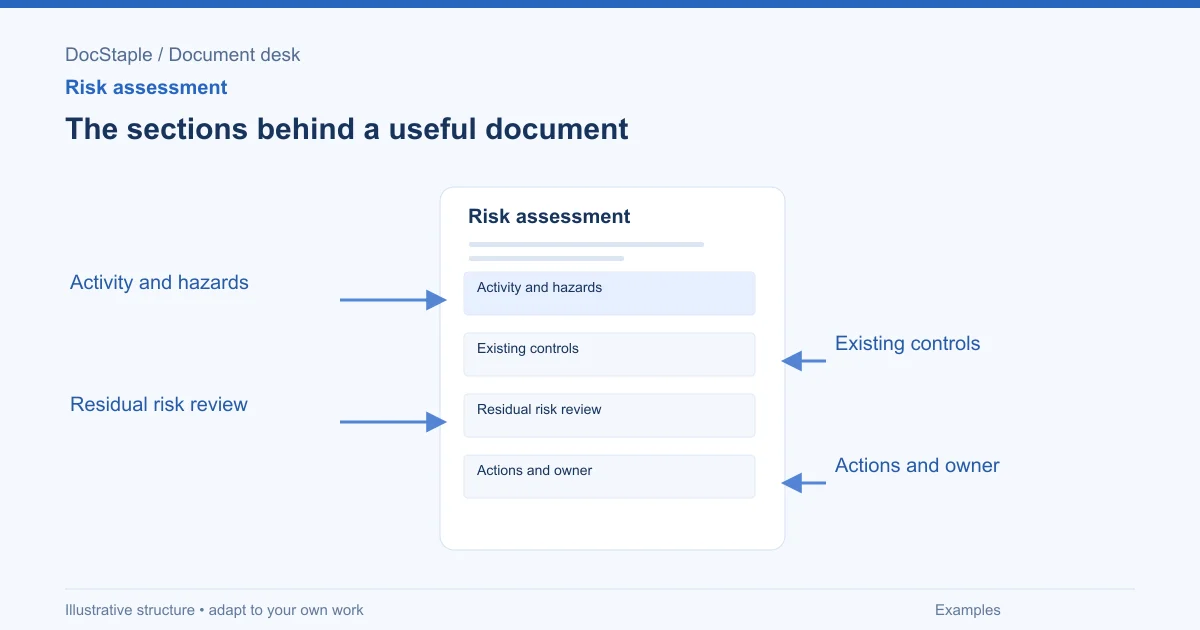
Risk assessment examples are most useful when they show the thinking, not just the finished table. A row that says "data breach: medium risk" does not help a consulting team decide what to do on Monday morning. A stronger example names the activity, the people affected, the existing controls that are already working, the exposure that remains and the person responsible for the next action.
This guide uses a fictional consulting firm preparing a strategy review for a regional distributor. The team will run interviews, analyze client documents, prepare recommendations and present them to the client sponsor. The examples are not legal, safety or cybersecurity advice. They show a practical drafting pattern you can adapt with qualified review.
Example 1: Discovery Interviews With Confidential Notes
Activity and hazards. The engagement lead schedules twelve discovery interviews with branch managers and finance staff. Hazards include collecting more personal or commercially sensitive information than the scope requires, storing notes in the wrong client folder, and quoting a staff member in a way that identifies them unnecessarily. For the information-security part of this example, NIST SP 800-30 Revision 1 provides a framework for assessing risks to information systems and organizations. It is US federal information-security guidance, not a mandatory consulting-project method. Here, identify the disclosure event, the weakness that could enable it, the likely effect and the evidence that current access controls work.
Existing controls. The statement of work limits interview topics to purchasing workflow and branch coordination. Interviewers use an approved question guide. Notes are stored in the project workspace, and the project manager checks access rights before interviews begin.
Residual risk review. The remaining risk is that a consultant copies raw notes into a general analysis file or includes unnecessary personal details in a client-facing summary. The residual risk is not removed by the existence of a workspace; it depends on whether the team actually uses it and whether the summary review catches over-disclosure.
Actions and owner. Assign the engagement lead to brief all interviewers before the first call. Assign the project manager to check that raw notes are not attached to the recommendations report. The client sponsor reviews the final summary for factual accuracy, but the consulting team remains responsible for its own handling of notes.
Draft language:
Discovery interview notes are restricted to the project workspace. The recommendations report will use role-level attribution only, unless the client sponsor approves a named quotation in writing.
Example 2: Analysis Workshop With Scope Drift
Activity and hazards. The consultants hold an internal analysis workshop. The team compares purchasing options and decides which recommendations to develop. A common consulting hazard is scope drift: the workshop turns into a wider operating model redesign, then the report contains recommendations nobody priced, reviewed or authorized.
Existing controls. The proposal defines the deliverable as a recommendations report on purchasing coordination. The workshop agenda lists the criteria to use. The engagement lead owns the decision log.
Residual risk review. Even with an agenda, senior stakeholders may introduce attractive but out-of-scope ideas. The residual risk is commercial and operational: the team may spend time on work it cannot deliver, or the client may rely on advice that has not been validated. Our recommended project-control rule is to compare every proposed recommendation against the approved deliverable before assigning analysis time. This is an editorial recommendation for managing the consulting engagement, not a workplace-safety requirement or a rule attributed to a regulator.
Actions and owner. The engagement lead adds a "scope check" column to the decision log. Anything outside the approved scope becomes a parking-lot item, not a recommendation, unless the client sponsor approves a change.
Draft language:
Recommendations outside the approved purchasing review scope will be recorded as potential follow-on work. They will not be included as final recommendations unless approved through the change-control process.
Example 3: Presentation of Unsupported Recommendations
Activity and hazards. The team presents a recommendations report to the client sponsor and leadership team. Hazards include unsupported conclusions, weak evidence trails and unclear advice handoff. The affected people are the client decision makers, staff who may be affected by the recommendations and the consulting firm if the advice is challenged later.
Existing controls. The report includes a source table linking each recommendation to interview themes, document review or workshop outputs. A peer reviewer checks whether conclusions are supported. The client receives a draft for factual correction before the leadership presentation.
Residual risk review. Peer review reduces but does not eliminate the risk of overstatement. The residual risk is highest where the report contains judgment rather than observed fact. For example, "centralizing purchasing will improve performance" is stronger than the evidence may support. "The evidence indicates three tradeoffs for centralizing purchasing" is easier to defend.
Actions and owner. The peer reviewer marks any recommendation as "supported", "partially supported" or "requires client decision". The engagement lead revises unsupported language before issue.
Draft language:
Based on the documents and interviews reviewed, the team recommends testing a central purchasing coordinator role for one quarter before committing to a permanent structure. This recommendation depends on client confirmation of branch staffing assumptions.
Example 4: Subcontractor Access to Client Materials
Activity and hazards. The consulting firm asks an independent analyst to model purchasing volumes. Hazards include sharing files before the subcontractor is approved, giving access to all project materials instead of the minimum needed and failing to remove access at the end.
Existing controls. The service agreement permits approved subcontractors only with client notice. The subcontractor has signed confidentiality terms. The project manager controls workspace permissions.
Residual risk review. The remaining risk is permission creep. A subcontractor may receive a folder link, then later view interview notes or draft advice they do not need. This is a control design issue, not just a trust issue.
Actions and owner. The project manager creates a separate analysis folder with only the input file and output location. The engagement lead records why the subcontractor needs each file. Access is removed after the analysis is accepted.
Draft language:
Subcontractor access is limited to the purchasing-volume input file and the analysis-output folder. The project manager will remove access after acceptance of the analysis output and record completion in the action log.
Review Criteria for the Finished Assessment
A useful consulting risk assessment should pass six checks.
First, the activity is specific. "Consulting project" is too broad; "discovery interviews for the purchasing strategy review" is workable. Second, the people, services, information and assets affected are named. Third, existing controls are controls that operate now, with evidence. Planned controls belong in the action plan. Fourth, residual risk is reviewed after current controls, not before. Fifth, each further action has an owner and a due date. Sixth, the responsible decision maker approves the remaining exposure before the work continues.
The UK government's Orange Book risk-management principles describe identifying and assessing risk, selecting responses, monitoring and reporting as connected management activities. Its formal scope is government departments and relevant public bodies; it does not impose requirements on this fictional private consultancy. As a drafting reference for organizational risk, it helps distinguish a one-time list from an ongoing decision process. For this engagement, use project retrospectives, client complaints, access logs, change requests and quality review notes to challenge whether the recorded controls remain effective.
Turn Examples Into a Working Draft
If you need a structured starting point, the consulting risk assessment template is an editable Word document with sections for activity and people affected, hazards and existing controls, evaluation and further action, approval and review. Use it to build a reviewed assessment from your own facts; do not treat the example entries as proof that your engagement is controlled.
Before approval, ask the reviewer: are the hazards credible, are the controls real, is the residual risk acceptable, and does every action have an owner? If any answer is unclear, the risk assessment is not ready to issue.
Last updated: September 26, 2026
Frequently Asked Questions
Related Articles
Audit Checklist Best Practices
Best practices for audit checklists, including scope, evidence, findings, actions, closure review, failure modes and sample wording.
Audit Checklist Checklist: Review Your Audit Form Before You Use It
A practical audit checklist checklist with decision gates for scope, evidence, findings, actions and closure review.
Audit Checklist Examples: Scope, Evidence, Findings and Closure
Audit checklist examples for consulting work, covering audit scope, evidence to inspect, findings and actions, closure review and practical draft wording.
Business Continuity Plan Best Practices for Consulting Teams
Business continuity plan best practices for consulting teams, including critical services, recovery priorities, communications, exercises and review criteria.
Business Continuity Plan Checklist for Consulting Teams
A practical business continuity plan checklist for consulting work, covering critical services, recovery priorities, communications, exercises and review criteria.
Business Continuity Plan Examples: Consulting Scenarios and Recovery Priorities
Business continuity plan examples for consulting teams, with critical services, recovery priorities, communications, exercises and review criteria.