Service Agreement Best Practices: Fix the Clauses That Usually Fail
Service agreement best practices for consulting work, with practical fixes for vague responsibilities, weak commercial terms, renewal problems and review gaps.
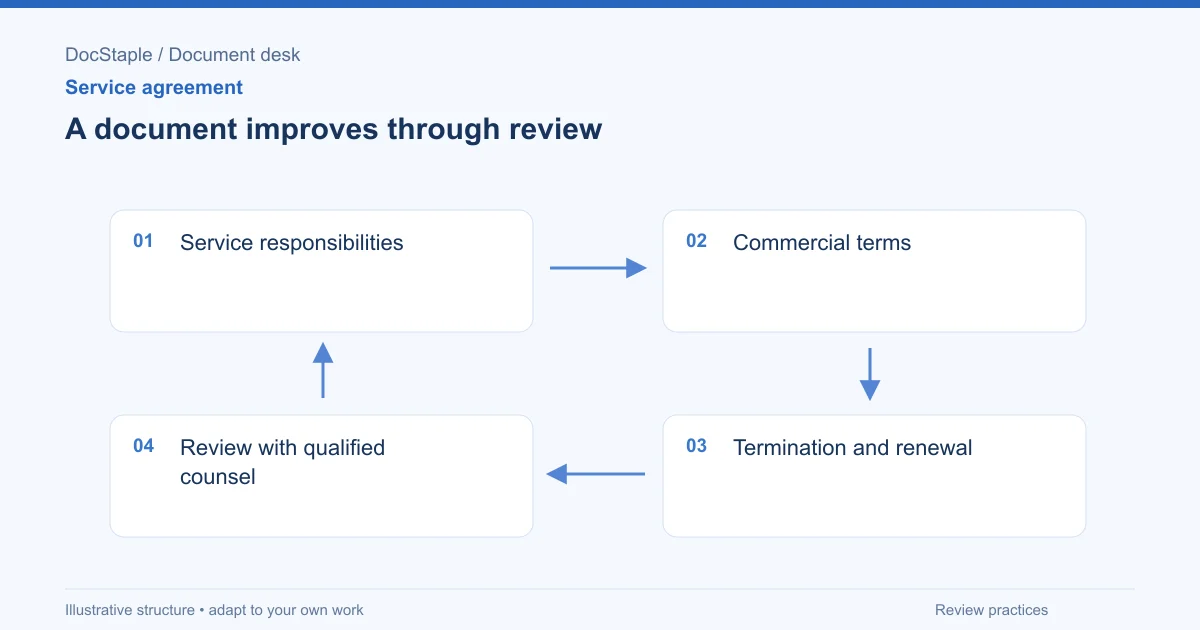
Service agreement best practices are not about making the document longer. They are about making the agreement easier to administer when the project is busy, the invoice is disputed or one party wants to leave.
This article uses a consulting scenario: a boutique advisory firm is entering a recurring operating-review agreement with a mid-sized client. The firm will prepare monthly advisory materials, run review meetings and maintain a decision log. The examples focus on failure modes and fixes, not a drafting sequence.
Make Responsibilities Observable
The first best practice is to write services so both parties can tell whether they happened. "Provide strategic support" is not observable. "Prepare one monthly advisory memo and facilitate one review call" is.
Failure mode
Consultant will provide ongoing strategic advisory support as needed.
This sounds flexible, but it hides the deliverable, time commitment, meeting cadence and client role.
Better approach
Consultant will prepare one monthly advisory memo, facilitate one review call of up to [duration], maintain a decision log and identify unsupported assumptions in the materials provided by Client.
Decision analysis: the revised wording is still flexible enough for consulting judgment, but it creates observable service events. If the client later asks for weekly workshops, the parties can see that the request is outside the monthly cadence.
For service orders under certain US federal schedules, FAR 8.405-2 points to concrete statement-of-work elements such as work to be performed, period of performance, deliverable schedule and performance standards when applicable (Acquisition.GOV FAR 8.405-2). Even outside federal procurement, those categories help expose vague drafting.
Use that test before arguing over clause style. If a service cannot be described by activity, timing, deliverable or standard, the issue is probably a business-design problem. Fix the service model first, then let the agreement record it.
Put Client Inputs Beside Provider Duties
Many service agreements over-focus on what the provider will do and understate what the client must supply. That creates avoidable conflict when data, access or approvals arrive late.
Failure mode
Consultant will deliver the monthly operating review by the fifth business day.
The sentence ignores the data needed to produce the review.
Better approach
Consultant will deliver the monthly operating review by the fifth business day after receiving the agreed data set listed in Schedule 2. Client will provide the data set by the first business day of each month.
Decision analysis: the timing now depends on a defined input. If the client is late, the agreement gives both parties a fair basis for rescheduling. This is better than arguing about whether the consultant "should have known" data was missing.
Add a practical escalation route:
If a required input is incomplete, Consultant will notify [client contact]. The affected deliverable date moves by the number of business days the input remains incomplete, unless the parties agree another date in writing.
This does not excuse poor communication. It gives the team a predictable path when delivery depends on the client.
The same principle applies to approvals. If the consultant needs sponsor approval before sending a board memo, name the approver and response time. Otherwise, the provider may be blamed for delay while waiting for a decision only the client can make.
Keep Commercial Terms Connected To Scope
Fees should connect to the work described. Best practice is to make the commercial model and the service model match.
Failure mode
Client will pay $[amount] per month for consulting services.
This leaves the fee untethered. Does it cover emails, meetings, rewritten reports, executive presentations and urgent analysis?
Better approach
The monthly fee covers the services in Schedule 1: one advisory memo, one review call, decision-log maintenance and up to [number] clarification emails per month. Work outside Schedule 1 requires a written change stating added services, timing and fees.
Decision analysis: this protects both sides. The client knows what the retainer includes, and the consultant has a written path for additional work. If the business wants unlimited access, the fee and staffing model should reflect that consciously.
The FTC advises small businesses to read contracts carefully, get terms in writing and keep the full agreement, particularly where sales promises and contract terms can diverge (FTC small business contract alert). The lesson for service agreements is simple: if the commercial promise matters, put it in the document.
Best practice also means protecting the change process from informal erosion. A friendly email saying "can you also look at this?" may be harmless once. Repeated extras become a new service line. The agreement should make it normal to pause, scope and price additional work.
Treat Confidentiality As An Operating Requirement
Confidentiality clauses fail when they are too abstract. Best practice is to connect information handling to the service being performed.
Failure mode
Each party will keep confidential information confidential.
That may be a starting point, but it does not tell the team what information will be exchanged or how it should be handled.
Better approach
Client will provide operating metrics, leadership decisions and process documents needed for the services. Consultant will use that information only for the services, limit access to personnel assigned to the engagement and return or delete copies according to Section [x] at the end of the term.
Decision analysis: this version is more operational. It names the expected information and the handling rules. If regulated personal data or financial account information will be shared, the agreement should say so and include appropriate safeguards.
The FTC tells businesses that security expectations for service providers with sensitive information should be built into contracts and monitored (FTC Start with Security). Do not copy a broad security promise if your firm cannot meet it.
For advisory work, the best information-handling clause is often narrower than the first draft. If the consultant does not need customer-level data, exclude it. If recordings are not needed after notes are prepared, set a deletion rule. Specific limits are easier to honor than sweeping promises.
Avoid Renewal And Exit Surprises
Renewal and termination clauses should match the business relationship. A short advisory pilot may need a clean end date. A managed service may need renewal mechanics and transition support.
Failure mode
This agreement renews automatically unless terminated.
This omits notice timing, renewal length and cancellation process.
Better approach
The agreement starts on [date] and ends on [date]. It renews for additional [period] terms only if both parties sign a renewal or statement of work before the end date.
Decision analysis: written renewal is often cleaner for consulting pilots because it forces a scope and fee review. If automatic renewal is important, have counsel review the notice mechanics and jurisdiction-specific rules.
For termination:
On termination, Consultant will provide completed advisory memos and the current decision log through the termination date. Client will pay undisputed fees earned and approved expenses incurred through that date.
This is not a full remedies clause. It is an operational exit rule. Liability, indemnity, breach remedies and dispute resolution belong in counsel-reviewed language.
Exit wording should also preserve continuity for the client without creating unpaid work. A concise transition package can include completed memos, the current decision log and a list of open questions. It should not include new analysis unless the agreement or a change order covers it.
Review The Draft In The Right Order
Best practice is to split review by expertise. The business owner reviews services and pricing. The delivery lead confirms the work can be performed. Finance reviews billing mechanics. Counsel reviews legal-effect terms for the governing jurisdiction.
When the agreement is edited in Word, finalize the document deliberately. Microsoft Support states that removing tracked changes requires accepting or rejecting them, because hiding markup does not remove it (Microsoft Support). That is a practical document-control step, not a legal review.
The consulting service agreement template gives you editable sections for services, client inputs, fees, termination and review notes. Use it to avoid starting from a blank page, then adapt the clauses to the real service model and send legal-risk provisions for qualified review.
The best agreements are boring in the right way: clear enough that delivery teams can follow them without interpretation games. When a clause needs a side explanation every time someone reads it, rewrite the clause or add the missing schedule.
Last updated: September 26, 2026
Frequently Asked Questions
Related Articles
Capability Statement Best Practices for Consulting Firms
Capability statement best practices for consulting firms, with fixes for vague competencies, weak past performance, generic differentiators and stale credentials.
Capability Statement Checklist for Buyer-Ready Consulting Drafts
A capability statement checklist for consulting firms, with review gates for core competencies, relevant experience, differentiators, credentials and contact details.
Capability Statement Examples: Four Sections Written Weak and Then Strong
Capability statement examples for a fictional consulting firm: core competencies, relevant experience, differentiators, and contact and credentials, each shown as weak and stronger draft wording with a review checklist.
Engagement Letter Best Practices
Best practices for engagement letters, including scope control, responsibility wording, limitation language and approval records.
Engagement Letter Checklist
Use this engagement letter checklist to review purpose, parties, responsibilities, limitations, approval and signature readiness.
Engagement Letter Examples: Purpose, Scope Limits and Signatures
Engagement letter examples for consulting work, with annotated wording for parties, responsibilities, scope limitations, approval and signatures.