Service Agreement Checklist: Responsibilities, Terms, Renewal and Review
A practical service agreement checklist for consulting work, covering service responsibilities, commercial terms, termination, renewal and legal review.
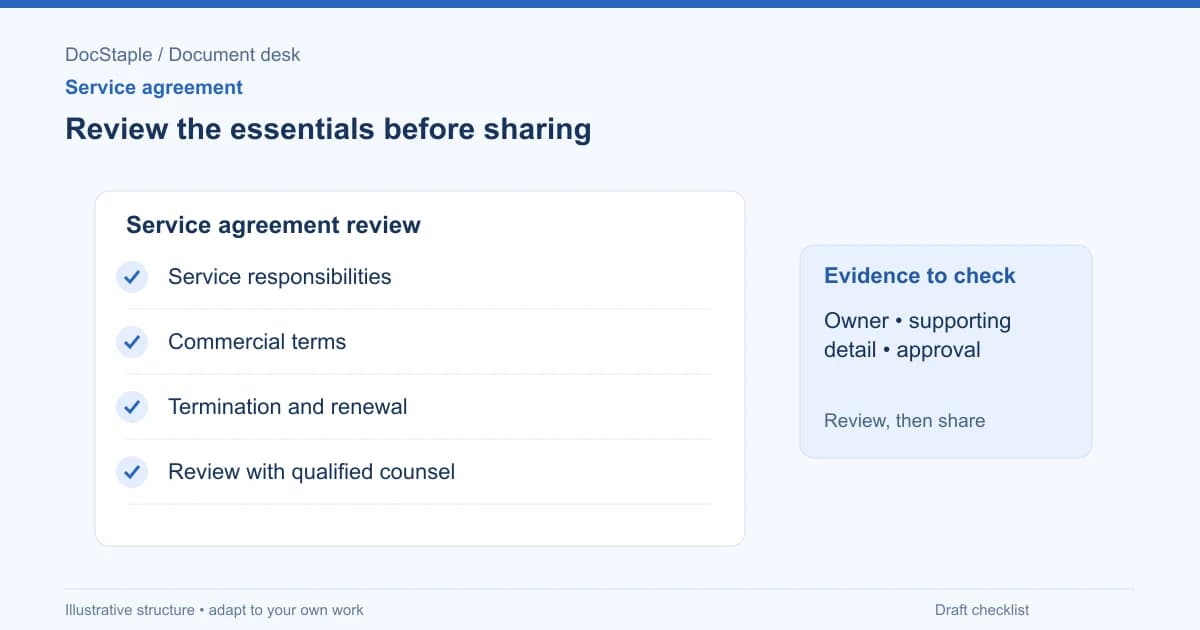
A service agreement checklist helps you find gaps before a draft becomes a signature copy. It should test whether the agreement explains who does what, how payment works, when the relationship starts and ends, and which terms need qualified legal review.
This article uses a consulting scenario: a firm will provide a three-month leadership operating review after completing a strategy project. The service includes monthly advisory memos, review calls and a decision log. It does not include implementation management or software configuration. The examples use United States business-contract context, but enforceability and required terms vary by state and country.
Confirm Parties, Scope And Service Responsibilities
Start with the agreement’s basic map. If the parties or services are wrong, polished legal language cannot save the draft.
Checklist items
- Legal names and addresses are correct.
- Signers have authority.
- Service start date is stated.
- Services are listed in measurable terms.
- Exclusions are visible.
- Client responsibilities are listed.
Worked example: responsibility table
| Provider responsibilities | Client responsibilities |
|---|---|
| Prepare one monthly advisory memo of up to [number] pages | Provide operating data by [day] of each month |
| Facilitate one monthly leadership review call | Ensure sponsor or delegate attends |
| Maintain decision and action log | Review action log within [number] business days |
| Flag unsupported assumptions | Decide whether to accept, defer or reject recommendations |
Decision analysis: this table prevents a retainer from becoming "available for anything." It also makes client inputs part of the service design. If the client misses data deadlines, the consultant’s deliverable timing may need to move.
FAR 8.405-2 says certain federal service statements of work include work to be performed, location, period of performance, deliverable schedule, performance standards and special requirements when applicable (Acquisition.GOV FAR 8.405-2). A private consulting agreement may not be governed by that rule, but those categories are a useful drafting test.
The same check can expose a hidden staffing assumption. If a client expects partner attendance at every meeting, the agreement should say so. If the provider may use analysts for research and a principal for review, write that model into the responsibility section before pricing is approved.
Test Commercial Terms
Commercial terms should answer ordinary billing questions without a side conversation. Check fees, invoicing, taxes, expenses, disputed amounts and extra work.
Checklist items
- Fee structure is stated.
- Invoice timing and due dates are clear.
- Expense approval rules are written.
- Taxes are addressed for the relevant jurisdiction.
- Disputed invoice process is included.
- Out-of-scope work requires written approval.
Worked example: fee clause
Client will pay [currency and amount] per month, invoiced monthly in advance and due [number] days after invoice date. The fee covers only the services in Schedule 1. Travel and out-of-pocket expenses require Client’s written approval before they are incurred.
Decision analysis: the clause is useful because it links the fee to Schedule 1. If the service list expands, the change process must be used. Without that link, a monthly fee can quietly turn into unlimited advisory availability.
Add a disputed invoice path:
If Client disputes part of an invoice, Client will notify Provider within [number] days, explain the disputed amount and pay undisputed amounts when due.
This language does not solve every payment issue, but it stops a whole invoice from becoming unclear because one line item is questioned.
Check whether the agreement connects late payment to service continuity. Some businesses pause work after overdue invoices; others continue during dispute escalation. Either choice has cash-flow and relationship consequences, so it should be a business decision reflected in the agreement instead of an improvised response.
Check Confidentiality And Information Handling
Consulting services often expose business plans, employee information or operational data. The agreement should say what information is expected and what restrictions apply.
Checklist items
- Confidential information is defined.
- Use of information is limited to the services.
- Access is limited to people who need it.
- Sensitive data categories are identified.
- Return or deletion requirements are addressed.
- Security expectations are specific enough to administer.
Annotated sample language
Provider will use Client confidential information only to perform the services. Client will not provide regulated personal data, health information or payment-card data unless the parties first agree the required safeguards in writing.
Why it works: it keeps the agreement aligned with the actual consulting work. If the service requires regulated data, the parties can add the necessary safeguards instead of pretending a generic confidentiality sentence covers everything.
The FTC advises businesses to build expectations into contracts with service providers that will access sensitive information (FTC service-provider security guidance). For a service agreement checklist, that means reviewing whether security language is operational enough to follow.
For a consulting retainer, the information-handling review should ask what the consultant truly needs. If the monthly advisory memo can be prepared from aggregated operating metrics, do not ask for raw personnel files. Minimizing unnecessary information makes the agreement easier to administer and lowers practical risk.
Review Term, Termination And Renewal
The checklist should force the draft to answer three questions: when does it start, how does it end and what survives after ending?
Checklist items
- Effective date is clear.
- Initial term is stated.
- Renewal method is written.
- Termination for convenience is addressed if intended.
- Termination for breach has notice and cure language.
- Post-termination deliverables, fees and return of information are covered.
Worked example: non-automatic renewal
The agreement starts on [date] and ends on [date]. It renews only if both parties sign a written renewal before the end date.
Decision analysis: this is appropriate when the parties want a defined pilot or short retainer. It avoids surprise renewals. If the business wants automatic renewal, ask counsel to review notice, cancellation and state-law implications.
Worked example: termination transition
Either party may terminate for convenience on [number] days’ written notice. Client will pay undisputed fees earned through the termination date. Provider will deliver completed advisory memos and the current decision log after payment of undisputed amounts.
Decision analysis: this clause focuses on what happens operationally at exit. It does not attempt to settle liability, indemnity or dispute remedies. Those legal-risk provisions deserve qualified review.
Renewal should also trigger a scope refresh. If the first three months produced new workstreams, the renewal should not quietly inherit the old fee and service list. Add a note requiring the parties to review service volume, meeting cadence, named contacts and open actions before renewal.
Send Legal-Effect Terms To Counsel
Some terms should not be finalized from a checklist alone. Have qualified counsel review governing law, liability limits, warranties, indemnity, intellectual property, confidentiality, dispute resolution, non-solicitation, insurance and signer authority.
This is especially important when the agreement crosses jurisdictions. A consultant in California serving a New York client, for example, may need different review than a local sole-proprietor agreement. The checklist can identify the issue; counsel decides whether the wording works.
Before sending the Word file, remove drafting artifacts. Microsoft says tracked changes must be accepted or rejected to remove markup from a document (Microsoft Support). Save a review copy internally if you need the edit history, then issue the intended version.
Use The Checklist With A Draft
Run the checklist against a complete draft, not a blank page. Mark each issue as "ready," "needs business decision" or "needs counsel." That separation helps the team avoid mixing practical service questions with legal-risk questions.
The consulting service agreement template provides an editable Word structure for parties, services, client inputs, commercial terms, termination and review notes. Use it to start the draft, then verify every clause against the actual consulting engagement and jurisdiction.
Use the checklist as a review record too. Save the business decisions that shaped the draft, especially exclusions, fee assumptions and data limitations. When a question comes up after signature, those notes help the team understand why the agreement says what it says.
Last updated: September 26, 2026
Frequently Asked Questions
Related Articles
Capability Statement Best Practices for Consulting Firms
Capability statement best practices for consulting firms, with fixes for vague competencies, weak past performance, generic differentiators and stale credentials.
Capability Statement Checklist for Buyer-Ready Consulting Drafts
A capability statement checklist for consulting firms, with review gates for core competencies, relevant experience, differentiators, credentials and contact details.
Capability Statement Examples: Four Sections Written Weak and Then Strong
Capability statement examples for a fictional consulting firm: core competencies, relevant experience, differentiators, and contact and credentials, each shown as weak and stronger draft wording with a review checklist.
Engagement Letter Best Practices
Best practices for engagement letters, including scope control, responsibility wording, limitation language and approval records.
Engagement Letter Checklist
Use this engagement letter checklist to review purpose, parties, responsibilities, limitations, approval and signature readiness.
Engagement Letter Examples: Purpose, Scope Limits and Signatures
Engagement letter examples for consulting work, with annotated wording for parties, responsibilities, scope limitations, approval and signatures.