Service Agreement Examples: Responsibilities, Fees and Exit Terms
Service agreement examples for a consulting support retainer, with annotated language for responsibilities, commercial terms, termination, renewal and legal review.
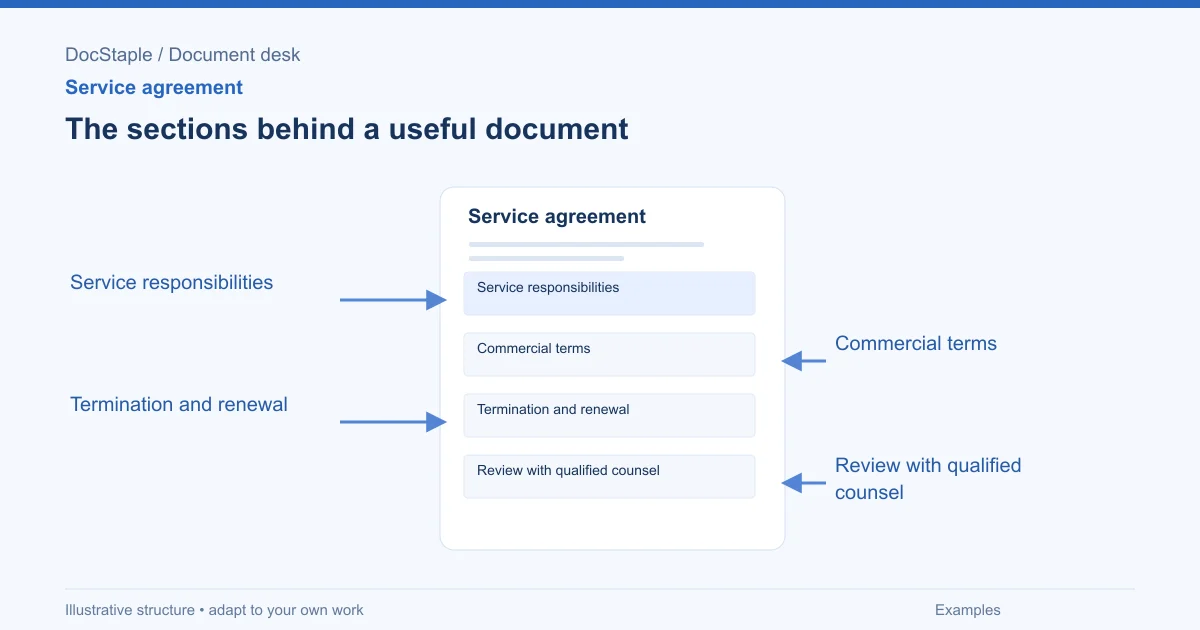
Service agreement examples are most useful when they show the tradeoffs hiding inside ordinary clauses. A line like "consultant will provide advisory support" sounds tidy, but it does not tell either party what support means, who supplies the inputs, when the work is due or how extra requests are handled.
This article uses a fictional U.S. consulting scenario: a small operations consultancy is providing a six-month monthly advisory retainer to a regional distributor after a strategy review. The client wants help turning recommendations into management routines, but not implementation labor. Names, amounts and dates below are placeholders. Because service agreements can create binding obligations, and contract law varies by state and country, treat the examples as drafting prompts and not legal advice.
Start with the services and the parties
A service agreement should begin by naming the legal parties, the effective date and the service purpose. Do not rely on brand names, nicknames or a contact's email signature.
Example language
This Service Agreement is between [Consultant legal name], a [state/country and entity type] with its principal address at [address], and [Client legal name], a [state/country and entity type] with its principal address at [address]. The agreement covers advisory support for the management routines described in Schedule 1.
Annotation: The wording separates the legal parties from the project description. If the client uses subsidiaries or regional branches, this line forces the question before the first invoice.
Then add a short purpose statement:
The purpose of the services is to help [Client] convert the approved strategy review recommendations into a repeatable monthly operating review. The services do not include system configuration, staffing decisions, supplier negotiation or implementation management unless added through a written change.
The exclusion is doing real work. It stops the agreement from becoming a soft promise to do anything connected with the strategy review. For U.S. federal service orders, FAR 8.405-2 says statements of work include the work to be performed, location, performance period, deliverable schedule, performance standards and special requirements when applicable (Acquisition.GOV, FAR 8.405-2). A private consulting agreement is not governed by that FAR clause unless incorporated by contract, but the list is a useful drafting test.
Define service responsibilities
Responsibilities are clearer when the agreement names both provider duties and client inputs. A one-sided list makes the provider look accountable for delays it cannot control.
Example language
Consultant will prepare one monthly advisory memo of up to [number] pages, attend one remote operating review meeting of up to [duration], and maintain an action log of decisions assigned during the meeting.
Client will provide monthly sales, inventory and staffing data by the [day] business day of each month, nominate one sponsor to consolidate comments, and make decision owners available for the operating review.
Annotation: The provider duties are countable. The client duties are not background wishes; they are prerequisites for the work.
Add review language for deliverables:
Client will review each advisory memo for factual accuracy within [number] business days. Consultant will correct factual errors identified by the sponsor. Advice, recommendations and professional judgments are not rejected merely because Client chooses a different business decision.
This sentence distinguishes factual review from approval of every recommendation. That matters in advisory work, where the consultant can deliver a well-supported recommendation that the client declines to follow.
Make commercial terms easy to audit
Commercial terms should answer five questions: how much, when invoiced, when due, what expenses are reimbursable and what happens if payment is disputed.
Example language
Fees are [currency and amount] per month for the services in Schedule 1, invoiced on the first business day of each month and due [number] days after invoice date. Pre-approved travel expenses are reimbursed at cost with receipts. Taxes are handled according to applicable law in [jurisdiction]. Client must notify Consultant of any disputed invoice amount within [number] days and pay undisputed amounts when due.
Annotation: The disputed-invoice sentence prevents an all-or-nothing payment argument. It also creates a record of the specific issue.
Be careful with cancellation promises and renewal fees. The FTC has warned small businesses to read payment-processing contracts and check how to get out before signing; it specifically advises getting agreement terms in writing and keeping the whole document, especially for electronic signatures (FTC consumer alert for small businesses). That FTC article is about a specific payment-processing context, not consulting retainers, but the drafting lesson transfers cleanly: do not bury duration, renewal or exit costs.
Write termination and renewal without traps
Termination and renewal clauses should be plain enough for a project manager to administer without guessing. Avoid "may terminate for convenience" unless you also state notice, final fees and transition duties.
Example language
Either party may terminate this agreement for convenience on [number] days' written notice. Client will pay for services performed and approved expenses incurred through the effective termination date. Consultant will provide the current action log and any completed advisory memos after payment of undisputed amounts.
This agreement starts on [date] and ends on [date]. It renews only by written agreement signed by both parties. No automatic renewal applies.
Annotation: This version uses an affirmative renewal. If your business uses automatic renewal, have counsel review whether state, federal or consumer rules apply. Requirements differ by jurisdiction and customer type.
For breach, use a cure period if appropriate:
If either party materially breaches this agreement, the non-breaching party may give written notice describing the breach. If the breach is capable of cure and is not cured within [number] days, the non-breaching party may terminate by written notice.
This language is deliberately incomplete on remedies, liability and governing law. Those terms carry legal consequences and should be reviewed by qualified counsel.
Add confidentiality and security only if you can operate it
Consulting agreements often mention confidential information, but vague promises can be weaker than a practical rule. If the consultant will receive sensitive client data, state who may access it, where it may be stored and how it is returned or deleted.
Example language
Consultant may use Client confidential information only to perform the services. Consultant will limit access to personnel who need the information for the engagement and are bound by confidentiality obligations. At termination, Consultant will return or delete Client confidential information except for archival copies retained under professional, insurance or legal obligations.
Annotation: The archival exception avoids a promise the consultant may not be able to keep. It also invites counsel to adjust the wording for the actual jurisdiction and records duties.
For data security, the FTC tells businesses that expectations, performance standards and monitoring methods should be reduced to writing when service providers have access to sensitive information (FTC business guidance on service providers). If security matters here, do not write "reasonable security" and stop. Attach a short schedule that names the actual controls the parties expect.
Run the counsel review before signature
Service agreement examples help you see structure; they do not make the agreement enforceable or complete. Before signature, route the draft through the person qualified to review contracts in the governing jurisdiction.
Use this review gate:
- Parties: legal names, addresses and signing authority confirmed.
- Services: recurring services, meeting limits, deliverables and exclusions stated.
- Client inputs: data, access, sponsor and review deadlines named.
- Commercial terms: fees, invoicing, taxes, expenses and disputed amounts covered.
- Term: start date, end date, renewal and termination mechanics clear.
- Legal terms: confidentiality, IP, liability, warranties, governing law and dispute process reviewed by qualified counsel.
- Operations: someone can administer the agreement without asking what the clause meant.
Start from an editable Word draft
The consulting service agreement template gives you an editable Word structure for parties and services, service obligations and client inputs, fees and commercial provisions, term, termination and disputes, plus an approval record. Use the examples above to test the wording, then replace every bracketed field with verified facts. The template is a starting draft, not a substitute for legal review.
Sources: FAR 8.405-2, Acquisition.GOV, FTC small business payment-processing contract alert, FTC service provider security guidance
Last updated: September 26, 2026
Frequently Asked Questions
Related Articles
Capability Statement Best Practices for Consulting Firms
Capability statement best practices for consulting firms, with fixes for vague competencies, weak past performance, generic differentiators and stale credentials.
Capability Statement Checklist for Buyer-Ready Consulting Drafts
A capability statement checklist for consulting firms, with review gates for core competencies, relevant experience, differentiators, credentials and contact details.
Capability Statement Examples: Four Sections Written Weak and Then Strong
Capability statement examples for a fictional consulting firm: core competencies, relevant experience, differentiators, and contact and credentials, each shown as weak and stronger draft wording with a review checklist.
Engagement Letter Best Practices
Best practices for engagement letters, including scope control, responsibility wording, limitation language and approval records.
Engagement Letter Checklist
Use this engagement letter checklist to review purpose, parties, responsibilities, limitations, approval and signature readiness.
Engagement Letter Examples: Purpose, Scope Limits and Signatures
Engagement letter examples for consulting work, with annotated wording for parties, responsibilities, scope limitations, approval and signatures.