Statement of Work Best Practices That Prevent Scope Drift
Statement of work best practices for consulting teams: set boundaries, build work packages, write acceptance criteria and control changes.
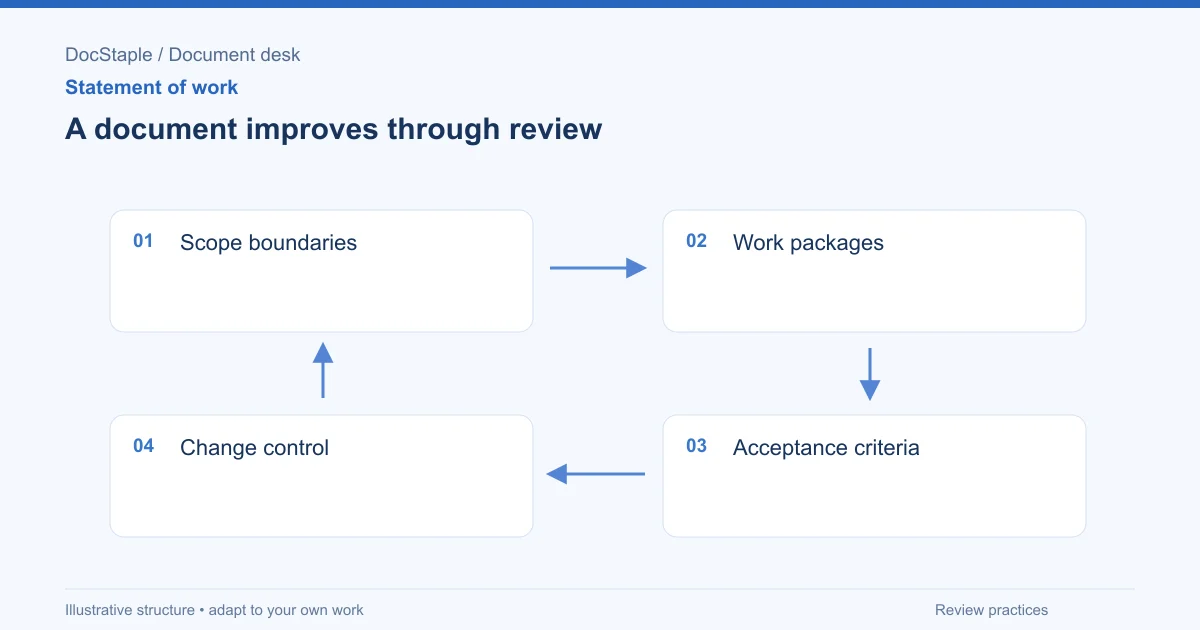
Statement of work best practices are easiest to understand through failure modes. A vague SOW rarely breaks on day one. It breaks when the client asks for extra interviews, a deliverable is rejected without a standard, or an informal email is treated as a change order.
This guide uses a consulting scenario: an analytics firm is hired to review sales pipeline reporting for a B2B software company. The engagement includes discovery interviews, analysis review and a recommendation presentation. It does not include dashboard build-out. The SOW must make that distinction plain.
Federal and state procurement sources are not a substitute for your agreement, but they provide useful drafting habits. FAR performance-work-statement guidance says agencies should describe required results rather than how work is accomplished, and enable assessment against measurable standards FAR 37.602. Oregon's SOW guide says deliverables should be tangible and measurable and warns against vague words such as assist and reasonable ODOT SOW Writing Guide.
Define the authorized work in one paragraph
A strong SOW opens with a sentence that limits authority.
This SOW authorizes [Consultant] to review sales pipeline reporting for [Client] and produce the deliverables listed below under [master agreement/date]. It authorizes only discovery, analysis and recommendation work; dashboard configuration and training are excluded unless approved through change control.
Annotation: this wording protects both sides. The consultant cannot wander into unapproved work, and the client can see exactly what the fee buys.
Add place and period. FAR SOW guidance for federal schedule services lists location and period of performance among required elements FAR 8.405-2. For private consulting, the same items avoid basic confusion: remote or on-site, start trigger, end date, time zone and access windows.
Use work packages instead of activity clouds
A weak SOW says the consultant will "review reporting and support stakeholder alignment." A better SOW breaks the work into packages with outputs.
| Package | Included work | Output | Not included |
|---|---|---|---|
| Discovery | Up to [number] interviews and review of named reports | Discovery summary | Survey design |
| Analysis | Compare definitions, handoffs and reporting gaps | Findings matrix | CRM configuration |
| Recommendation | Draft report and one presentation | Recommendations report | Training materials |
Annotation: the package format catches scope drift early. If someone asks for training materials, the answer is not hostile; it is simply outside the current package.
Make acceptance objective enough to use
Acceptance should not depend on whether the reviewer likes the conclusion. It should depend on whether the deliverable meets the agreed test.
Draft language:
The findings matrix is accepted when it lists the agreed pipeline stages, identifies the source used for each definition, records unresolved definition conflicts and is reviewed by [sponsor] within [number] working days. Rejection must identify the unmet criterion and the correction requested.
Best practice is to tie each deliverable to evidence. Consulting recommendations are especially vulnerable to arguments about unsupported judgment. Require source notes: interview, report version, data extract or decision record.
Treat dependencies as part of scope
A dependency is not admin detail. If the client does not provide data, access or reviewers, the project changes. Write dependencies in the same section as work packages.
The timetable assumes [Client] provides the report inventory and CRM field definitions by [date]. If the materials are not received by that date, affected milestones move by the number of working days delayed unless both parties approve another recovery plan.
This is better than saying the client will provide materials "promptly." Promptly is an argument waiting politely in the corner.
Control change without making it theatrical
Change control should be simple enough that people use it. Require a written request, an impact assessment and authorized approval. Keep the current approved SOW version with the project records.
Good change language covers four impacts: scope, schedule, fee and acceptance. If a requested dashboard mockup affects only scope and fee, state that. If it also changes the acceptance test for the recommendations report, state that too.
For optional work that may or may not be needed, Oregon's guide describes contingency tasks that are tightly defined and started only by written notice ODOT SOW Writing Guide. Private teams can borrow the principle by defining optional workshops or extra interviews with a cap and approval condition.
Keep legal and commercial terms in their lane
A SOW often sits under a master services agreement. Do not accidentally rewrite liability, confidentiality, payment remedies or termination terms in the SOW unless the agreement allows it and the right reviewer has approved the change. Use a precedence clause so contradictions do not become a puzzle.
Draft language:
If this SOW conflicts with the master services agreement dated [date], [state which document prevails for which subject].
That bracket should not be guessed. It belongs with whoever owns commercial and legal review in the relevant jurisdiction.
Worked decision: when a dashboard mockup belongs outside the SOW
The analytics-firm scenario has a predictable pressure point. Once the consultant identifies inconsistent sales-stage definitions, the client may ask for a dashboard mockup so leaders can "see what good looks like." That can be useful, but it is not the same as reviewing pipeline reporting. It can pull the work toward design, CRM configuration and user training.
There are three possible ways to handle the request. First, exclude dashboard work entirely. Second, include a lightweight conceptual exhibit inside the recommendation report. Third, add a separate dashboard-design package with its own inputs, fee and acceptance criteria. The right choice depends on the evidence available. If the project has not settled field definitions or source reports, a dashboard design package is premature. A conceptual exhibit may be enough to illustrate the recommendation without implying build responsibility.
Draft wording for that middle path:
The recommendations report may include one non-technical sample view to illustrate reporting principles. The sample view is not a dashboard specification, wireframe for build, CRM configuration instruction or training material. Any dashboard design, prototype or implementation support requires a separate work package.
This wording lets the consultant communicate clearly without letting a single example become an accidental deliverable. It also gives the client a practical decision point: resolve definitions first, then decide whether design or implementation support is worth buying.
If the client insists on a prototype during the same engagement, make it a different package rather than a sentence inside the report deliverable. A prototype package would need source-system assumptions, sample data rules, responsible reviewers from sales operations and revenue leadership, and a separate acceptance test. For example: "Prototype accepted when it displays the agreed sample fields using test data supplied by [Client]; it is not production-ready and is not connected to live CRM records." That is materially different from a recommendation report.
The evidence should drive the sequencing. A findings matrix can expose that two teams use "qualified opportunity" differently. Until that definition conflict is resolved, a dashboard mockup may make disagreement look polished instead of solved. Put the definition decision before the visual design decision.
Start from an editable Word draft
Use the consulting statement of work template to pin the pipeline-reporting review to defined packages, evidence-based deliverables and a change path for later dashboard work. If the engagement is still being sold, start with the consulting proposal template.
Last updated: September 26, 2026
Frequently Asked Questions
Related Articles
Capability Statement Best Practices for Consulting Firms
Capability statement best practices for consulting firms, with fixes for vague competencies, weak past performance, generic differentiators and stale credentials.
Capability Statement Checklist for Buyer-Ready Consulting Drafts
A capability statement checklist for consulting firms, with review gates for core competencies, relevant experience, differentiators, credentials and contact details.
Capability Statement Examples: Four Sections Written Weak and Then Strong
Capability statement examples for a fictional consulting firm: core competencies, relevant experience, differentiators, and contact and credentials, each shown as weak and stronger draft wording with a review checklist.
Engagement Letter Best Practices
Best practices for engagement letters, including scope control, responsibility wording, limitation language and approval records.
Engagement Letter Checklist
Use this engagement letter checklist to review purpose, parties, responsibilities, limitations, approval and signature readiness.
Engagement Letter Examples: Purpose, Scope Limits and Signatures
Engagement letter examples for consulting work, with annotated wording for parties, responsibilities, scope limitations, approval and signatures.