How to Write a Standard Operating Procedure: A Practical Drafting Sequence
Learn how to write a standard operating procedure with purpose and owner, step-by-step instructions, exceptions, escalation, version review and review criteria.
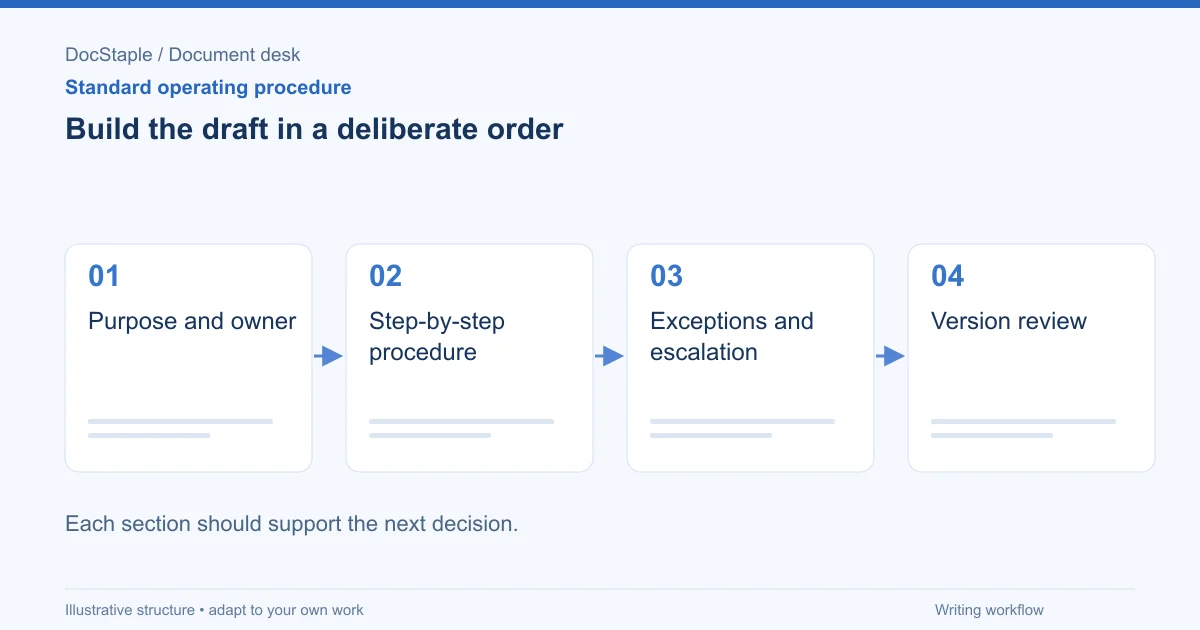
A standard operating procedure is not a description of how work might happen on a perfect day. It is an instruction for a trained person to complete repeatable work in a consistent way, including what to do when the normal path breaks.
This guide uses a consulting scenario: a firm needs an SOP for preparing a recommendations report after discovery interviews. The SOP covers purpose and owner, step-by-step procedure, exceptions and escalation, and version review. The example language is a drafting aid, not a compliance guarantee.
Define the Purpose, Scope and Owner
Start by deciding whether the work really needs an SOP. An SOP is useful when work is repeated, quality depends on consistent execution, records matter or different people need to hand off the same task. EPA guidance describes SOPs as written instructions that document routine or repetitive activities and says they describe technical and administrative operational elements (US EPA SOP FAQ).
For the consulting scenario, the purpose is not "write better reports". That is too broad. A tighter purpose is:
This SOP defines how the consulting team prepares, reviews and issues the recommendations report for the strategy review engagement after discovery interviews are complete.
Then define the scope:
This SOP starts when the engagement lead confirms discovery is complete. It ends when the approved recommendations report is issued to the client sponsor. It does not cover contract changes, implementation planning or legal review of client decisions.
Name an owner. The owner is responsible for keeping the SOP current, not necessarily for performing every step.
Document owner: Engagement operations lead. Process owner: Engagement lead for each client project. Reviewers: Peer reviewer, client sponsor for factual corrections and quality manager for version release.
Map the Workflow Before Writing Steps
Before drafting numbered steps, map the actual workflow with the people who do the work. The EPA says SOPs should be specific to the organization, that there is no one correct format, and that individuals knowledgeable about the activity should write them or participate in a team approach (US EPA).
For the recommendations report, the workflow might be:
- Confirm discovery is complete.
- Lock the evidence register.
- Draft findings.
- Hold analysis review.
- Draft recommendations.
- Complete peer review.
- Send factual-check draft.
- Resolve comments.
- Issue approved report.
Now add prerequisites. Prerequisites prevent people from starting before the process is ready:
Do not begin Step 3 unless the approved scope, interview notes, evidence register and decision log are available in the project workspace.
That sentence is more useful than a warning buried near the end. It gives the user a stop condition.
Write the Step-by-Step Procedure
Each step should say who acts, what they do, what record they create and what decision happens next. Use verbs that can be observed. "Consider the evidence" is weak. "Compare each finding to at least one source in the evidence register" is stronger.
Example procedure section:
Step 1: Confirm discovery completion. The engagement lead checks that planned interviews are complete or that missing interviews are recorded as unavailable. Record the decision in the project decision log.
Step 2: Lock the evidence register. The project manager exports the evidence register as version [number] and saves it in the report folder. Later evidence is added only with engagement lead approval.
Step 3: Draft findings. The report author drafts each finding with a short evidence note. Findings without support are marked "unconfirmed" and may not become recommendations.
Step 4: Hold analysis review. The engagement lead and peer reviewer classify each finding as supported, partly supported or removed.
Step 5: Draft recommendations. The report author links each recommendation to supported findings and states any client decision required.
EPA's SOP guidance page points to its detailed SOP preparation guidance, and the underlying guidance is designed as a working tool for documenting routine quality-system management and technical activities (US EPA SOP guidance). Even if your consulting SOP is not an EPA quality-system document, the drafting lesson transfers: the SOP should support repeatable work and evidence of how it was performed.
Add Exceptions and Escalation
Most SOPs fail at the edge cases. They describe the happy path and leave users guessing when a prerequisite is missing, a client asks for a shortcut or confidential information appears in the wrong place.
For this consulting SOP, include exceptions:
Missing evidence. If a recommendation cannot be linked to the evidence register, the author marks it "unsupported" and escalates to the engagement lead. The recommendation is removed unless the engagement lead approves additional analysis.
Scope change. If the client requests a recommendation outside the approved scope, record the request in the decision log and follow the change-control process before drafting advice.
Confidential information incident. If client material is shared outside the approved project workspace, pause affected work, notify the engagement lead and follow the firm's information incident process before continuing.
Escalation should name roles, not moods. "Escalate when necessary" makes every user decide what necessary means. "Escalate to the engagement lead when evidence is missing" is operational.
Define Records, Checks and Version Review
An SOP should say what records prove the process happened. In this scenario, records include the evidence register, decision log, peer review comments, factual-check response and issued report.
Quality checks should be specific:
- Every recommendation links to at least one supported finding.
- Unsupported findings are removed or labeled as unresolved.
- Client factual corrections are recorded separately from client preference changes.
- The issued report has no unresolved comments or tracked changes.
- The file name and version match the issue log.
Version review prevents procedures from becoming folklore. Add triggers:
Review this SOP every twelve months, after a material change to the report workflow, after a quality incident involving unsupported recommendations or after repeated user questions show the procedure is unclear.
ISO's overview of ISO 9001 says the standard addresses resources, competence, awareness, communication and documented information, and that organizations must plan, implement and control processes needed to meet customer requirements (ISO). Do not claim ISO compliance from a blog article or a template. Use that principle as a reminder that procedures, competence and records belong together.
Review the SOP Before Release
Have someone perform a dry run using a past project or a controlled sample. Ask:
- Can a trained user identify when the SOP starts and ends?
- Are prerequisites visible before the first action?
- Does each step have an actor, action and record?
- Are decision points written as decisions, not vague guidance?
- Are exceptions realistic for the work?
- Does escalation identify a role and trigger?
- Are version history and next review date complete?
If the dry run exposes missing steps, revise the SOP before release. Do not ask staff to compensate for a weak procedure with memory and good intentions.
Start From an Editable Draft
The consulting standard operating procedure template is an editable Word document with sections for purpose, scope and prerequisites, step-by-step procedure, exceptions and escalation, quality checks and records, and approval. Use it as a structure for your own verified workflow.
The test of an SOP is simple: a trained person should be able to use it on a normal day, and know exactly what to do on a non-normal one.
Last updated: September 26, 2026
Frequently Asked Questions
Related Articles
How to Adapt a Quality Assurance Plan for Construction
How to adapt a quality assurance plan for construction projects, with quality criteria, inspection points, nonconformance handling, release approval and draft language.
How to Write a Consulting Quality Assurance Plan: Criteria, Reviews and Release Approval
How to write a consulting quality assurance plan for a strategy review engagement, including quality criteria, inspection points, nonconformance handling, release approval and draft wording.
How to Write a Construction Standard Operating Procedure
A construction-specific guide to adapting a standard operating procedure for site work, subcontractors, permits, escalation, evidence and approval checks.
How to Write a Consulting Standard Operating Procedure: Scope, Steps and Escalation
How to write a consulting standard operating procedure for a strategy review engagement, with purpose, owner, step-by-step workflow, exceptions, version review, draft wording and approval checks.
How to Write a Construction Training Manual: Site Workflow, Examples and Sign-Off
How to write a construction training manual for a commercial fit-out project, with learning objectives, practical workflow, worked examples, competency sign-off, draft wording and approval checks.
How to Write a Consulting Training Manual: Objectives, Workflow and Competency Sign-Off
How to write a consulting training manual for a strategy review engagement, including learning objectives, workflow, worked examples, competency sign-off, draft wording and approval checks.