How to Write a Training Manual for a Consulting Workflow
A practical sequence for writing a training manual with learning objectives, workflow steps, worked examples, practice tasks and competency sign-off.
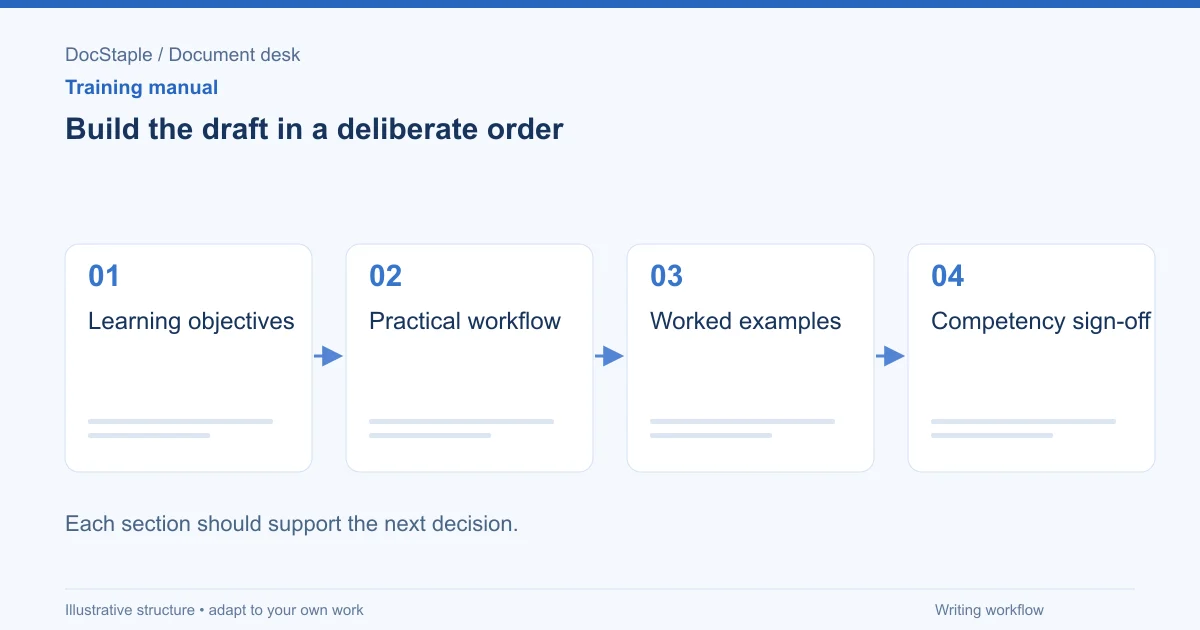
A training manual should help someone perform a job task, not simply read about it. The best manuals connect learning objectives to the real workflow, show a worked example, give the learner a safe practice task, and record whether they demonstrated competence. A manual that only explains company background may be useful orientation, but it is not enough for operational training.
This guide uses a consulting scenario: new analysts need to learn how to prepare an evidence table for a strategy review engagement. The final deliverable is a recommendations report, and each recommendation must be traceable to interview notes, approved scope or a decision record. The same structure works for many business workflows. If your manual covers regulated, safety-critical or clinical work, use qualified reviewers and the requirements that apply in your jurisdiction.
Define the learner and learning objectives
Start with the audience. A manual for a new analyst should not assume the same background as a manual for a senior consultant. List prerequisites before objectives: system access, confidentiality briefing, approved scope, example records and any required induction.
CDC training guidance says learning objectives are brief statements describing the knowledge, skills or attitudes learners gain, and that they help guide instructors and learners (CDC learning objectives). For a business manual, make them observable.
Weak objective:
Understand evidence tables.
Better objective:
By the end of this training, the analyst can add a recommendation to the evidence table, attach an approved source reference, flag an evidence gap, and route the item for engagement lead review using the current project workflow.
Draft manual language:
Audience: analysts supporting strategy review engagements. Prerequisites: completed confidentiality briefing, access to the approved sample project folder, and review of the engagement scope summary. Objective 1: prepare one evidence-table row from approved sample interview notes. Objective 2: identify whether a recommendation is supported, unsupported or outside scope. Objective 3: record a review question for the engagement lead.
Review criteria: each objective should use an action verb, match a real work output, and connect to the sign-off method later in the manual.
Map the practical workflow
The workflow section should show the order of work. Do not begin with every policy detail. Put the learner inside the task: what do they open, what do they check, what do they produce, and when do they stop?
For the evidence-table scenario:
- Open the current approved scope summary.
- Open the sample interview note.
- Copy the proposed recommendation into the evidence table.
- Add the source reference and short evidence summary.
- Mark the evidence status.
- Add questions for the engagement lead.
- Save the table using the naming convention.
- Submit for review.
Draft language:
Before adding a recommendation, read the scope summary and confirm the topic is within the approved engagement. If the topic is outside scope, do not add it as a recommendation. Record it as a review question for the engagement lead.
This is the kind of sentence that makes a manual useful. It tells the learner what to do at a decision point, not merely what the final file should contain.
If the manual is built in Word, use heading styles for sections. Microsoft Support says heading styles make a document easier to scan and can be used to build a table of contents (Microsoft Support: add a heading). That matters for longer manuals because learners need to find the right step quickly after training.
Include worked examples
Worked examples are where the manual becomes practical. Use sample information that looks realistic but is safe to share. Do not use live confidential interview notes unless the training environment and permissions allow it.
Example source note:
Interviewee A said the monthly reporting pack is often delivered after leadership decisions have already been made. The approved scope includes reporting cadence and decision governance.
Example evidence-table row:
| Recommendation | Source | Evidence status | Review question |
|---|---|---|---|
| Move monthly reporting pack delivery five working days before leadership meeting | Interview A, note 4 | Supported by one interview; needs corroboration | Is there a decision record confirming current meeting date? |
Explain why the example is acceptable. The recommendation relates to approved scope, the source is named without exposing personal details, and the evidence status does not exaggerate one interview into a universal fact.
Common error example:
Error: "Leadership always receives reporting too late." Why it fails: the source is one interview, and "always" is stronger than the evidence. Corrected wording: "One interviewee reported that the monthly reporting pack can arrive after leadership decisions have been made."
Review criteria: worked examples should show normal work, borderline decisions and common mistakes. Learners need to see how judgment is applied, not just a perfect finished output.
Add practice and support
Practice tasks let learners make mistakes before they touch live work. CDC quality training standards include practice-based learning and training evaluation as quality signals (CDC Quality Training Standards). For a consulting manual, the practice should use approved sample records with enough ambiguity to force decisions.
Draft practice task:
Practice task: using Sample Interview Note 2 and Scope Summary A, add two rows to the evidence table. One row should be supported by the sample evidence. One row should be marked as an evidence gap or review question. Save the completed table in the training folder and notify the trainer.
Add support routes:
- Technical question about the table: senior analyst.
- Scope question: engagement lead.
- Confidentiality question: designated privacy or contract contact.
- System access issue: operations support.
Include stop conditions:
Stop and ask for help if the sample record appears to contain live client information, if the recommendation requires legal or technical advice outside your role, or if the evidence conflicts with approved scope.
Support routes prevent learners from improvising. They also make the manual useful after the training session.
Record competency sign-off
Attendance is not the same as competence. Competency sign-off should match the learning objectives. If the objective is to prepare a correct evidence-table row, the assessor needs to observe or review that output.
Draft sign-off table:
| Task observed | Evidence | Result | Coaching required | Assessor | Date |
|---|---|---|---|---|---|
| Prepared evidence-table row from sample note | Training file ET-01 | Competent with minor coaching | Add clearer review questions | Senior analyst | 26 Sep 2026 |
CDC evaluation guidance says evaluation should assess how successfully the learner met the training's learning objectives (CDC training evaluation). For business manuals, that means the sign-off record should connect directly to the objectives stated at the start.
Operational review criteria:
- Objectives are observable.
- The workflow matches current practice.
- Examples use approved sample information.
- Practice tasks include normal and exception cases.
- Support contacts are current.
- Sign-off records demonstrated performance, not attendance only.
- The manual has an owner and review date.
For an editable starting point, the consulting training manual template includes sections for audience and objectives, workflow and worked examples, practice and common errors, competency review and support, plus approval. Use it to organize the manual, then fill it with your actual workflow and approved training examples.
Keep the manual current
Training manuals age quickly when systems, client requirements or file naming rules change. Add review triggers: new project repository, change in evidence standards, repeated learner errors, confidentiality incident, updated scope process or replacement of the trainer. Record what changed and who approved the revision. A manual is part instruction and part promise; keep it aligned with the work people are expected to perform.
Last updated: September 26, 2026
Frequently Asked Questions
Related Articles
How to Adapt a Quality Assurance Plan for Construction
How to adapt a quality assurance plan for construction projects, with quality criteria, inspection points, nonconformance handling, release approval and draft language.
How to Write a Consulting Quality Assurance Plan: Criteria, Reviews and Release Approval
How to write a consulting quality assurance plan for a strategy review engagement, including quality criteria, inspection points, nonconformance handling, release approval and draft wording.
How to Write a Construction Standard Operating Procedure
A construction-specific guide to adapting a standard operating procedure for site work, subcontractors, permits, escalation, evidence and approval checks.
How to Write a Consulting Standard Operating Procedure: Scope, Steps and Escalation
How to write a consulting standard operating procedure for a strategy review engagement, with purpose, owner, step-by-step workflow, exceptions, version review, draft wording and approval checks.
How to Write a Construction Training Manual: Site Workflow, Examples and Sign-Off
How to write a construction training manual for a commercial fit-out project, with learning objectives, practical workflow, worked examples, competency sign-off, draft wording and approval checks.
How to Write a Consulting Training Manual: Objectives, Workflow and Competency Sign-Off
How to write a consulting training manual for a strategy review engagement, including learning objectives, workflow, worked examples, competency sign-off, draft wording and approval checks.