Quality Assurance Plan Checklist for Consulting Deliverables
A quality assurance plan checklist covering quality criteria, inspection points, nonconformance handling and release approval for consulting teams.
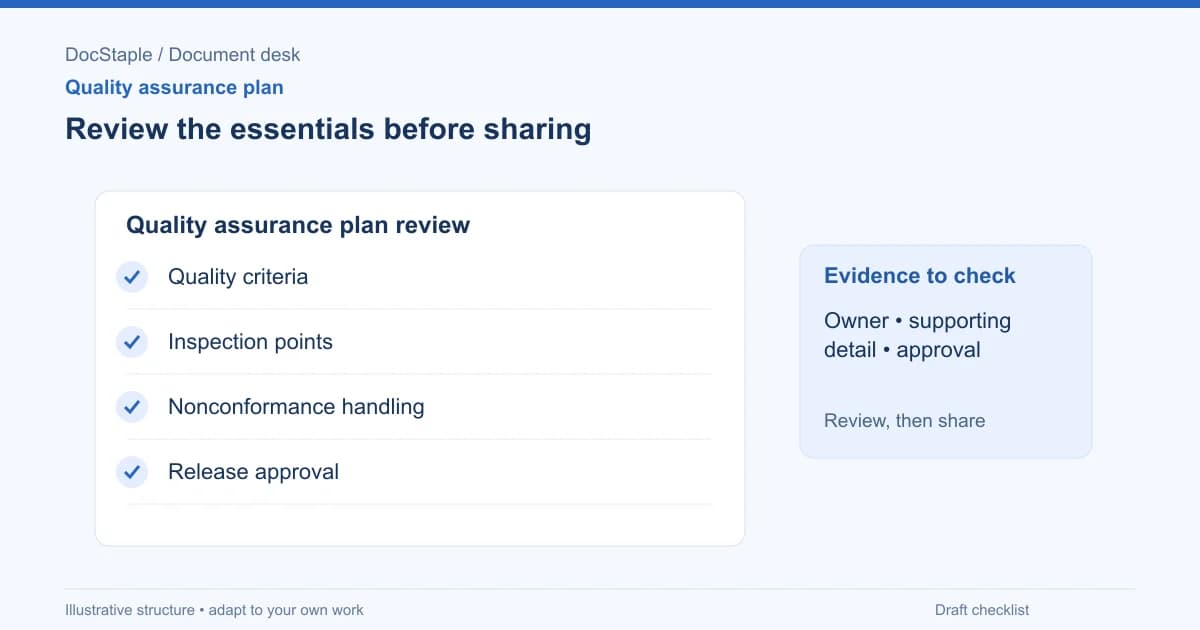
A quality assurance plan checklist is a decision tool. It should help you decide whether the plan is ready to guide the work, not merely whether every box contains text. In consulting, the checklist should protect the quality of advice, evidence, client communications and release decisions.
Use this scenario: a consulting team is producing a recommendations report after discovery interviews and data review. The client sponsor expects a clear set of options, but the project team is working quickly and several findings are based on incomplete evidence. The QA checklist should force the team to separate supported findings from assumptions before the report is released.
Check quality criteria first
Quality criteria define what the deliverable must satisfy. EPA's Quality Assurance Project Plan requirements describe a QA Project Plan as documenting QA, QC and technical activities needed to ensure results satisfy stated performance criteria EPA. Although that source is written for environmental data operations, the principle translates well: no stated criteria, no meaningful quality review.
Checklist questions:
- What deliverable or process does the plan cover?
- What is the intended use of the deliverable?
- What are the client's explicit requirements?
- Which criteria are mandatory and which are internal preferences?
- How will reviewers know whether each criterion is met?
For the consulting report, criteria might include evidence traceability, scope alignment, confidentiality review, accurate figures, clear limitations and approved recommendation logic.
Draft language:
A recommendation is release-ready only when it is supported by approved evidence, an agreed assumption or an identified limitation that the engagement lead has accepted.
Review criterion: remove or rewrite any quality criterion that cannot be checked against evidence.
Add a source column to the checklist. For each criterion, identify whether it comes from the statement of work, client instruction, internal delivery standard, legal or regulatory requirement, or technical method. This avoids a common review problem: a senior reviewer rejects a section because it does not match a personal preference that was never approved as a criterion. Preferences can become criteria, but they should be visible before the team starts work.
Verify inspection points and reviewer roles
A checklist should confirm that review points happen early enough to prevent rework. Final proofreading is not quality assurance. It is one control among many.
Inspection points for the scenario:
- kickoff review of scope, data sources and confidentiality limits;
- evidence review before recommendations are drafted;
- technical review of analysis and assumptions;
- confidentiality review before external circulation;
- final release approval of the client-ready version.
EPA QAPP guidance says assessment procedures should be sufficient to confirm that the needed and expected type and quality of data are obtained EPA. In consulting, this means checking the evidence while it can still change the analysis.
Checklist questions:
- Is each inspection point tied to a work stage?
- Is the reviewer independent enough for the risk involved?
- Does the plan say what evidence the reviewer examines?
- Does the plan record review outcomes?
- Is there enough time for rework?
Draft language:
The midpoint review will sample interview summaries, evidence tags and draft findings before recommendations are written. Findings that cannot be traced to approved evidence will be marked for correction or removal.
Review criterion: if the first substantive review occurs after the final deck is designed, move it earlier.
Inspection points should also have entry conditions. For example, do not hold the evidence review until the interview summaries are complete, the source list is current and unresolved scope questions are logged. Otherwise the meeting becomes a status conversation rather than a quality check. A good checklist asks whether the material is ready for the review being performed.
Test nonconformance handling
Nonconformance handling is where many QA plans become vague. A good checklist asks what happens when a requirement is not met. EPA's older QA guidance refers to outlining policies for corrective action and addressing non-conforming conditions by responsible persons EPA QA/G-5.
In consulting, nonconformances can include:
- a recommendation without evidence;
- a figure that does not match the source;
- client confidential material in the wrong deck;
- a missed approval step;
- a deliverable that expands beyond scope;
- use of an unapproved subcontractor output.
Checklist questions:
- Does the plan define nonconformance for this deliverable?
- Who records it?
- Who decides correction, rejection, deviation or escalation?
- When must the client be informed?
- How is the fix verified?
Draft language:
Nonconformance records must state the requirement, the observed issue, affected deliverable version, decision, owner and verification evidence. The issue is not closed until the reviewer confirms the correction or approved deviation.
Review criterion: the plan should prevent quiet fixes that leave no record of what changed.
Confirm release approval is controlled
Release approval is not the same as "everyone seems happy." A checklist should confirm who has authority to release the deliverable and what they are approving.
Release checklist:
- current version identified;
- all required reviews complete;
- open issues recorded;
- limitations included;
- client-facing copy checked for confidentiality;
- sponsor or internal approver identified;
- approval decision recorded.
Draft language:
Release approval confirms that the report version listed below meets the approved quality criteria for client circulation. Approval does not waive unresolved limitations unless those limitations are listed in the release record.
This matters because a consulting deliverable may be reused in later decisions. A future reader should know whether a limitation was unresolved, accepted or missed.
Review criterion: a person who did not attend the meeting should be able to identify the approved version and any remaining restrictions.
Include corrective action for repeat problems
Corrective action addresses the system. If one analyst misses an evidence tag, correction may be enough. If three sections have unsupported findings, the QA plan should trigger a broader response.
Checklist questions:
- What failure patterns require corrective action?
- Who investigates the cause?
- Is the action aimed at process improvement?
- How is effectiveness checked?
- Does the plan update training, templates or review timing when needed?
Draft language:
If two or more report sections fail evidence traceability review, the engagement lead will pause new drafting, review the evidence tagging method with the team and sample corrected sections before work resumes.
The goal is not blame. It is to stop repeated defects from moving downstream.
Review criterion: corrective action should change conditions that allowed the issue, not simply remind people to be careful.
Where client approval is involved, add an escalation rule. Some quality failures can be fixed internally; others affect scope, timing or the client's decision process. If a defect changes the basis of advice or delays a promised deliverable, the QA checklist should tell the engagement lead when to brief the client sponsor instead of silently adjusting the workplan.
Use the checklist as a live review record
A QA checklist is strongest when it becomes a review record. Add columns for result, evidence, owner, due date and approval. Avoid checkmarks without notes for high-risk items.
For a consulting report, review evidence may include:
- approved scope;
- source data list;
- interview summary sample;
- evidence tagging export;
- review comments;
- confidentiality check result;
- release approval record.
The consulting quality assurance plan template provides editable sections for quality objectives and scope, review and inspection activities, acceptance and nonconformance, corrective action and approval. Use the checklist above to review the draft before it becomes the working plan.
Final operational test: can the checklist stop a weak deliverable before the client sees it? If the answer is no, the checklist is probably too generic.
Last updated: September 26, 2026
Frequently Asked Questions
Related Articles
How to Adapt a Quality Assurance Plan for Construction
How to adapt a quality assurance plan for construction projects, with quality criteria, inspection points, nonconformance handling, release approval and draft language.
How to Write a Consulting Quality Assurance Plan: Criteria, Reviews and Release Approval
How to write a consulting quality assurance plan for a strategy review engagement, including quality criteria, inspection points, nonconformance handling, release approval and draft wording.
How to Write a Construction Standard Operating Procedure
A construction-specific guide to adapting a standard operating procedure for site work, subcontractors, permits, escalation, evidence and approval checks.
How to Write a Consulting Standard Operating Procedure: Scope, Steps and Escalation
How to write a consulting standard operating procedure for a strategy review engagement, with purpose, owner, step-by-step workflow, exceptions, version review, draft wording and approval checks.
How to Write a Construction Training Manual: Site Workflow, Examples and Sign-Off
How to write a construction training manual for a commercial fit-out project, with learning objectives, practical workflow, worked examples, competency sign-off, draft wording and approval checks.
How to Write a Consulting Training Manual: Objectives, Workflow and Competency Sign-Off
How to write a consulting training manual for a strategy review engagement, including learning objectives, workflow, worked examples, competency sign-off, draft wording and approval checks.