Quality Assurance Plan Examples for Consulting Deliverables
Practical quality assurance plan examples for consulting work, including quality criteria, inspection points, nonconformance handling and release approval.
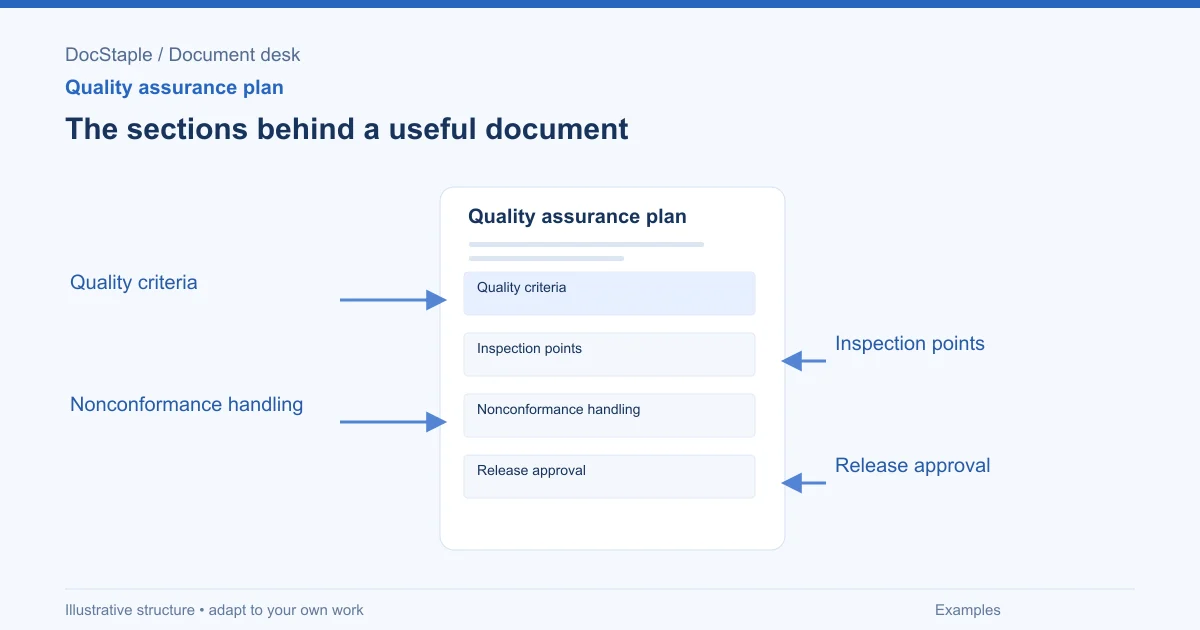
Quality assurance plan examples are most useful when they show decisions, not just headings. A good QA plan explains what quality means for this deliverable, when checks occur, what happens when work does not meet the criteria, and who can release the final output. A weak plan says "all work will be reviewed for quality" and leaves the team to guess.
The examples below use one consulting scenario: a strategy review engagement that ends with a recommendations report. The client sponsor expects findings to be traceable to interview notes, approved scope and decision records. The examples are not a regulatory QA plan. EPA's Quality Assurance Project Plan guidance is written for environmental information work, but it is useful because it emphasizes documented planning, acceptance criteria, responsibilities and corrective action (EPA QAPP guidance).
Example 1: Quality criteria
Quality criteria define what acceptable work looks like before people review it. Without criteria, reviewers often drift into personal preference: one person rewrites style, another checks evidence, and a third asks whether the recommendation belongs in scope.
Draft language:
Quality criteria: The recommendations report is acceptable when each recommendation is linked to approved evidence, each finding is within the client-approved engagement scope, assumptions are labeled, unresolved evidence gaps are listed, and the client sponsor has enough context to approve, reject or request revision.
Make criteria testable. "Clear and insightful" may be a goal, but it is not enough for a QA plan. A better plan separates mandatory criteria from editorial preferences:
| Criterion | Type | Evidence |
|---|---|---|
| Recommendation linked to source evidence | Mandatory | Evidence table |
| Scope alignment checked | Mandatory | Approved scope reference |
| Plain-language executive summary | Preference | Reviewer comment |
EPA's older QA/G-5 material says acceptance criteria should be consistent with overall project technical and quality criteria and that inspection or acceptance testing requirements should be documented (EPA QA/G-5 text). For consulting, that means the QA plan should point back to the engagement scope and client-approved deliverable expectations.
Operational review criteria: every quality criterion should have an owner, evidence source and decision route. If the criterion cannot be inspected, rewrite it as a behavior or output the reviewer can see.
Example 2: Inspection points
Inspection points are the moments when review happens. They should occur early enough to prevent rework, not only at the end when everyone is tired and the deadline is close.
For the strategy review report, useful inspection points are:
- Scope check before analysis starts.
- Evidence-table check before drafting recommendations.
- Internal review of draft findings.
- Senior review of the full recommendations report.
- Release approval before sending to the client.
Draft language:
Inspection point 2: Before recommendations are drafted, the analyst sends the evidence table to the engagement lead. The engagement lead checks that each proposed finding has a source reference, any conflicting evidence is flagged, and evidence gaps are marked for decision. Drafting may continue only for findings marked "ready" or "ready with stated assumption."
This example avoids a common failure mode: reviewing the finished report and discovering that a recommendation has no support. It also creates a decision state, so the team knows whether to continue.
Inspection points should not be arbitrary. Use more review where the cost of error is high, where work becomes hard to change later, or where different roles hand work to each other.
Example 3: Nonconformance handling
Nonconformance means the work does not meet an agreed requirement or criterion. It is not always a disaster. It may be corrected, accepted with a recorded deviation, rejected, or routed for client decision. The QA plan should say who decides.
Draft language:
Nonconformance: If a recommendation is outside approved scope, the analyst records it in the nonconformance log with the source, effect and proposed route. The engagement lead decides whether to remove it, request a scope change, or keep it as an appendix item labeled outside scope. The recommendation is not included in the client-facing main report until the decision is recorded.
EPA QA/G-5 text says a QAPP should describe corrective action taken when data fail acceptance criteria, including who is responsible and what action follows (EPA QA/G-5 text). Translate that principle carefully for consulting: document the failure, assess effect, assign decision authority, and keep the record.
Nonconformance log fields:
| ID | Requirement missed | Effect | Decision | Owner | Evidence |
|---|---|---|---|---|---|
| NC-03 | Scope alignment | Recommendation may exceed approved scope | Remove from main report | Engagement lead | Updated draft |
Failure mode to avoid: treating every defect as a style edit. A missing source, unsupported claim, confidentiality issue or scope conflict needs a decision record, not just a rewritten sentence.
Example 4: Corrective action
Correction fixes the immediate item. Corrective action addresses why the problem happened. If three recommendations lack evidence because analysts are drafting before the evidence table is complete, fixing only the three recommendations leaves the process broken.
Draft language:
Corrective action: If two or more evidence gaps are found after senior review, the engagement lead pauses release, reviews why the evidence-table inspection failed, assigns an action owner, and updates the QA plan or SOP before the next reporting cycle. The action is closed only when a later evidence-table check shows the revised control worked.
This language includes a trigger, owner, action and effectiveness check. It does not promise a universal deadline or quantified improvement. Those should come from your organization and project risk.
Operational review criteria:
- Nonconformances are classified by effect.
- Decisions are made by authorized roles.
- Immediate corrections and root-cause actions are separate.
- Client or stakeholder notification follows the contract and applicable law.
- Effectiveness is verified with evidence, not assumed.
Release approval
Release approval is the final gate before the deliverable leaves the team. It should be active. "No comments received" is not approval unless the contract or agreed process says so.
Draft language:
Release approval: The engagement lead confirms that mandatory quality criteria are met, nonconformances are closed or accepted, and the senior reviewer approves the recommendations and evidence. The client sponsor receives the report only after the approval record is complete.
For the consulting template context, this matches the acceptance condition: sponsor approves recommendations and evidence. In another project, the release approver may be a practice director, compliance reviewer, client sponsor or technical lead.
Review criteria before release:
- Quality criteria are traceable to approved scope or requirements.
- Inspection points were completed at the planned stages.
- Nonconformances have decisions and owners.
- Corrective actions are assigned for recurring or material failures.
- Release approval names the approver, date and document version.
- Confidential material is handled according to the engagement's approved procedures.
The consulting quality assurance plan template provides an editable Word structure for quality objectives, inspection activities, acceptance and nonconformance, corrective action, review and approval. Use the examples above to fill it with project-specific criteria rather than generic quality statements.
Final example review
Before you reuse any QA plan example, ask one practical question: could a reviewer use this plan to stop, correct or release a real deliverable? If the answer is no, the plan is probably descriptive rather than operational. Add the missing decision points, evidence records and approval roles before issuing it.
Last updated: September 26, 2026
Frequently Asked Questions
Related Articles
How to Adapt a Quality Assurance Plan for Construction
How to adapt a quality assurance plan for construction projects, with quality criteria, inspection points, nonconformance handling, release approval and draft language.
How to Write a Consulting Quality Assurance Plan: Criteria, Reviews and Release Approval
How to write a consulting quality assurance plan for a strategy review engagement, including quality criteria, inspection points, nonconformance handling, release approval and draft wording.
How to Write a Construction Standard Operating Procedure
A construction-specific guide to adapting a standard operating procedure for site work, subcontractors, permits, escalation, evidence and approval checks.
How to Write a Consulting Standard Operating Procedure: Scope, Steps and Escalation
How to write a consulting standard operating procedure for a strategy review engagement, with purpose, owner, step-by-step workflow, exceptions, version review, draft wording and approval checks.
How to Write a Construction Training Manual: Site Workflow, Examples and Sign-Off
How to write a construction training manual for a commercial fit-out project, with learning objectives, practical workflow, worked examples, competency sign-off, draft wording and approval checks.
How to Write a Consulting Training Manual: Objectives, Workflow and Competency Sign-Off
How to write a consulting training manual for a strategy review engagement, including learning objectives, workflow, worked examples, competency sign-off, draft wording and approval checks.