Standard Operating Procedure Best Practices for Practical SOPs
Best practices for writing standard operating procedures that define purpose, owner, step-by-step work, exceptions, escalation and version review.
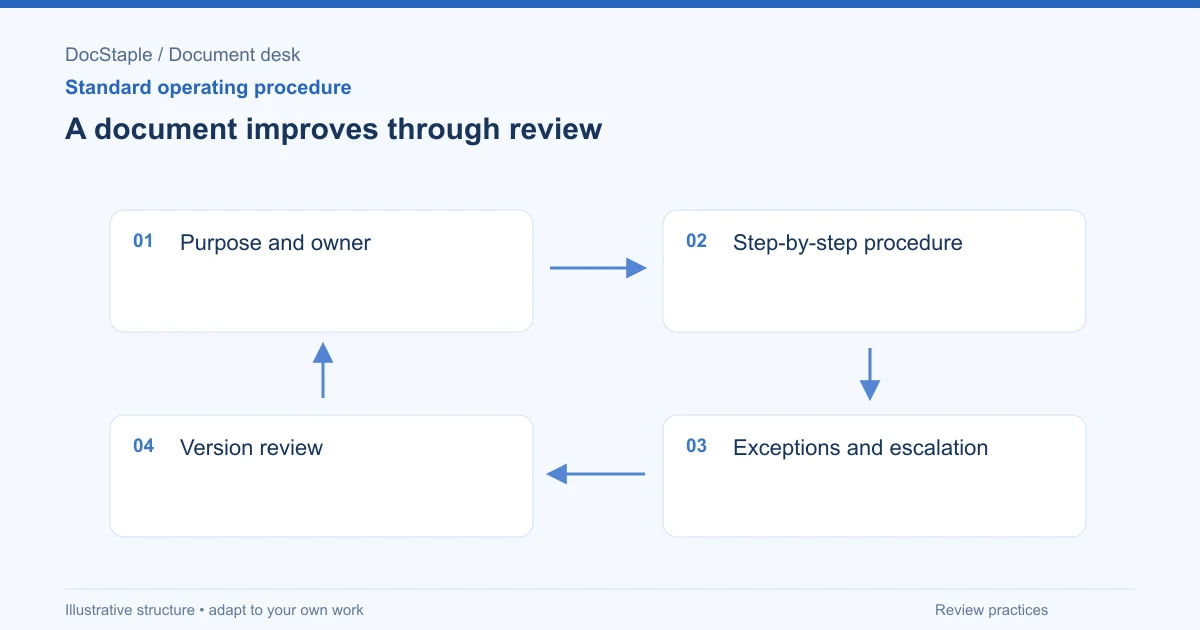
The best standard operating procedures are not impressive because they are long. They are useful because a trained person can follow them, know when to stop, and prove the work was done. A weak SOP often fails in one of four places: the purpose is vague, the owner is missing, the steps describe intentions instead of actions, or the document stays in circulation after the process changes.
This guide uses a consulting scenario: a firm needs an SOP for preparing the evidence table behind a strategy review recommendations report. The team collects interview notes, maps findings to recommendations, and sends the table for senior review before the client presentation. The same best practices apply to many industries, but legal, safety, privacy and regulated work need jurisdiction-specific review.
Start with purpose and owner
The U.S. EPA's SOP guidance defines an SOP as written instructions for a routine or repetitive activity followed by an organization, and says there is no single correct format (EPA SOP guidance). That freedom is useful, but it also means the first best practice is to make the document's reason and owner unmistakable.
A strong opening answers:
- Why does this procedure exist?
- When does it start and stop?
- Who performs the work?
- Who owns the procedure?
- Which prerequisites must exist before work begins?
Draft language:
Purpose: This SOP explains how analysts prepare the evidence table for the strategy review recommendations report so that each recommendation can be traced to approved interview notes, analysis workpapers or client-provided records. Owner: engagement lead. Backup owner: practice manager. Trigger: starts when discovery interviews are complete and ends when the senior reviewer approves the evidence table for use in the draft report.
This wording is deliberately operational. "Ensure evidence is robust" sounds polished, but it does not tell the analyst what work is covered or who answers questions. Naming a role rather than only a person helps the SOP survive staffing changes.
Review criteria: a reader should be able to tell whether the SOP applies to their situation within one minute. If the purpose section could fit any document in the company, it is too generic.
Write steps as observable actions
EPA guidance recommends SOPs be concise, step-by-step and easy to read, with enough detail for someone with a basic understanding of the task to carry it out. For consulting work, that means the steps should not say "validate the evidence." They should show exactly how validation happens.
Better steps use one actor and one action:
- The analyst copies each draft recommendation into the evidence table.
- The analyst adds at least one approved source reference for each recommendation.
- The analyst marks unsupported recommendations as "evidence gap" and does not move them to the report draft.
- The engagement lead reviews all evidence gaps before the senior review meeting.
- The senior reviewer approves, rejects or requests changes in the review column.
The best practice is not to overload the SOP with every possible explanation. Put reference material in linked guidance or appendices when it would interrupt the sequence. The procedure itself should preserve the path through the work.
Concrete failure mode: a step that says "check all evidence carefully" creates inconsistent behavior. One analyst may check only source names, another may inspect quotations, and a third may ask the client for confirmation. If the output matters, define the check.
Build exceptions and escalation into the procedure
Most SOP drafts describe the normal route. Real work includes missing inputs, late approvals, unclear authority and records that contradict each other. A best-practice SOP names stop conditions and escalation paths before people are under pressure.
In the evidence-table scenario, possible exceptions include a recommendation with no source, a client record that conflicts with an interview note, confidential client material accidentally placed in a wider folder, or a senior reviewer unavailable before the client deadline.
Draft language:
If a recommendation has no approved supporting evidence, the analyst marks it "evidence gap" and notifies the engagement lead before adding it to the report draft. If confidential client material appears outside the approved project folder, the person who notices stops further sharing, records the location and time, and escalates to the engagement lead and designated privacy or contract contact. The engagement lead records permission to resume affected work.
This is not legal advice about notification obligations. It is a routing rule: preserve the facts, stop uncontrolled sharing, and put the decision with the role responsible for the contract and applicable law.
Operational review criteria:
- Each exception has a first action.
- The person who can decide is named.
- The record of the exception has a location.
- The SOP says whether work continues, pauses or changes route.
- Urgent issues point to the organization's approved emergency or incident arrangements.
Define records and quality checks
An SOP should make evidence easy to inspect. In consulting, the proof may be a completed table, approval comment, decision log, meeting note or final issued report. In field work, it may be a checklist, inspection form or instrument record. The format changes, but the question stays the same: what record shows the procedure was followed?
EPA's SOP guidance emphasizes that SOPs are part of a quality system and need to be current and controlled (EPA SOP guidance). For the evidence-table SOP, useful records include the evidence table version, the list of approved source records, senior reviewer comments, and the final approval note.
Draft language:
Required record: Evidence_Table_ProjectCode_Rev[number].docx, stored in the approved engagement folder. Completion check: every recommendation has a source reference, reviewer decision and open issue status. Release check: the senior reviewer approves the evidence table before the recommendation appears in the client-facing report.
Avoid saying a checklist is complete because every box is ticked. The quality check should state what "acceptable" means. If the reviewer is approving the recommendations and evidence, say that directly.
Control versions without making review impossible
Version control is where good SOPs go stale. EPA guidance says SOPs should be reviewed periodically, updated when procedures change, and reapproved; it also warns that review processes should not be so cumbersome that reviews never happen. The best practice is to make review visible but lightweight enough to survive.
Use a simple control block:
SOP-CON-012 | Evidence table preparation | Rev. 2 | Owner: engagement lead | Approved: 26 Sep 2026 | Next review: 26 Mar 2027
Use a short revision table:
| Rev. | Date | Change | Approved by |
|---|---|---|---|
| 2 | 26 Sep 2026 | Added escalation for unsupported recommendations | Practice manager |
Review triggers should include more than a calendar date. Review after a client complaint, repeated evidence gaps, a new document repository, a change in confidentiality process, or a change in the deliverable workflow. If the SOP is used by subcontractors, review whether their access and obligations still match the procedure.
Microsoft Word users should use heading styles for SOP sections because Microsoft says heading styles help readers scan and can be used to build a table of contents (Microsoft Support: add a heading). That is a formatting point, not a substitute for document control, but it keeps longer SOPs navigable.
Review the SOP before release
The final best practice is to test the SOP with someone other than the author. Ask them to perform the task using only the SOP and the referenced materials. Watch for places where they ask "where is that file?", "who approves this?", "what happens if this is missing?", or "am I allowed to continue?"
Operational review criteria:
- Purpose and scope are specific to the task.
- The owner and backup owner are named by role.
- Prerequisites are listed before the steps.
- Steps are ordered, observable and assigned to actors.
- Exceptions include stop, escalate and resume rules.
- Records are named with storage locations.
- Approval and release checks are distinct.
- Version history shows what changed and who approved it.
- The SOP has been tested by a user who did not write it.
For an editable Word structure, the consulting standard operating procedure template includes sections for purpose and prerequisites, step-by-step procedure, exceptions and escalation, quality checks, records and approval. Treat it as a starting draft, then fill it with the procedure your team actually follows.
Last updated: September 26, 2026
Frequently Asked Questions
Related Articles
How to Adapt a Quality Assurance Plan for Construction
How to adapt a quality assurance plan for construction projects, with quality criteria, inspection points, nonconformance handling, release approval and draft language.
How to Write a Consulting Quality Assurance Plan: Criteria, Reviews and Release Approval
How to write a consulting quality assurance plan for a strategy review engagement, including quality criteria, inspection points, nonconformance handling, release approval and draft wording.
How to Write a Construction Standard Operating Procedure
A construction-specific guide to adapting a standard operating procedure for site work, subcontractors, permits, escalation, evidence and approval checks.
How to Write a Consulting Standard Operating Procedure: Scope, Steps and Escalation
How to write a consulting standard operating procedure for a strategy review engagement, with purpose, owner, step-by-step workflow, exceptions, version review, draft wording and approval checks.
How to Write a Construction Training Manual: Site Workflow, Examples and Sign-Off
How to write a construction training manual for a commercial fit-out project, with learning objectives, practical workflow, worked examples, competency sign-off, draft wording and approval checks.
How to Write a Consulting Training Manual: Objectives, Workflow and Competency Sign-Off
How to write a consulting training manual for a strategy review engagement, including learning objectives, workflow, worked examples, competency sign-off, draft wording and approval checks.