Standard Operating Procedure Checklist: Review an SOP Before Release
A standard operating procedure checklist for reviewing purpose, owner, step-by-step procedure, exceptions, escalation, version review and release readiness.
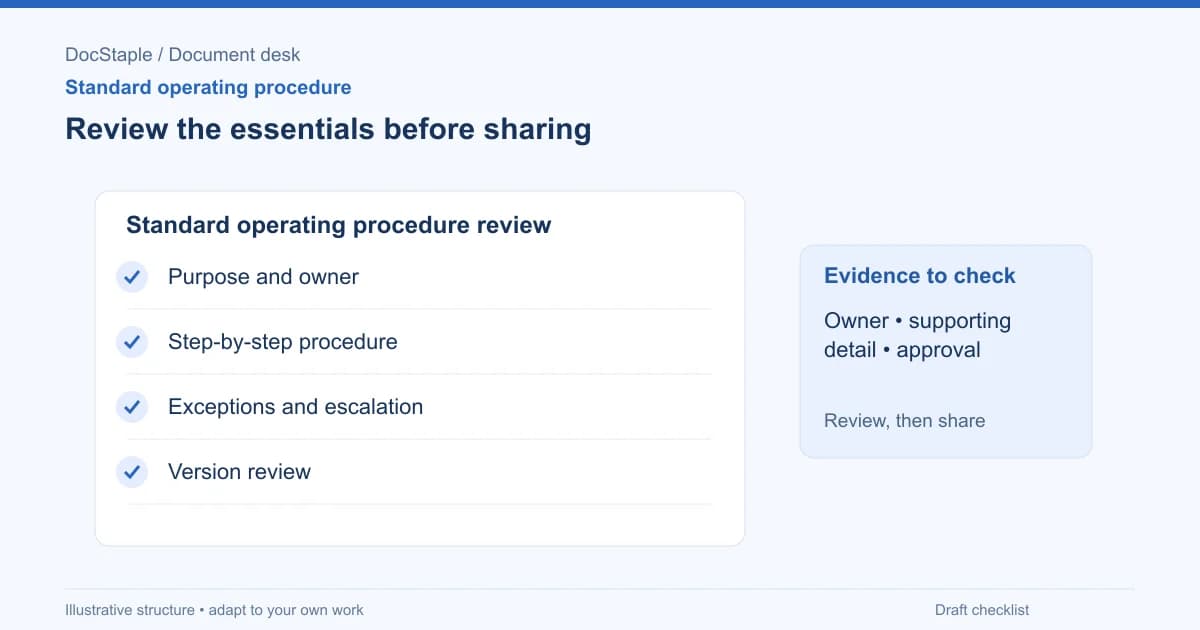
A standard operating procedure checklist is a release gate. It helps you decide whether an SOP is clear enough, controlled enough and realistic enough to use. It should not be a cosmetic review that asks only whether the title looks right.
This checklist uses a consulting scenario: an SOP for preparing a recommendations report after discovery interviews. The same decision gates apply to many procedures: purpose and owner, step-by-step procedure, exceptions and escalation, and version review.
Check Purpose, Scope and Owner
Start with the front of the SOP. A user should know why the procedure exists, when to use it and who maintains it.
Checklist questions:
- Does the purpose describe a repeatable activity, not a broad aspiration?
- Does the scope say where the procedure starts and ends?
- Are exclusions listed so users know what the SOP does not cover?
- Is the document owner named?
- Is the process owner named for each use of the procedure?
- Are reviewers and approvers identified by role?
Example pass:
This SOP defines how the consulting team prepares, reviews and issues the recommendations report for the strategy review engagement. It starts when discovery is complete and ends when the approved report is issued to the client sponsor.
Example fail:
This SOP explains how to do project reporting.
EPA's SOP FAQ says SOPs are written instructions that document routine or repetitive activities and can support consistency and knowledge transfer (US EPA). If your purpose statement does not identify the routine activity, the procedure is probably too broad.
Check Prerequisites and Inputs
Many SOP failures happen before Step 1. The user starts without access, training, approvals or current records.
Checklist questions:
- Are required inputs listed?
- Are required systems, tools or permissions listed?
- Are training or competence assumptions visible?
- Does the SOP say what to do if a prerequisite is missing?
- Are current source documents named, such as scope, policy, contract or approved method?
For the consulting report SOP, prerequisites might include:
Approved scope, completed interview tracker, current evidence register, decision log, report template and access to the project workspace.
Add a stop rule:
If the evidence register is missing or not current, stop and escalate to the engagement lead before drafting findings.
The stop rule matters because it prevents the user from improvising around a missing control.
Check the Step-by-Step Procedure
A procedure should be written as a sequence of actions, not as background explanation. A trained user should be able to follow it without hunting through paragraphs for the next decision.
Checklist questions:
- Is each step numbered or otherwise clearly ordered?
- Does each step identify the actor?
- Does each step use an observable verb?
- Does each step say what record or output is created?
- Are decision points written as decisions?
- Are handoffs clear?
- Are quality checks placed before the output is issued?
Weak step:
Review the evidence and prepare recommendations.
Stronger step:
The report author compares each draft finding to the evidence register. Findings without a source reference are marked "unsupported" and sent to the engagement lead for decision before recommendations are drafted.
EPA's SOP guidance page points to formal guidance for preparing SOPs, and EPA describes SOPs as documentation for routine quality-system management and technical activities (US EPA SOP guidance). The practical lesson is that a procedure should be detailed enough to reproduce the work, not merely describe it.
Check Exceptions and Escalation
A checklist that ignores exceptions approves only the easiest version of the work. A good SOP tells users what to do when normal conditions are not met.
Checklist questions:
- Are common exceptions named?
- Does each exception have a response?
- Are escalation triggers specific?
- Is the escalation role named?
- Does the SOP protect people, records, confidentiality and service continuity where relevant?
- Does it say when work may resume?
Consulting examples:
If a client asks for advice outside the approved scope, record the request and follow change control before adding it to the report.
If confidential client material is shared outside the project workspace, pause affected work and notify the engagement lead under the information incident process.
If the peer reviewer rejects a recommendation as unsupported, the report author either revises it with evidence or removes it.
Avoid "use judgment" as the only instruction. Judgment is still needed, but the SOP should give the user boundaries.
Also check whether escalation creates a record. In a consulting engagement, a verbal decision can disappear by the time the report is challenged. If the engagement lead approves an exception, the SOP should say where that approval is recorded.
Example:
The engagement lead records exception approval in the project decision log before work resumes. The entry states the exception, reason, approved action, date and any restrictions.
This keeps the SOP usable without turning every exception into a meeting. The user knows who decides, when to stop and what evidence remains afterward.
Check Records, Version Review and Approval
An SOP should create records that show the work was done. It should also be controlled so people do not use old versions.
Checklist questions:
- Are required records listed?
- Does the SOP say where records are stored?
- Is the retention period or retention reference named?
- Is there a version number and date?
- Is the next review date or review trigger stated?
- Are change history and approver recorded?
- Are draft instructions removed before release?
ISO's overview of ISO 9001 says the standard addresses documented information and that organizations must plan, implement and control processes needed to meet customer requirements (ISO). Do not infer certification or compliance from this article. Use the broader control idea: if a document tells people how to work, its version and evidence trail matter.
Draft version-review language:
Review this SOP annually, after a material process change, after a report-quality incident, or after repeated user questions show the instruction is unclear.
Dry-Run the SOP
Do not release an important SOP based only on a desk review. Ask a trained user who did not write it to perform a dry run using a sample or completed project.
Dry-run criteria:
- The user can identify when to start.
- The user can find required inputs.
- The user can complete each step without asking what the verb means.
- The user knows when to stop.
- The expected records are created.
- The reviewer can verify the output.
Record dry-run issues as edits, not as training footnotes. If several users misunderstand the same step, the SOP needs clearer wording.
Also check the time burden during the dry run. A procedure that technically works but takes twice as long as the real process will be bypassed. If the SOP requires a record, approval or quality check, make sure the team has a realistic way to complete it during normal delivery.
Start From a Structured SOP Draft
The consulting standard operating procedure template is an editable Word document with sections for purpose, scope and prerequisites, step-by-step procedure, exceptions and escalation, quality checks and records, and approval. Use this checklist to review the draft before release.
The best SOP checklist does not ask, "Does this look official?" It asks, "Can the right person do the work, handle exceptions and leave evidence that the work was done?"
Last updated: September 26, 2026
Frequently Asked Questions
Related Articles
How to Adapt a Quality Assurance Plan for Construction
How to adapt a quality assurance plan for construction projects, with quality criteria, inspection points, nonconformance handling, release approval and draft language.
How to Write a Consulting Quality Assurance Plan: Criteria, Reviews and Release Approval
How to write a consulting quality assurance plan for a strategy review engagement, including quality criteria, inspection points, nonconformance handling, release approval and draft wording.
How to Write a Construction Standard Operating Procedure
A construction-specific guide to adapting a standard operating procedure for site work, subcontractors, permits, escalation, evidence and approval checks.
How to Write a Consulting Standard Operating Procedure: Scope, Steps and Escalation
How to write a consulting standard operating procedure for a strategy review engagement, with purpose, owner, step-by-step workflow, exceptions, version review, draft wording and approval checks.
How to Write a Construction Training Manual: Site Workflow, Examples and Sign-Off
How to write a construction training manual for a commercial fit-out project, with learning objectives, practical workflow, worked examples, competency sign-off, draft wording and approval checks.
How to Write a Consulting Training Manual: Objectives, Workflow and Competency Sign-Off
How to write a consulting training manual for a strategy review engagement, including learning objectives, workflow, worked examples, competency sign-off, draft wording and approval checks.