Standard Operating Procedure Examples: Three Worked Consulting SOPs
Three short standard operating procedure examples from a consulting engagement, with draft wording for purpose and owner, numbered steps, escalation and version review, plus a checklist for reviewing your own.
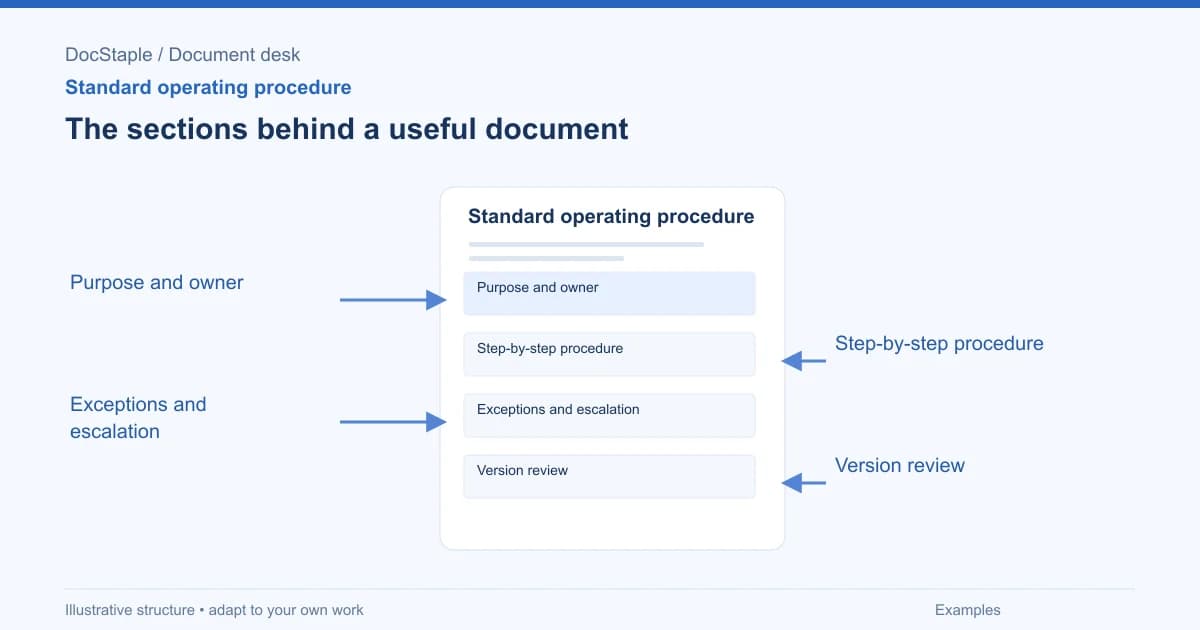
The most useful way to judge an SOP draft is to see a finished one. This article walks through three short SOP examples from one fictional setting: a consulting firm running a strategy review engagement. Each shows the drafting choices behind it. They illustrate structure, so replace the details with your own facts before using any of them.
What an SOP is, and what examples should show
The U.S. Environmental Protection Agency's Guidance for Preparing Standard Operating Procedures (EPA QA/G-6) defines an SOP as a set of written instructions that document a routine or repetitive activity followed by an organization. The guidance was written for EPA's own quality system and environmental data work, so it is not a rulebook for consultancies. It is still a useful, plain-language reference for how a procedure document is put together.
Two points from it are worth keeping in mind as you read the examples. First, the guidance says there is no one "correct" format, and that internal formatting varies with the organization and the type of SOP. Second, it says the best-written SOPs will fail if they are not followed, so current copies need to be easy to reach where the work happens.
A good example does not just look tidy. It answers four questions: why the procedure exists and who owns it, what to do and in what order, what to do when it does not go to plan, and how to know you are reading the current version. The sections below take them in turn.
Example 1: Purpose and owner
Scenario. A consulting team is running discovery interviews for a client's strategy review. Interviewees speak candidly on the understanding that notes stay within the project team. The firm wants one procedure for how interview notes are stored and shared.
The EPA guidance says a well-written SOP should first briefly describe the purpose of the work or process, and it lists personnel qualifications and responsibilities among the topics an administrative SOP may cover. Here is how that might read in a draft:
SOP-CON-004: Handling interview notes Purpose: To keep discovery interview notes accurate, accessible to the project team and protected from wider circulation during the strategy review engagement. Applies to: All consultants and analysts working on the engagement, including subcontractors. Owner: Engagement lead. Backup owner: Senior consultant. Trigger: Starts when an interview is scheduled and ends when the final report is issued and the notes are archived.
Notice what this draft does. It names a role rather than a person, so the document survives a staffing change. It states when the procedure starts and stops. It names a backup, so approval and questions do not depend on one individual.
Example 2: A step-by-step procedure
Continuing the same procedure, the steps are where most draft SOPs go wrong. EPA guidance asks for a concise, step-by-step, easy-to-read format, in active voice and present tense, and it suggests the sequence be written so that someone with a basic understanding of the task can carry it out unsupervised. It also says diagrams or flow charts can help break up long text.
A draft for the interview-notes example:
- Within one working day of each interview, the interviewer saves the notes to the engagement folder using the naming pattern ClientCode_Interview_Role_Date.
- The interviewer removes personal contact details from the working notes and keeps them in the restricted contact list.
- The interviewer marks the file "Confidential – project team only" in the header.
- The analyst checks that the file is in the correct folder and records the check in the interview log.
- Quotes used in a client deliverable are attributed by role only, unless the interviewee has agreed otherwise in writing.
- The engagement lead confirms at each weekly review that the interview log is complete.
Each step has one actor, one action and, where it matters, one check. A step that says "ensure notes are handled appropriately" fails that test. Step 5 shows a decision point written into the procedure itself instead of left to memory.
Word steps that keep numbered lists tidy
If you build the SOP in Word, use Word's own numbering rather than typing numbers by hand. Microsoft's guidance on changing the numbering in a numbered list, which lists Word for Microsoft 365, 2024, 2021, 2019 and 2016, says to double-click the numbers in the list, right-click the number where a new list should start and choose Restart at 1. To set a specific start value, right-click the number, choose Set Numbering Value and change the Set value to box.
This matters when a long SOP has separate phases, such as "Before the interview" and "After the interview", and you want each to restart at 1 without the numbers drifting when someone inserts a step later.
Example 3: Exceptions and escalation
The third question is the one most example SOPs leave out. A procedure that covers only the happy path leaves the team improvising when something goes wrong, which is exactly when a written instruction is most useful.
Continuing the interview-notes scenario, a realistic exception is that notes are accidentally shared outside the project team. Draft language could read:
If interview notes are shared outside the project team:
- The person who notices stops further sharing and tells the engagement lead the same day.
- The engagement lead records what was shared, with whom and when, in the deviation log.
- The engagement lead decides, with the firm's designated contract or privacy contact, whether the client sponsor or interviewees must be told, and records the decision and its reason.
- Work that depends on the affected notes pauses until the engagement lead records permission to resume.
- The owner reviews whether the procedure needs a change and records the outcome at the next review.
Three drafting choices are worth copying. The first person to notice has a defined first action, so nobody waits to be told. A named role decides on notification, because whether disclosure is legally or contractually required depends on the contract and the jurisdiction. The SOP should route that question to a qualified person, not answer it. The pause-and-resume record shows the team stopped, then restarted with permission.
Version review and document control
The last part of an SOP is easy to skip, and it is where the previous three examples quietly go out of date.
EPA's guidance says SOPs need to remain current, and that whenever procedures change, the SOP should be updated and re-approved. It also says SOPs should be reviewed on a periodic basis, that the review date should be added to each SOP reviewed, and that the frequency should be set by management. It adds that the review process should not be overly cumbersome or reviews will never happen. The guidance's document control suggestion is a small block on each page after the title page with a short title or ID, revision number, date and "Page 1 of".
You can copy that idea directly:
SOP-CON-004 | Rev. 3 | 26 September 2026 | Page 1 of 4
The same guidance says the first page should show a title, an ID number, the issue or revision date, the applicable division, and the signatures and dates of those who prepared and approved the SOP. It also says it is especially helpful if a draft SOP is tested by someone other than the original writer before it is finalized. A simple version record then sits near the start of the document:
| Rev. | Date | Change | Prepared by | Approved by |
|---|---|---|---|---|
| 3 | 26 Sep 2026 | Added step 5 on quote attribution | [Name, role] | [Name, role] |
Add "Page X of Y" in Word
Microsoft's article on including the total number of pages in the page number lists Word for Microsoft 365, 2024, 2021, 2019 and 2016, with Mac versions for the first three. On Windows, go to Insert > Page Number, choose Current Position if you already have a header or footer, scroll until you see Page X of Y, select a format, then choose Close Header and Footer. Type the SOP ID and revision beside it in the same footer, so they appear on every page. EPA's guidance notes that showing the page count lets a reader quickly check whether the SOP is complete.
Review criteria before you publish an SOP
Use this checklist on any SOP draft, whether you built it from an example or from scratch:
- Purpose: Can a reader tell in one or two sentences why the procedure exists and when it applies?
- Owner: Is there a named role, and a backup, responsible for keeping it current?
- Steps: Does each step have one actor and one action, in the order the work happens?
- Testing: Has someone other than the author followed the steps as written, and were their questions fixed in the text?
- Exceptions: Does it say what to do when a precondition is missing or a step fails, and who decides?
- Records: Does it say which log, form or file proves the work was done, and where it is kept?
- References: Are related procedures and forms named with their version, and attached or locatable?
- Control block: Does every page show the ID, revision, date and page count?
- Approval: Is there a named approver, and a date, before the SOP is issued?
- Review date: Is the next review recorded, and is someone responsible for it?
Regulated activities need extra care. If your procedure touches safety, employment, privacy or a formal standard, check the requirements that apply in your jurisdiction and have a qualified adviser review the text. An SOP records how you intend to work. It does not show that any law or standard is met.
Start from a structured Word draft
If you would rather not build the layout from scratch, the consulting standard operating procedure template is an editable Word file with sections for purpose, scope and prerequisites, the step-by-step procedure, exceptions and escalation, quality checks and records, and approval. The examples above show how to fill each of those sections with real content instead of placeholders.
Sources: Guidance for Preparing Standard Operating Procedures (EPA QA/G-6), U.S. EPA, Change the numbering in a numbered list, Microsoft Support, Include total number of pages in the page number in Word, Microsoft Support
Last updated: September 26, 2026
Frequently Asked Questions
Related Articles
How to Adapt a Quality Assurance Plan for Construction
How to adapt a quality assurance plan for construction projects, with quality criteria, inspection points, nonconformance handling, release approval and draft language.
How to Write a Consulting Quality Assurance Plan: Criteria, Reviews and Release Approval
How to write a consulting quality assurance plan for a strategy review engagement, including quality criteria, inspection points, nonconformance handling, release approval and draft wording.
How to Write a Construction Standard Operating Procedure
A construction-specific guide to adapting a standard operating procedure for site work, subcontractors, permits, escalation, evidence and approval checks.
How to Write a Consulting Standard Operating Procedure: Scope, Steps and Escalation
How to write a consulting standard operating procedure for a strategy review engagement, with purpose, owner, step-by-step workflow, exceptions, version review, draft wording and approval checks.
How to Write a Construction Training Manual: Site Workflow, Examples and Sign-Off
How to write a construction training manual for a commercial fit-out project, with learning objectives, practical workflow, worked examples, competency sign-off, draft wording and approval checks.
How to Write a Consulting Training Manual: Objectives, Workflow and Competency Sign-Off
How to write a consulting training manual for a strategy review engagement, including learning objectives, workflow, worked examples, competency sign-off, draft wording and approval checks.