Training Manual Best Practices: Objectives, Workflow, Examples and Sign-Off
Training manual best practices for writing useful manuals with learning objectives, practical workflow, worked examples, competency sign-off and operational review criteria.
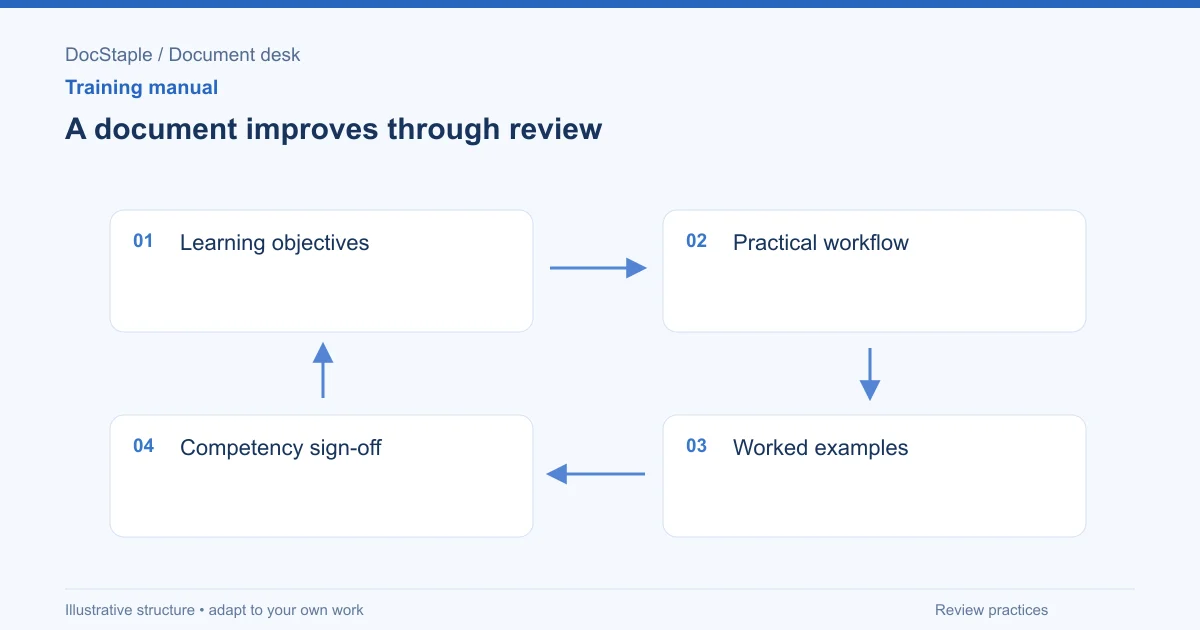
A good training manual is not a storage cabinet for everything someone might need to know. It is a practical guide that helps a learner perform a defined workflow, recognize common errors and demonstrate competence. The best manuals make the work visible.
This article uses two comparison scenarios. In a consulting firm, a new analyst is learning how to prepare an evidence-backed analysis pack for a strategy review engagement. In a construction firm, a junior site coordinator is learning how to assemble a site completion pack after inspection closeout. The subject matter is different, but the manual design problem is the same: turn messy real work into a teachable sequence without hiding the judgment calls.
OSHA's construction outreach materials distinguish general safety awareness from an employer's duty to provide training required by specific OSHA standards OSHA outreach library. That distinction is useful outside safety too. A manual can support training, but it is not proof by itself that someone can perform the task. Competence needs observation, practice and sign-off appropriate to the work.
Start with observable learning objectives
Learning objectives should describe what the learner can do after training. Avoid objectives that only say "understand" or "be familiar with" unless you also define how that understanding is demonstrated.
Weak objective:
Understand the analysis review process.
Stronger consulting objective:
By the end of training, the analyst can prepare an analysis review pack that links each finding to a source in the evidence index, flags limitations and passes engagement lead review.
Stronger construction objective:
By the end of training, the coordinator can assemble a site completion pack containing the approved inspection records, drawing references, punch-list closeout and handover evidence required by the project manager.
Good objectives set the boundaries for the manual. They tell you what to include, what to leave to another document and what the trainer must check before sign-off.
Teach the workflow, not the department chart
Many manuals begin with organizational background because it feels safe. Learners usually need the workflow first. Show the trigger, inputs, steps, decision points, records and completion condition.
For the consulting example:
| Workflow stage | Learner action | Decision point | Record |
|---|---|---|---|
| Receive discovery material | Check interview log and document list | Is the source known? | Evidence index |
| Draft analysis pack | Group findings by theme | Is each finding supported? | Analysis pack |
| Review limitations | Mark gaps and contrary evidence | Is more clarification needed? | Review notes |
| Submit for approval | Send to engagement lead | Approved, actioned or rejected? | Approval record |
For the construction example:
| Workflow stage | Learner action | Decision point | Record |
|---|---|---|---|
| Gather inspection records | Check current project register | Is a record missing? | Inspection log |
| Match drawing references | Confirm revision numbers | Is a drawing superseded? | Drawing register |
| Verify punch-list closeout | Confirm completion evidence | Is any item open? | Punch-list record |
| Compile handover pack | Save controlled copy | Is approval recorded? | Handover register |
This structure also exposes failure modes. If the learner cannot identify the input, the manual should tell them to stop, not improvise.
Use worked examples with normal and exception cases
Worked examples are where a manual becomes useful. They let the learner see what "good" looks like before practicing.
A consulting worked example might show one strong finding, one weak finding and one hypothesis:
Strong finding. Three regional managers described duplicate approval steps in the sales forecasting process. The document review found two active approval matrices with different thresholds. Limitation: finance leadership has not yet confirmed which matrix is current.
Weak finding. The forecasting process is inefficient.
Hypothesis for discussion. Duplicate approval thresholds may be contributing to delayed forecast submission.
The learner can see why the strong finding is usable: it ties interviews, documents and limitations together. The weak finding gives no evidence.
A construction worked example might compare completion evidence:
Accepted evidence. Inspection record IR-042, dated [date], signed by [role], linked to drawing A-401 Rev C and punch-list item P-17.
Not accepted. Photo of ceiling area with no date, location, drawing reference or approver.
Training manuals should include common errors beside the example. WHO's quality resources emphasize that SOP templates must be customized to local practice because a copied procedure does not describe how work actually happens WHO LQSI. The same is true for examples. Use sample data, not live confidential records, and make the example reflect the real workflow.
Build practice around decision gates
Practice tasks should ask learners to make the decisions they will face on the job. Reading a manual is not enough.
For consulting:
- classify five findings as supported, unsupported or hypothesis
- identify which client documents cannot be shared outside the project team
- mark three gaps that require engagement lead review
- prepare a one-page analysis pack from sample interview notes
For construction:
- identify missing inspection evidence in a sample pack
- match records to current drawing revisions
- decide whether a punch-list item can be closed
- write a handover exception note for a missing certificate
If the work has safety implications, separate training from authorization. OSHA defines a competent person in construction as someone capable of identifying hazards and authorized to take prompt corrective measures OSHA competent person. A manual can explain the process, but the organization must decide who is qualified and authorized for the specific task.
Record competency sign-off
Competency sign-off should record more than "attended training." Attendance proves presence. Competence requires evidence that the learner performed the task or a realistic simulation to the required standard.
Use a sign-off table:
| Competency item | Evidence observed | Result | Follow-up |
|---|---|---|---|
| Identifies correct inputs | Completed evidence index | Pass | None |
| Applies decision gate | Correctly flagged unsupported finding | Pass | None |
| Handles exception | Escalated confidential material issue | Needs coaching | Repeat scenario |
| Completes record | Submitted approval log | Pass | None |
Draft language:
The trainer signs off competence only when the learner has completed the practice task using approved sample information, explained the decision points and recorded required evidence. If supervised practice is required, the sign-off states the restriction and review date.
This protects both sides. The learner knows what remains to improve, and the organization has a record of what was actually checked.
Review the manual like an operating tool
Training manuals decay. Systems change, roles move, examples become stale and people invent workarounds. Review should be scheduled and event-driven.
Review criteria:
- Objectives: Are they observable and tied to the task?
- Workflow: Does the manual show triggers, inputs, steps, decisions and records?
- Examples: Are there normal and exception cases?
- Practice: Does the learner practice real decisions, not just recall definitions?
- Competency: Does sign-off record observed evidence and restrictions?
- Confidentiality: Are sample materials sanitized and separated from live records?
- Version control: Is the current manual easy to identify?
- Change triggers: Is review required after incidents, quality failures, system changes or new requirements?
If your manual is for consulting delivery, the consulting training manual template provides editable Word sections for audience and objectives, workflow and worked examples, practice and common errors, competency review, preparation checks and approval. Use it as a structure for your facts, not as a substitute for trainer judgment or local requirements.
Last updated: September 26, 2026
Frequently Asked Questions
Related Articles
How to Adapt a Quality Assurance Plan for Construction
How to adapt a quality assurance plan for construction projects, with quality criteria, inspection points, nonconformance handling, release approval and draft language.
How to Write a Consulting Quality Assurance Plan: Criteria, Reviews and Release Approval
How to write a consulting quality assurance plan for a strategy review engagement, including quality criteria, inspection points, nonconformance handling, release approval and draft wording.
How to Write a Construction Standard Operating Procedure
A construction-specific guide to adapting a standard operating procedure for site work, subcontractors, permits, escalation, evidence and approval checks.
How to Write a Consulting Standard Operating Procedure: Scope, Steps and Escalation
How to write a consulting standard operating procedure for a strategy review engagement, with purpose, owner, step-by-step workflow, exceptions, version review, draft wording and approval checks.
How to Write a Construction Training Manual: Site Workflow, Examples and Sign-Off
How to write a construction training manual for a commercial fit-out project, with learning objectives, practical workflow, worked examples, competency sign-off, draft wording and approval checks.
How to Write a Consulting Training Manual: Objectives, Workflow and Competency Sign-Off
How to write a consulting training manual for a strategy review engagement, including learning objectives, workflow, worked examples, competency sign-off, draft wording and approval checks.