Training Manual Checklist for Consulting Workflows
A training manual checklist for consulting teams, covering learning objectives, practical workflow, worked examples and competency sign-off.
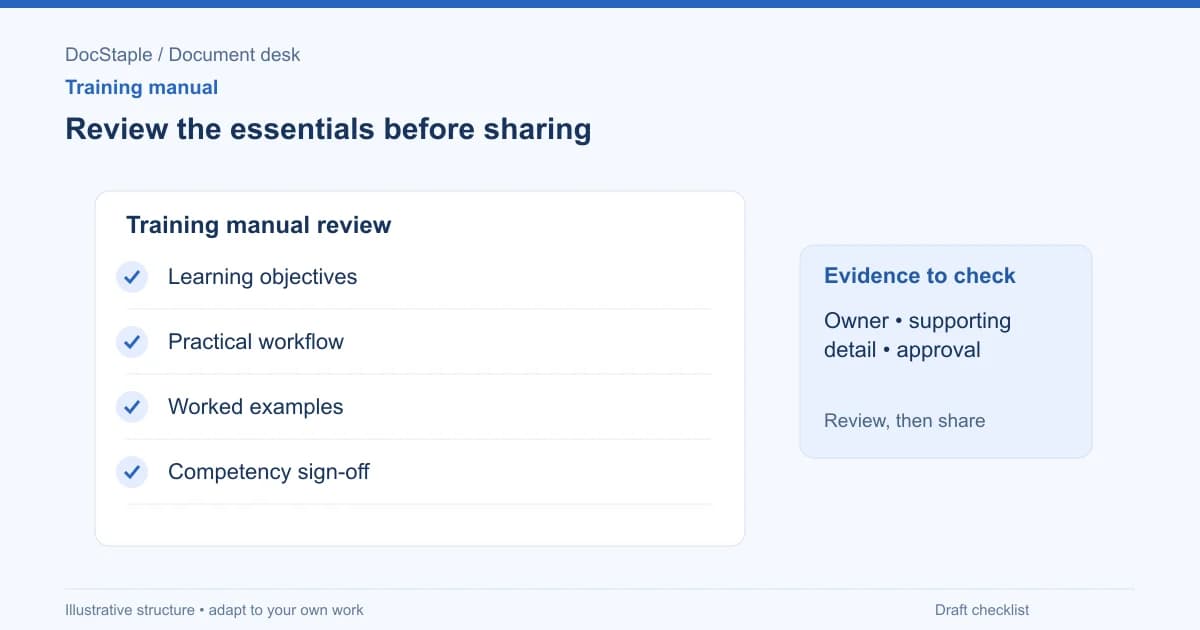
A training manual checklist keeps the document focused on what the learner must be able to do. Without a checklist, training manuals drift into background reading, screenshots and policy excerpts. Those materials may be useful, but they do not prove that a consultant can run the workflow correctly.
Use this scenario: a consulting firm is training new analysts to support a strategy review engagement. Analysts must prepare interview summaries, tag evidence, update an issue log and draft a section of the recommendations report. The work involves confidential client material, so the manual must teach judgment as well as steps.
Identify audience, prerequisites and objective
Start with the learner. A training manual for a new analyst is different from one for a senior engagement manager. The CDC describes learning objectives as brief statements of the knowledge, skills or attitudes learners will gain, and says they should align with training goals and competencies CDC. That is training-design guidance, not a consulting rule, but it is a useful standard for avoiding vague objectives.
Checklist:
- Who is the manual for?
- What must the learner know before starting?
- What systems, client context and policies are required?
- What task should the learner be able to perform after training?
- How will the trainer assess the outcome?
Weak objective:
Understand the strategy review process.
Usable objective:
By the end of training, the analyst can prepare an interview summary from approved notes, tag supporting evidence to the issue log and flag confidentiality concerns before the summary is shared.
Review criterion: every objective should include an observable action. If the trainer cannot assess it, rewrite it.
Map the practical workflow
A training manual should show the work in the order the learner performs it. Do not arrange the manual around department names if the learner experiences the task as a sequence.
For the analyst scenario, the workflow might be:
- Receive approved interview notes.
- Confirm the notes belong to the current engagement.
- Create a summary using the approved format.
- Tag each claim to evidence.
- Enter open issues in the issue log.
- Check for confidential or personal information that should not be circulated.
- Submit to the reviewer.
OSHA's education and training guidance says training should give workers knowledge and skills for their work and awareness of hazards, controls and reporting routes OSHA. In a consulting manual, "hazards" may include confidentiality breaches, unsupported recommendations and client commitments missed because evidence was not recorded.
Checklist:
- Are the steps in the actual order of work?
- Are decision points visible?
- Are stop conditions clear?
- Are systems and records named?
- Does the manual distinguish live client records from practice records?
Draft language:
Stop and ask the engagement lead before summarizing any note that includes employee health information, legal allegations, disciplinary details or information outside the approved scope.
Review criterion: a learner should know when to continue, when to escalate and when to stop.
Include worked examples and common errors
Worked examples turn instructions into judgment. A good example should show a normal case, a borderline case and an error. Do not use real confidential client material in training unless it has been approved for that use. Use realistic but fictional records.
Example:
Source note: "Several regional managers said the monthly forecast template is too slow, so they keep offline trackers."
Good summary: "Regional managers reported maintaining offline forecast trackers because the monthly forecast template is perceived as slow. Evidence: interviews 04, 07 and 09."
Poor summary: "The forecasting system is broken and managers refuse to use it."
The poor version overstates the evidence and assigns motive. That distinction matters in consulting, where unsupported conclusions can damage credibility.
Checklist:
- Does each example connect to an objective?
- Is the data fictional or approved for training?
- Does the manual show both correct and incorrect work?
- Are common errors explained, not just marked wrong?
- Does each example include the review standard?
The CDC's Quality Training Standards include learner assessments such as knowledge checks, exercises, observed practice, question-and-answer sessions or problem solving tied to learning objectives CDC Quality Training Standards. Use that idea directly: every example should lead to a practice task or question.
Review criterion: if the manual shows only perfect examples, add at least one realistic failure mode.
Design practice tasks with safe materials
Practice is where the manual becomes useful. Give learners a sample packet, a task and a standard. Avoid vague assignments such as "review these notes." Give an output.
Practice task:
Using the sample interview pack, prepare a 250-word summary of the procurement theme, tag each key statement to its source interview and list two questions for the engagement lead.
Add constraints:
- do not include names from the sample notes;
- do not create recommendations not supported by evidence;
- flag any item that appears outside the approved project scope;
- submit the summary through the training workspace, not the client workspace.
Checklist:
- Does the practice task use approved sample material?
- Does it require the learner to perform the real workflow?
- Is there a rubric?
- Are support contacts listed?
- Are errors handled as coaching opportunities unless the issue is serious?
Review criterion: the trainer should be able to compare two learners' outputs against the same standard.
Also decide what support looks like during practice. A useful manual tells learners when they may ask for help, what help is allowed before assessment, and which mistakes require the trainer to pause the exercise. For example, a typo in a summary may be coaching feedback, while copying live client names into a training file may require immediate correction and a confidentiality reminder. That distinction keeps the assessment fair without ignoring serious process risks.
Record competency sign-off
Competency sign-off is not a certificate for decoration. It is a record that the learner demonstrated the task to the agreed standard. For consulting, the sign-off should usually say what work the learner may perform independently and what still requires supervision.
Sign-off fields:
- learner name and role;
- workflow trained;
- objectives assessed;
- evidence reviewed;
- result: competent, supervised practice required or retraining required;
- reviewer name and date;
- restrictions or follow-up date.
Draft language:
The learner demonstrated the ability to prepare an interview summary, tag evidence to the issue log and escalate confidentiality concerns using the approved sample pack. The learner may prepare first-draft summaries for live engagements subject to reviewer approval before client circulation.
Review criterion: sign-off should be specific enough that a future manager knows what the person was approved to do.
Maintain the manual after the first session
Training manuals go stale when systems, templates or client requirements change. EPA notes that approved SOPs can serve as resources for training, reference and documentation of proper procedures EPA. The same principle applies to a training manual: keep it aligned with the procedure it teaches.
Maintenance checklist:
- assign a manual owner;
- record version and approval date;
- link the manual to the current procedure or template;
- review after project changes, incidents or repeated learner errors;
- remove outdated screenshots and contacts;
- preserve sign-off records according to the organization's retention rules.
For a structured drafting base, the consulting training manual template includes editable sections for audience and objectives, workflow and worked example, practice and common errors, competency review and approval. Use it as a framework, then fill it with your actual consulting workflow and review standards.
Final check: if the manual does not show what good work looks like and how competence is confirmed, it is a reference guide, not a training manual.
Last updated: September 26, 2026
Frequently Asked Questions
Related Articles
How to Adapt a Quality Assurance Plan for Construction
How to adapt a quality assurance plan for construction projects, with quality criteria, inspection points, nonconformance handling, release approval and draft language.
How to Write a Consulting Quality Assurance Plan: Criteria, Reviews and Release Approval
How to write a consulting quality assurance plan for a strategy review engagement, including quality criteria, inspection points, nonconformance handling, release approval and draft wording.
How to Write a Construction Standard Operating Procedure
A construction-specific guide to adapting a standard operating procedure for site work, subcontractors, permits, escalation, evidence and approval checks.
How to Write a Consulting Standard Operating Procedure: Scope, Steps and Escalation
How to write a consulting standard operating procedure for a strategy review engagement, with purpose, owner, step-by-step workflow, exceptions, version review, draft wording and approval checks.
How to Write a Construction Training Manual: Site Workflow, Examples and Sign-Off
How to write a construction training manual for a commercial fit-out project, with learning objectives, practical workflow, worked examples, competency sign-off, draft wording and approval checks.
How to Write a Consulting Training Manual: Objectives, Workflow and Competency Sign-Off
How to write a consulting training manual for a strategy review engagement, including learning objectives, workflow, worked examples, competency sign-off, draft wording and approval checks.