Training Manual Examples: Objectives, Workflows, Examples and Sign-Off
Training manual examples for consulting teams, with learning objectives, practical workflow, worked examples, competency sign-off and review criteria.
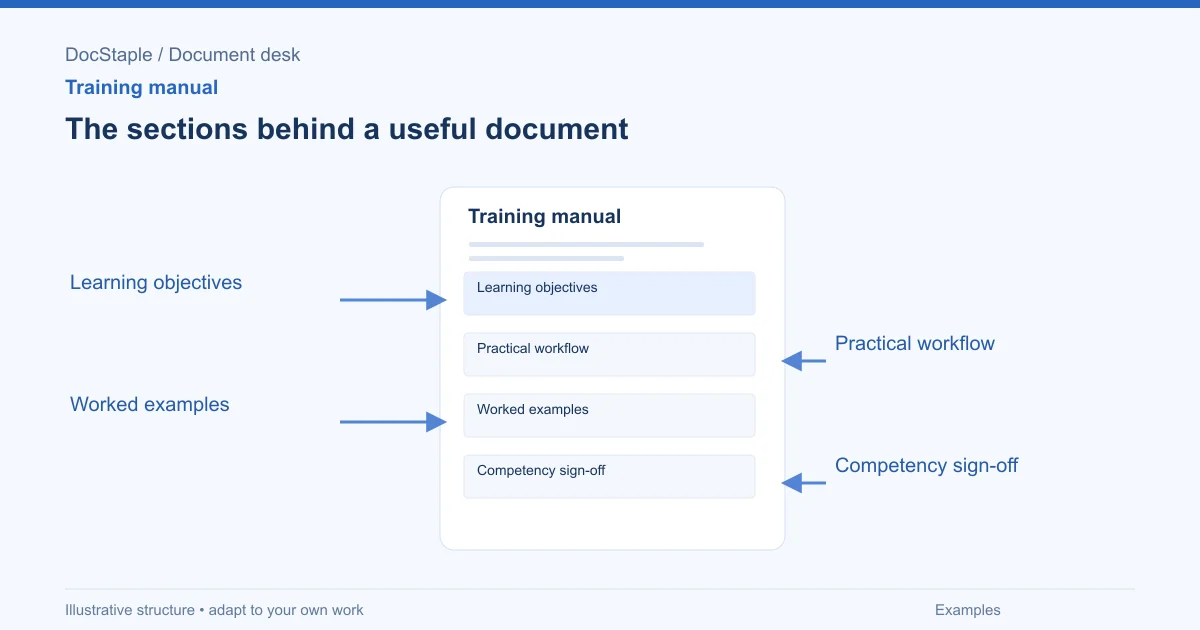
Training manual examples are useful only when they connect learning to the work people actually perform. A manual that explains company values for twenty pages but never shows how to complete the task will not help a new consultant prepare a client-ready report.
This guide uses a fictional consulting team training new analysts to support a strategy review engagement. The manual covers learning objectives, practical workflow, worked examples and competency sign-off. The examples are intentionally practical: they show what a learner needs to do, how the trainer checks it and where the common mistakes appear.
Example 1: Audience and Learning Objectives
The first page of the manual should tell readers whether it is for them. For the consulting scenario:
Audience: New analysts supporting strategy review engagements. Learners should already know how to use the project workspace, handle client confidential information and follow the firm's document naming rules.
Then write learning objectives. CDC training-development guidance says learning objectives are brief statements describing the knowledge, skills or attitudes learners will gain, and that they should be learner-centered, action-oriented, specific, achievable and measurable (CDC).
Weak objective:
Understand recommendations reports.
Stronger objective:
By the end of training, the analyst can prepare a findings table from approved discovery notes, link each finding to evidence and identify unsupported statements for reviewer decision.
That objective is useful because it names the task, output and quality standard. For a training manual, write three to six objectives, not twenty. Too many objectives usually means the manual is trying to replace onboarding, SOPs and supervision at once.
Example 2: Practical Workflow
The workflow section should show the task in order. For new analysts, the training manual should not assume they can infer the process from a finished report.
Example workflow:
- Open the approved project workspace.
- Confirm the current scope and evidence register.
- Review assigned interview notes.
- Extract potential findings into the findings table.
- Add evidence references for each finding.
- Mark uncertain items for reviewer decision.
- Save the table using the naming convention.
- Notify the engagement lead that the table is ready for review.
Add decision points where learners commonly go wrong:
If an interview note contains a strong opinion but no supporting operational detail, record it as an interview theme, not as a verified finding.
CDC's quality training standards say training content should be accurate and relevant, should meet learner and program needs, and should include real-world examples that support the content (CDC Quality Training Standards). A consulting training manual should therefore include examples that resemble the team's real work, while keeping live client records out of the training file.
Example 3: Worked Finding
Worked examples show what "good" looks like. Use a normal example first, then a borderline example.
Normal example:
Source note: Branch managers in three interviews reported that urgent purchasing requests are currently sent by email to the head office purchasing inbox.
Finding entry: Urgent purchasing requests are handled through an email inbox rather than a standardized request queue.
Evidence reference: Interview notes I-03, I-06, I-09.
Reviewer question: Confirm whether document review supports the same workflow.
Borderline example:
Source note: One manager said, "The current process is chaos."
Weak finding: The purchasing process is chaotic.
Improved entry: One interviewee described the current process as difficult to manage. Additional evidence is required before making a process-wide finding.
The manual should explain why the second version is better. It separates a quote from a finding, avoids exaggeration and tells the learner what to do next.
Example 4: Practice Task and Common Errors
Practice tasks turn the manual from reading material into training. Provide a small sample pack that is not live client information.
Practice task:
Using Sample Notes A, B and C, prepare a findings table with no more than five findings. Each finding must include an evidence reference and a reviewer question if the evidence is incomplete.
Common errors:
- Treating one person's opinion as a confirmed fact.
- Copying confidential details that the report does not need.
- Writing recommendations before findings are reviewed.
- Losing the evidence reference when editing language.
- Saving the practice file in a live client folder.
CDC guidance on evaluating training says assessment should be designed to evaluate how successfully learners met the learning objectives and, where possible, whether they can apply learning back at work (CDC). In this scenario, a quiz alone is not enough. The learner should demonstrate the actual task on a sample.
Competency Sign-Off Example
Competency sign-off should not be a vague "trained: yes" checkbox. It should record what the learner demonstrated, what evidence the trainer reviewed and whether any supervision is still needed.
Draft sign-off language:
Competency item: Prepare a findings table for a strategy review engagement.
Evidence observed: Learner completed Sample Task 2 with five findings, evidence references and two reviewer questions.
Result: Meets standard for supervised project work. First live findings table must be reviewed by the engagement lead before client-facing use.
Trainer: [name]. Learner: [name]. Date: [date]. Next review: after first live assignment.
That last condition is important. Training sign-off does not have to pretend the learner is ready for every scenario. It can approve a controlled next step.
Add a second sign-off line for support. New analysts often pass the sample task but still need help deciding when a finding is sensitive, out of scope or too weak to use. The manual can make that support normal:
Support condition: For the first two live assignments, the analyst sends the findings table to the engagement lead before adding recommendations. The engagement lead records coaching points in the training log.
That is more operational than a general reminder to "ask questions". It gives the learner permission to pause and gives the trainer evidence that early work was supervised. It also protects the client engagement because the report does not depend on an unsupported judgment by someone still learning the workflow.
Review Criteria for a Training Manual
Before issuing a manual, review it against these criteria:
- Audience: Does it say who the manual is for and what they should already know?
- Objectives: Are objectives observable and aligned with the actual work?
- Workflow: Can a learner follow the order without guessing?
- Examples: Do worked examples show both normal and borderline cases?
- Practice: Does the learner perform a realistic task with sample information?
- Assessment: Does sign-off record evidence, not just attendance?
- Support: Does the manual say who to ask when the learner is unsure?
- Maintenance: Is there an owner, version number and review trigger?
CDC says training evaluation can help improve current and future trainings and recommends planning evaluation early, including purpose, questions and data collection methods (CDC). For a consulting manual, useful evaluation questions include: where did learners hesitate, which errors repeated and did the first live assignment require rework?
Build Your Own Manual
The consulting training manual template is an editable Word document with sections for audience and objectives, workflow and worked example, practice and common errors, competency review and support. Use it to create a manual that trains the task, not just the topic.
A good training manual gives the learner a path, a standard and a place to go when judgment is needed. That is what turns documentation into usable training.
Last updated: September 26, 2026
Frequently Asked Questions
Related Articles
How to Adapt a Quality Assurance Plan for Construction
How to adapt a quality assurance plan for construction projects, with quality criteria, inspection points, nonconformance handling, release approval and draft language.
How to Write a Consulting Quality Assurance Plan: Criteria, Reviews and Release Approval
How to write a consulting quality assurance plan for a strategy review engagement, including quality criteria, inspection points, nonconformance handling, release approval and draft wording.
How to Write a Construction Standard Operating Procedure
A construction-specific guide to adapting a standard operating procedure for site work, subcontractors, permits, escalation, evidence and approval checks.
How to Write a Consulting Standard Operating Procedure: Scope, Steps and Escalation
How to write a consulting standard operating procedure for a strategy review engagement, with purpose, owner, step-by-step workflow, exceptions, version review, draft wording and approval checks.
How to Write a Construction Training Manual: Site Workflow, Examples and Sign-Off
How to write a construction training manual for a commercial fit-out project, with learning objectives, practical workflow, worked examples, competency sign-off, draft wording and approval checks.
How to Write a Consulting Training Manual: Objectives, Workflow and Competency Sign-Off
How to write a consulting training manual for a strategy review engagement, including learning objectives, workflow, worked examples, competency sign-off, draft wording and approval checks.